Is Starbucks breaking up with Seattle?
Published in Business News
On Washington Gov. Bob Ferguson’s public calendar this week, one item might have stood out to Seattleites: a Wednesday meeting with Starbucks CEO Brian Niccol.
Ferguson’s office declined to share the agenda, but it almost certainly included Starbucks’ big new office in Nashville, Tennessee, where taxes are lower and where the Seattle-based coffee giant plans to move its supply chain teams.
Starbucks insists it isn’t leaving Seattle, the city of its birth 55 years ago. “Seattle remains our North America and Global Support HQ,” the company said last month.
That may not reassure some in and around Seattle, not least the 3,000 or so people who work at Starbucks’ headquarters in the city’s Sodo neighborhood.
Starbucks has leased enough space in Nashville for 1,000 to 2,000 employees, and says it will consider moving additional “teams and roles” there.
And Nashville isn’t the only city to catch Starbucks’ eye recently.
In December, Starbucks briefly considered leasing most of a 21-story Bellevue, Washington, office tower large enough, in theory, for much of the Sodo staff, according to a former Starbucks executive and nearly a dozen Seattle-area real estate and civic leaders with direct or indirect knowledge of lease discussions.
Starbucks declined to comment about the Bellevue lease or its future in Nashville, and reupped its earlier assurances about its commitment to Seattle and its Sodo headquarters, where it has been since the 1990s, and which is still leased through 2038.
But the company’s apparent restlessness is triggering flashbacks of other major Seattle exits, like Boeing’s move of its headquarters from Seattle to Chicago in 2001, or the departure of Seattle SuperSonics to Oklahoma City in 2008.
It’s also fueling the already heated narrative over the business climate in Washington and Seattle, where taxes are up and corporate citizens complain they’ve become political punching bags.
It’s no coincidence, wags say, that Bellevue lease rumors surfaced soon after Seattle Mayor-elect Katie Wilson urged Seattleites to boycott Starbucks at a Nov. 13 union rally.
Or that the Nashville office will likely allow Starbucks to save millions of dollars under Washington’s recently enacted state tax on IT services.
But even before Nashville or Bellevue, Starbucks’ relationship with Seattle was likely under scrutiny by Niccol, a turnaround specialist hired in 2024 to get the struggling company back on track.
At his last job, as CEO of Chipotle, Niccol moved that company’s headquarters from Denver to Newport Beach, California, where he lived and where Starbucks initially let him work remotely, with fly-ins to Seattle on a company jet.
Niccol said soon after taking the Starbucks job that he wasn’t planning a similar move for the company’s Seattle headquarters.
But Niccol has since expressed frustration with Starbucks’ headquarters staff. Some longtime employees think he and his top executives, many of them Starbucks outsiders, regard the Seattle headquarters as a liability.
“Brian and his team have been wholly unimpressed by Starbucks corporate culture,” said one senior executive at Sodo, who spoke on condition of anonymity to protect their employment. “If he could’ve blown it up and started over when he got here, he would have.”
‘We’re going to be unrelenting’
Some of that distrust was inevitable, given the problems Niccol was hired to solve after his predecessor, Laxman Narasimhan, was pushed out in August 2024, after just 17 months.
The coffee giant had seen declines in sales, profits and share price. Overly complicated beverages, staffing cuts and other missteps were frustrating customers at many of the company’s roughly 18,000 stores in North America.
Niccol’s turnaround strategy, dubbed “Back to Starbucks,” includes store upgrades and additional staff, a streamlined menu and a revival of Starbucks traditional coffeehouse vibe. Niccol also wants to expand in the South and the Northeast, where Starbucks isn’t so prevalent.
But Niccol’s turnaround also rests on steep cost savings, including $2 billion in cuts over the next two years, as Niccol told investors in January. “We’re going to be unrelenting” on cuts, he said.
That has meant hundreds of store closures and several rounds of layoffs, with more cuts rumored as early as May.
It has also raised concerns among some at the Sodo headquarters.
To drive those cuts, Starbucks is offering hefty bonuses, including $6 million in restricted stock grants to Niccol and each of his executive vice presidents, if the company slashes $800 million in operating expenses by the end of fiscal year 2027, Oct. 3, 2027, according to company filings. If the company meets that cost reduction goal, senior executives may be eligible for another $6 million in bonuses linked to other turnaround goals, such as store renovations and a new loyalty program — but no bonuses will be paid unless all the cuts are made.
Bonuses for cost-cutting aren’t novel. But companies under pressure to boost profits, as Starbucks is, often target corporate operations as a way to reduce expenses without hurting sales.
And Wall Street has long believed Starbucks could do more to reduce administrative expenses and other costs that typically arise in corporate operations, said Danilo Gargiulo, an industry analyst at Bernstein Research.
So when the bonus program was rolled out last July, the mood soured in Sodo. Internally, people likened it to “The Hunger Games,” said one midlevel manager at headquarters.
‘Working on the wrong things’
Sodo staff members aren’t the only ones expecting a corporate shake-up as Niccol revamps a company heavily shaped by personalities like three-time CEO Howard Schultz.
Schultz, who took the reins in 1987, built Starbucks into a global powerhouse. He also enabled the rise of an “empire of middle management” that has been slow to respond to changing business realities and isn’t keen to be turned around, says Gargiulo.
Niccol appears to agree. In a March interview with the online news outlet Semafor, he complained that his turnaround plans “almost resonated faster with store-level employees than it did in our corporate office.”
“A lot of work that (corporate staff) were doing was in conflict with creating a great coffee house experience,” Niccol continued, adding, somewhat ominously, that “if you aren’t working on initiatives that ultimately make the store experience better … (you’re) probably working on the wrong things.”
Niccol, arguably, has dealt with that sort of reluctance before.
When he moved Chipotle’s headquarters to Newport Beach soon after becoming CEO, the stated reason was to gain more access to industry talent.
But because many of Chipotle’s Denver-based corporate staff didn’t make the move, Niccol also made a clean break from a company culture heavily shaped by Chipotle’s Denver-based leadership, according to industry experts.
Experts like Gargiulo think Starbucks and its shareholders might be well-served if Niccol considers similar shock therapy in Seattle.
Moving some or all of corporate operations would let Starbucks leadership “restructure their worker base by changing the location,” Gargiulo said.
Other observers think relocation might also help Starbucks’ efforts to expand beyond its traditional upscale “coastal” demographic and win middle-American, value-minded consumers.
Starbucks is “not really a high-end cappuccino type of business anymore,” says Bloomberg business columnist Conor Sen.
As Sen put it in an X post after the Nashville news broke, “Starbucks should move the whole company to Nashville tbh. It’s a better cultural fit for what the brand is in 2026.”
Siren song
For many longtime Seattleites, Starbucks hasn’t been a “Seattle” brand for decades.
Yes, the company still goes by a name and “siren” logo inspired by Seattle’s maritime traditions. It still leans on the origin story of the little coffee bean shop near Pike Place Market — as in the recent rollout of its “1971 Roast.”
But much of Starbucks’ operations, customers and employees are now scattered across the globe. Many of its formative executives have left, most notably Schultz, who stepped down for the final time in 2023 and noisily announced his departure from Seattle to Miami last month.
And even before Niccol arrived, some company leaders were disenchanted by changes in Seattle, not least the city’s underwhelming response to security complaints at local Starbucks and other retailers.
Still, the company’s wandering eye has many locals mystified.
When word of a Bellevue lease surfaced in commercial real estate circles several months ago, some saw it as executive overreaction to new business taxes and the antibusiness rhetoric of some politicians, including Seattle Mayor Wilson.
Others saw Bellevue as a calculated ploy by Starbucks to squeeze more government concessions for the Nashville office, where the company is getting a year’s rent free and is expected to qualify for hefty state and city tax breaks.
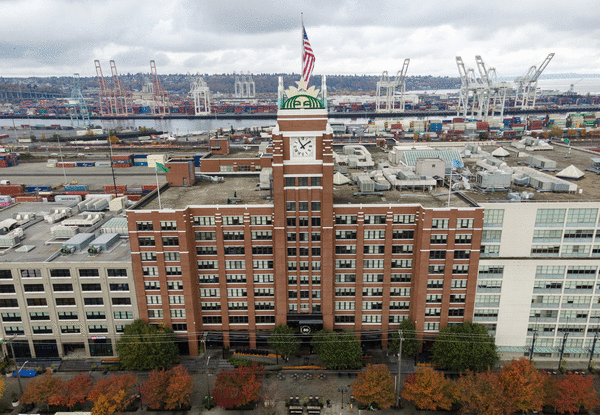
And whether it was Nashville or Bellevue, there’s still the question of the Starbucks Support Center, the 1.3-million-square-foot space it now occupies in what was once a Sears warehouse on Utah Avenue South.
Starbucks’ lease, which was renewed in 2018, runs through 2038, with no options for “termination,” according to a July credit rating report by Morningstar.
In addition to total lease costs of around $50 million annually, Starbucks would be walking away from an iconic property where it has invested $350 million over the decades in upgrades, according to Morningstar.
But Starbucks has walked away from expensive real estate before. Recent closures of underperforming stores are expected to cost Starbucks around $500 million in severance and lease-related expenses, according to company filings.
And conceivably, Starbucks might make up some of its Sodo lease expense with the tax savings gained under its new Nashville office. By moving some functions to Tennessee, Starbucks looks to avoid a recently enacted 6.5% state tax on IT services, though that tax is scheduled to expire in 2029.
Taxes and rhetoric aside, after recent layoffs and other restructurings, several employees said, Starbucks no longer needs so much space.
Even after Niccols instituted an aggressive four-day-a-week return-to-work policy last year, parts of the building are underused, some Sodo employees say.
That has left many Starbucks employees in Seattle in a state of limbo. They’re aware that Starbucks’ Nashville plans have gotten the attention of politicians like Ferguson and Wilson.
But they also know Starbucks is talking about moving more teams to Nashville. And that with growing pressure from Wall Street to deliver Niccol’s turnaround, it may just be a matter of time before bigger moves are announced.
That state of uncertainty extends to outsiders, among them Kevin Daniels, who redeveloped the Sodo property in the early 1990s and still co-owns it.
Late last year, Daniels began hearing rumors Starbucks was looking at office space in Nashville, Dallas and Bellevue, but was “stunned” to hear reports last month about the size of the Nashville lease.
He said he has been trying to get Starbucks’ leadership to clarify their plans for Sodo.
But like many in the building — and elsewhere in the city where Starbucks started — he’s still waiting on an answer.
“I’m still contemplating where we go from here and what their plans are,” Daniels said. “Until they share them, there’s really not much to be done.”
(Seattle Times reporter Alex Halverson contributed.)
©2026 The Seattle Times. Visit seattletimes.com. Distributed by Tribune Content Agency, LLC.








Comments