Fooda launches marketing campaign to make return-to-office mandates more appetizing
Published in Business News
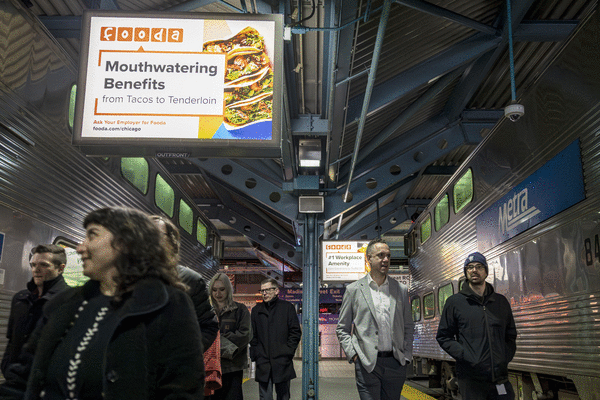
Chicago-based Fooda, which introduced its pop-up lunch service at downtown office buildings 15 years ago, launched its first outdoor marketing campaign this week in an effort to boost its brand in the post-pandemic hybrid work landscape.
The campaign is centered at Ogilvie Transportation Center, with a presence at CTA stations and Divvy bike stations across the city, pitching Fooda’s rotating roster of restaurants as an amenity to lure remote employees back to the office.
The billboards, which are intended to reach up to 90% of all Loop workers during the campaign’s two-month run, will feature the Fooda logo with messages such as “The HR benefit you can taste” and “Shared meals. Stronger team.” Chicago is the pilot market for the campaign.
That the restaurant lunch service not only survived but is thriving in the wake of the pandemic — an existential threat to its business model — is reason enough to remind returning Chicago office workers that Fooda is still there.
“We really reinvented ourselves during the pandemic,” said Orazio Buzza, 53, founder and CEO of Fooda.
Founded in 2011, Fooda features a variety of restaurants that workplaces can employ to provide lunches through pop-up kitchens, delivery, catering, pantry and cafe programs. It has grown to more than 2,500 corporate clients and 4,000 restaurant partners across 38 states, including 235 locations and over 300 restaurants in Chicago. But these days, lunches are more likely bound for a distribution center or hospital than a downtown office building.
The idea for Fooda started when Buzza was president of Echo Global Logistics, one of several tech unicorns started by Eric Lefkofsky, the Chicago-based serial entrepreneur.
Buzza, a Schiller Park native and graduate of the University of Illinois Urbana-Champaign, was at Echo from its inception in 2005 through 2010, leading it through an IPO and helping it to grow into a multibillion-dollar logistics giant. One of his employees came up with the idea of having local restaurants at the office.
Echo was housed at 600 W. Chicago Ave., the former Groupon headquarters, which became the center of Chicago’s tech universe but was located far from its thriving food scene. In 2007, Echo began bringing in a restaurant once a week to serve lunch to its growing employee base.
It soon evolved into a daily program, becoming so popular that interlopers from other companies began showing up at lunchtime, forcing Echo to come up with a way to keep them out.
“Our solution at the time was to hang a sign that said, ‘if you don’t work at Echo, you can’t be here,’” Buzza said. “That was our high-tech solution.”
When Buzza left Echo to start his own entrepreneurial venture, he decided the restaurant lunch service could be scaled up for companies and multi-tenant offices across the city. He started Fooda in 2011, and the idea caught on.
In 2013, Fooda expanded to New York, which grew into its largest market. By early 2020, Fooda was in about 25 markets, sitting on a pile of cash from a recent fundraising round and had just turned its first monthly profit. Then the pandemic hit in March 2020, stay-at-home orders were issued and the business ground to a halt.
As offices emptied and downtowns became ghost towns, Fooda saw its sales fall from $183 million in 2019 to an annual run rate of $13 million by spring 2020.
Buzza acted quickly, dropping 10 markets and laying off more than three-fourths of Fooda’s 450 employees. Sales bottomed in the second quarter of 2020, and Buzza decided to pivot the business model, shifting to essential services such as hospitals, distribution centers and industrial plants, where workers couldn’t phone it in and still needed to eat lunch.
“We had to really rethink who we were as a business, because we didn’t know how long this would take,” Buzza said.
The retooled company began growing again and returned to profitability in 2023, Buzza said. Fooda has since built back its annual revenue to a projected $300 million in 2026, far above its pre-pandemic high. It is looking to top $400 million next year.
With Chicago office buildings still at 57% of pre-pandemic occupancy levels in March, according to the latest report by Kastle Systems, Fooda is growing despite a smaller pool of potential downtown foragers hitting their respective lobbies during lunchtime.
Beyond the broader client base, much of the recent growth has come through geographic expansion, with Fooda adding service in 95 cities last year. Fooda has more than doubled its footprint since emerging from the pandemic, bringing its service to hundreds of cities, including smaller markets like Rockford and Joliet.
While the office market is slowly recovering, multi-tenant clients remain a smaller part of the overall business, Buzza said. One of Fooda’s largest Chicago clients, for example, is Rush University Medical Center.
Across the country, Fooda has become a mainstay in Amazon distribution centers, manufacturing facilities and government offices. The Pentagon is among its clients, Buzza said.
“We’re way more diversified as a business today than we were before,” Buzza said.
But with companies reeling remote workers back to their cubicles — even on a hybrid basis — it represents a growing opportunity for Fooda to reestablish itself in downtown offices. That is a focal point for Fooda’s pilot brand campaign in Chicago.
What started as a productivity tool — keeping tech workers on-site for lunch — and later morphed into a recruitment tool for employers, is now pitching itself as an amenity on par with lounges, gyms and roof decks in service of the back-to-office movement.
“For clients, it is top of mind to make sure their teams not only are happy, but give them a reason to come into the office,” Buzza said. “And that sort of dovetails into our campaign in Chicago.”
Fooda is blitzing transportation stations across the city with outdoor messages touting the benefits of bringing lunch from Chicago restaurants such as Beatrix Market, Lexington Betty Smokehouse and Happy Lobster to the office. It will be ubiquitous for anybody that drives, bikes, takes a train or rides a bus to work over the next two months, the company said.
The campaign is aimed at both employers and employees, hoping to build demand as companies begin to use amenities as a lure for bringing workers back to the office. The outdoor ads will steer viewers to a landing page on the Fooda website to learn how to get the service at their workplace.
To incentivize social media participation, Fooda is giving away weekly lunch packages during April to Chicagoans who post “creative” photos of the outdoor campaign with an @Fooda tag on LinkedIn.
If the inaugural campaign proves successful in Chicago, Fooda plans to roll it out to other markets down the road.
While the billboards tout Fooda as the “#1 Workplace Amenity,” the underlying message of adapting to the post-pandemic environment is embodied by the company itself. Surviving its “near-death” experience, Fooda has built up its workforce to 650 employees, including 105 in Chicago, Buzza said. It even rehired 82 employees laid off during the pandemic.
To accommodate its resurgent growth, Fooda is moving in May from its current headquarters at 1 N. Dearborn St. to new digs at 125 S. Clark St., doubling its office space to 16,000 square feet.
“When you get a chance to build something over, the second time you’re going to do it better,” Buzza said. “I think across the board, it’s just a much better company.”
©2026 Chicago Tribune. Visit at chicagotribune.com. Distributed by Tribune Content Agency, LLC.







Comments