California is a sanctuary state. Its public pensions invest in companies working with ICE
Published in Business News
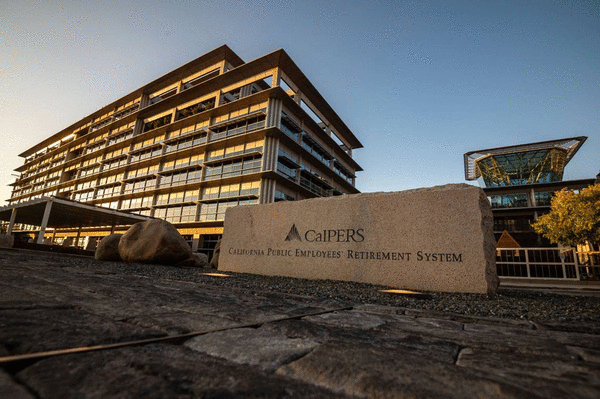
California’s two biggest pension funds have invested more than $2.7 billion with companies contracting with Immigration and Customs Enforcement or the Department of Homeland Security, a new analysis shows.
CalPERS, the statewide megafund for public employees, has put some $1.6 billion into tech firm Palantir, weapons manufacturers General Dynamics and L3Harris, and telecommunications companies AT&T and CACI, according to an analysis conducted by nonprofit advocacy and research group Stand.earth that was released Thursday.
CalSTRS, which funds public school teacher pensions, has invested $1.1 billion into these companies.
The pension funds’ largest contributions were to Palantir, with CalPERS investing $734 million and CalSTRS investing $625 million.
Data involved in the analysis was drawn from quarterly filings with the U.S. Securities and Exchange Commission as of December 2025.
Richard Brooks, who leads research at Stand.earth focused on the financial sector, pointed to the seeming contradiction of teachers in California, a sanctuary state, witnessing first-hand the government’s aggressive immigration enforcement break up students’ families while their retirement funds grow.
“There should be an alignment between where money is being invested and the types of values that people of the state embrace,” he said. “People’s hard-earned savings are going to enable ICE to rip families apart. It’s very egregious to me that California’s biggest two pensions have chosen to turn a blind eye to this.”
Palantir has for years provided data-analytics software to federal immigration enforcement, and earlier this year signed a new$1 billion purchasing agreement with the Department of Homeland Security.
CalPERS spokesperson James Scullary said the pension fund does not comment on individual holdings, but that it considers “environmental, social and governance matters.”
“When issues are identified, we work to analyze the situation, gather relevant facts and seek a resolution,” Scullary said.
CalPERS, with more than $550 billion in assets, is the largest pension fund in the U.S., with investments earning 11.6% in returns in the last fiscal year.
Both CalPERS and CalSTRS said that investment portfolios seek to minimize risk and maximize returns.
CalSTRS spokesperson Barbara Zumwalt said ithe fund takes “a long-term view of investing to manage opportunities and risks across a global portfolio.”
“Everything we do at CalSTRS is grounded in our mission to secure the financial future of California’s current and retired public school teachers,” Zumwalt said.
According to the CalSTRS website, approximately 10% of a California educator’s gross annual compensation is invested into CalSTRS’ pension fund.
For two years a group of teachers in Los Angeles, San Diego, Berkeley and elsewhere in California called CalSTRS Divest has been pushing the pension fund to relinquish its holdings in Palantir as well as other companies involved in Israel’s U.S.-backed war in Gaza, such as aerospace and defense company Lockheed Martin, heavy machinery company Caterpillar Inc. and weapons manufacturer Elbit Systems.
Andrea Pritchett, 62, a middle school teacher in Berkeley involved in the group said Palantir is a focal point “because the harms it inflicts on people abroad are also related to the harms [the company has] been inflicting on people within this country.”
Members of CalSTRS Divest say that such investments conflict with the fund’s own stated policies, which consider whether a company or industry makes a product that is highly detrimental to human health. But, Pritchett said there has been little movement from CalSTRS thus far.
“Their response has been that their fiduciary responsibility outweighs any other consideration,” Pritchett said.
The two California pension funds have also declined to divest from fossil fuel companies. Both CalPERS and CalSTRS unveiled sustainable investments strategies to increase holdings in low-carbon assets and other climate solutions several years ago, but continue to invest in multinational oil giants such as ExxonMobil and Chevron.
In 2024, California’s Legislature considered a bill seeking to force CalPERS and CalSTRS to divest from fossil fuel companies by 2031. But it faced some pushback and the bill’s author, Lena Gonzalez, D-Long Beach, ended up pulling the proposal with plans to reintroduce it at a later time.
Gonzalez said in a statement Thursday that the pension funds’ investments in ICE contractors were “extremely concerning” and that workers “should not have to rely on outside investigations to understand where their retirement funds are going.”
“We must demand transparency and accountability, especially when billions are being funneled into contracts that threaten the safety and dignity of Californians,” Gonzalez said.
Combined, 30 U.S. public pensions have more than $8.8 billion invested in ICE contractors that also include private prison companies Core Civic and Geo Group, according to Stand.earth’s analysis. The New York State Common Retirement Fund, the New York State Teachers’ Retirement System and the Florida State Board of Administration are among those that made contributions.
Researchers with Stand.earth also analyzed bank disclosures and found that the top eight U.S. banks — including JPMorgan Chase, Bank of America, Wells Fargo, and Citi — have provided financing of more than $72 billion to ICE contractors since 2020.
Wells Fargo said that the analysis’s characterization of banks financing of such companies as strictly loans was incorrect, since numbers in the analysis also include commitments by credit facilities. Through credit facilities, banks offer annual preapproved lines of credit that might only be used sporadically or in part.
Other banks did not respond to requests for comment.
©2026 Los Angeles Times. Visit at latimes.com. Distributed by Tribune Content Agency, LLC.









Comments