General Mills offloads Brazil business as sales dip
Published in Business News
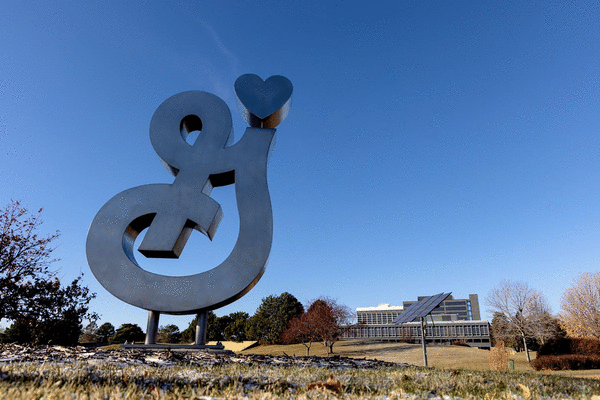
General Mills is continuing to sell off chunks of its business to focus on growing brands while low consumer sentiment jostles its sales.
The company announced Tuesday, March 17, the day before reporting third-quarter financials, it is offloading its Brazilian segment for what’s equivalent to about $154 million when converting from Brazilian reals to U.S. dollars.
Meanwhile, Progresso soup is possibly still on the market after reportedly going up for sale in 2021, though General Mills declined to confirm on mergers and acquisitions speculation. And the company is “maintaining a sharp focus on efficiency” to fund its investments, CEO Jeff Harmening said Wednesday, March 18.
Divestitures are transforming the reflection of Minnesota’s largest consumer food company at grocery stores around the world. There’s more General Mills protein and dog food but less of some of the products the company has become known for, such as yogurt in the U.S. and cereal in Europe.
“While it’s not on the scale of” multibillion-dollar pet food or yogurt transactions, the Brazil deal is “the same disciplined approach” General Mills has often taken to reshape its portfolio, Harmening said.
This approach reflects “namely, our desire to prioritize our resources, investments on brands and platforms where we have the strongest opportunity to generate profitable growth,” Harmening said in a March 18 call with financial analysts.
These divestitures are allowing the Golden Valley-based company to rethink its investments at a time when revenue is sluggish, but it still needs to focus on its turnaround strategy to increase sales through marketing and price reductions. These measures temporarily bring down profit.
With the Brazil divestiture, General Mills has turned over nearly a third of its portfolio since 2018, Harmening said.
The Brazil sale will enhance the company’s margins and increase the international segment’s focus on “key global platforms” such as premium ice cream, Mexican food, snack bars and pet food, Harmening said.
General Mills isn’t alone in using divestitures as executives at many food companies struggle to respond to waning consumer sentiment. Chicago’s Conagra Brands sold Chef Boyardee in June to pay down debt and focus on growing brands. Nestlé’s CEO said on a recent call with investors the company is selling the remainder of its ice cream business as it is “a distraction.”
“There are times when we decide that focusing means exiting businesses,” Nestlé chief executive Philipp Navratil said in February.
General Mills’ stock closed down nearly 3% Wednesday as profit missed financial analysts’ expectations for the third quarter that ended that ended Feb. 22. Harmening said the expected cost of divestitures, reinvestment and unfavorable trade conditions as well as new weather-related supply chain disruptions and struggles with retailer inventories hindered profit.
For the third quarter, General Mills reported $4.4 billion in sales, down 8% compared to the same quarter last year. Adjusted profit per share was 64 cents, about 9 cents short of expectations.
BNP Paribas Equity Research senior analyst Max Gumport commented in a note to investors that he views the “quarter as coming in toward the lower end of [the] anticipated outcome, due primarily to a larger-than-anticipated gap between consumption and shipments in the North America Pet segment, poor North America Foodservice profitability and a higher-than-anticipated tax rate.”
North American retail sales were down 4% on an organic basis — a financial figure which strips out costs like product discontinuations.
One reason for that: The company changed a Totino’s package from a bag to a box.
“And in today’s economic times, when the consumers are stressed, they just didn’t see any value in that box, and we saw sales declined significantly. And so we’re in process of converting that back now,” said Dana McNabb, the group president of General Mills’ North America retail and pet segments.
McNabb said the company is in the process of returning to the bag, and retailers have been “really supportive” of the backtrack.
“We think we’ve got the price right, and we’ve really got to up the product quality and how we’re talking about the product to consumers, which you’ll see go into marketplace this year,” McNabb said.
Food service sales were down down 3% on an organic basis as the divestiture of the yogurt business continued to weigh on this segment, in which General Mills sell products to institutions such as schools. Declining flour sales also caused some of this decline.
“I am really proud of our competitiveness in K-12 schools, the fact that we that we’ve changed to natural colors ahead of when we said we were going to do, and we’re competing quite effectively outside of flour,” Harmening said.
The company kept its profit and sales outlook steady after dropping it last year amid a broader trend of Americans cutting back in the grocery aisle. Harmening previously cited “historically low consumer sentiment, heightened uncertainty and significant volatility” as the cause.
A bright spot amid this uncertainty is General Mills’ new protein line of Cheerios, which Harmening said is helping keep the company’s North American retail segment on track to deliver a roughly 25% increase in net sales for new products this year.
“We have really leaned into mainstream premium benefits such as protein and fiber, better tasting ... snacks items, and that is resonating really well,” McNabb said.
©2026 The Minnesota Star Tribune. Visit at startribune.com. Distributed by Tribune Content Agency, LLC.









Comments