Boeing is reworking some 737 Max planes to fix scratches on wires
Published in Business News
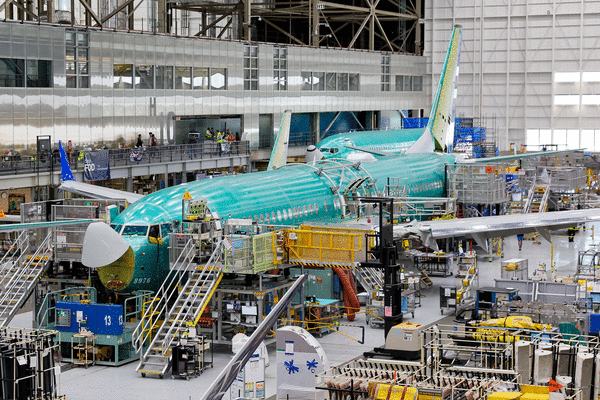
Boeing is reworking some 737 Max planes to fix small scratches on wires, the company said Tuesday.
The scratches were caused by a machining error and do not present an immediate safety issue, according to Boeing's engineering analysis.
Boeing is repairing planes that have already moved through its production line but have not yet been delivered to customers. 737 Max planes now in service can continue to operate safely, Boeing said.
If Boeing determines the Max planes that are already flying need the same rework, the company will issue a bulletin to operators. Boeing said it has notified the Federal Aviation Administration and its customers of the issue.
It's not clear how many planes are affected by the scratches, or when Boeing first identified the problem.
Boeing expects the rework will take a matter of days, rather than weeks.
It will likely slow the company’s deliveries in the first quarter, but Boeing said Tuesday it does not expect the rework will impact its yearly delivery totals.
The issue is not expected to affect new Max planes being built, Boeing said. It is still producing the Renton, Washington-built Max at an average rate of 42 per month.
Also on Tuesday, Boeing said it had delivered 51 airplanes in February, including 43 737 Maxes.
That's slightly higher than the 37 Max planes it delivered in January and about even with its 44 Max deliveries in December. In February 2025, Boeing delivered 31 Maxes.
The number of deliveries in a given month is an approximate measure of how quickly Boeing is producing planes but it's not a direct comparison. Some planes roll out of the factory but are not immediately delivered to customers.
The 43 Maxes delivered last month include the final Max plane that went through Boeing’s so-called “shadow factory” to be reworked after two fatal 737 Max crashes in 2018 and 2019.
Boeing put some planes in storage while the Max was grounded and then used the spaces as shadow factories" to rework the planes to prepare to fly again. There, mechanics maintained the engines and other systems on parked planes, and, on some, installed a new software package to fix the Max’s flawed flight-control system. That software — the Maneuvering Characteristics Augmentation System — was implicated in the two fatal plane crashes, which killed 346 people.
Boeing flew the final stored Max from the Moses Lake, Washington, shadow factory to Seattle in August where it was set to be “reactivated for delivery,” according to an internal company announcement last year. That marked “the ‘beginning of the end’ for 737 Max storage operations,” Boeing wrote at the time.
Meanwhile, Boeing delivered just three 787 Dreamliners last month as it continued to deal with delays related to seats.
CEO Kelly Ortberg warned investors on Boeing’s quarterly earnings call in January that “seat issues” may constrain 787 deliveries as safety regulators are slow to approve new seat configurations for airlines.
Certification programs for new seats with safety regulators like the Federal Aviation Administration and European Union Aviation Safety Agency typically have been tough to get through,” Ortberg said in January. “I think that’s going to be with us for a little while going forward.”
The seat issue is less of a risk for 787 production, which takes place in Boeing’s South Carolina factory, but it could hold up deliveries, Ortberg said. Boeing is working to “stabilize” 787 production at eight planes per month, and then 10 later this year.
The three deliveries in February is a drop from five 787 deliveries in January and 14 in December. In February 2025, Boeing delivered five 787s.
Last month, Boeing also delivered two 777 freighters and three 767s, including two freighters to UPS and one to Boeing’s defense division for the KC-46 tanker program.
With 51 total deliveries, Boeing surpassed its European rival Airbus last month. Airbus delivered 35 planes in February, including 25 from its narrowbody A320 family, which competes directly with the Max, and two widebody A350s.
Airbus booked 28 gross orders last month, all for its A320 family, while Boeing booked 21 gross orders, including eight for the 787, seven for the 737 Max and six for the 767. The 767 orders were all from an unidentified customer for the KC-46 program.
Boeing also marked six cancellations for the 737 Max from WestJet, which swapped its order from Maxes to two 787s.
Factoring in cancellations and accounting principles that moved some firm orders out of Boeing’s backlog and into its reserve, Boeing recorded six net orders in February.
This month, Boeing could see a massive order from China for up to 500 aircraft, according to multiple news outlets citing anonymous sources. The order could coincide with President Donald Trump’s visit to Beijing. Boeing declined to comment on the reports.
©2026 The Seattle Times. Visit seattletimes.com. Distributed by Tribune Content Agency, LLC.









Comments