Air India grounds a Boeing 787 over worry about switches tied to crash
Published in Business News
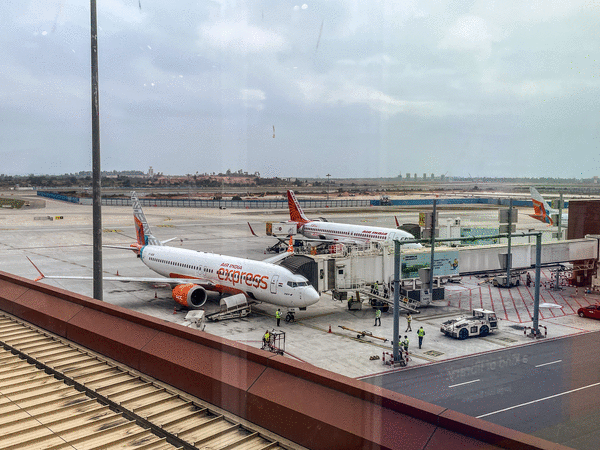
Air India grounded one of its Boeing 787 planes Monday after a pilot reported a possible problem with the engine fuel control switches, the same mechanism at the center of the investigation into a fatal Air India 787 crash in June.
On Monday, Air India said one of its pilots reported a “possible defect” on the fuel control switch of a Boeing 787-8.
The plane, an Everett-built 787, took off from London Sunday evening and landed safely in Bangalore, India, Monday morning, according to FlightAware.
After receiving the pilot’s report, Air India grounded the aircraft and contacted Boeing “to get the pilot’s concerns checked,” a spokesperson for the airline said. “At Air India, the safety of our passengers and crew remains top priority.”
A spokesperson for Boeing said “We are in contact with Air India and are supporting their review of this matter.”
The same switches — two toggles that start and stop the flow of fuel to the plane’s engines — are a focus of India’s investigation into the fatal 787 crash in Ahmedabad, India, last year.
In that case, the Air India plane struggled to gain altitude after taking off and crashed into a medical college, killing 241 of the 242 people on board and 19 people on the ground. The plane’s backup power generator, known as the ram air turbine, or RAT, deployed shortly after takeoff, indicating the plane may have lost power to its engines.
India’s aviation safety board is still investigating the accident and has not yet offered a probable cause.
In a preliminary report released in July, the Aircraft Accident Investigation Bureau focused on movement of the two fuel control switches, which both shifted from the run to cutoff position about 1 second apart.
The cockpit voice recorder captured one pilot asking the other why they had moved the switches, the report stated. The pilot responded that they had not done so.
The switches were then moved back to “run,” but the engines could not regain thrust quickly enough to avoid the crash, the report said.
The preliminary report did not recommend any actions related to Boeing’s 787 or the GE Aerospace engines that powered it.
A 2018 service bulletin from the Federal Aviation Administration regarding the same switches began to recirculate following the crash last year. The FAA warned in 2018 that it had received reports that some switches were installed with a locking feature disengaged. Without the lock, it would be easier for pilots to accidentally move the switches and inadvertently cut power to the engines.
The FAA determined at the time that the reported issue did not pose a safety risk. It recommended airlines inspect the locking feature but did not require those inspections. The regulator reiterated its determination in July, issuing a “continued airworthiness notification” that said the earlier reports did not capture a safety risk.
Air India had not inspected the engine fuel control switches after the FAA’s 2018 notice because the bulletin was advisory and not mandatory, India's AAIB wrote in the preliminary report. The airline did replace the throttle control module, including the switches, on the aircraft involved in the June accident in 2019 and 2023, for reasons unrelated to the locking feature.
On Monday, the airline said it had inspected the fuel control switches on all its Boeing 787 aircraft after the fatal crash, following a directive from India’s Directorate General of Civil Aviation, and found no issues. The airline notified DGCA of the new issue, the spokesperson said.
The 787 grounded Monday was built in 2017, according to aviation analytics firm Cirium. The plane that crashed in June was built in 2014, one of the first 787 jets and among the group of planes dubbed the “Terrible Teens” because of design flaws, out-of-sequence work and production delays.
©2026 The Seattle Times. Visit seattletimes.com. Distributed by Tribune Content Agency, LLC.










Comments