How JBS used TikTok to lure Haitian refugees to work at its Colorado meat-processing plant
Published in Business News
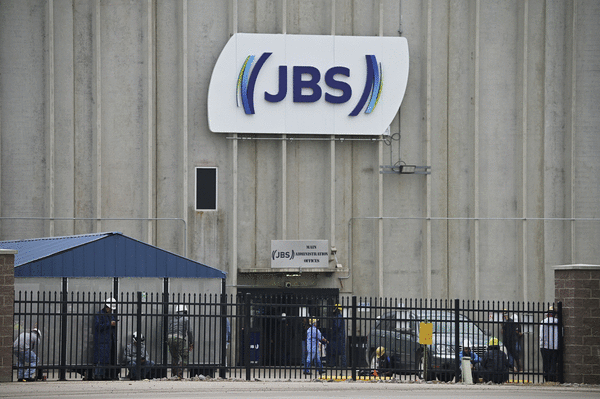
JBS needed workers.
It was 2023, and the meat-processing giant headquartered in Greeley had just endured a tumultuous stretch.
The plant became one of Colorado’s hotspots during the COVID-19 pandemic, with the virus responsible for the deaths of at least seven workers. Many laborers left the company as a result. The ones who stayed demanded better conditions by walking off the job.
So JBS got creative. A Colorado resident, Mackenson Remy, told a company human resources supervisor that he had a TikTok channel targeted at Haitian immigrants in the U.S. and that he could use it to advertise JBS jobs, according to a proposed class-action lawsuit filed Tuesday in U.S. District Court in Denver.
The job was perfect for these refugees, the HR representative, Edmond Ebah, told Remy, the lawsuit alleges: The gig was hard but paid well and required no English. Housing and food would be taken care of while they got set up in Greeley.
Remy, after posting several videos extolling that opportunity, began receiving hundreds of messages from Haitians all over the country, the lawsuit says.
But their experience in Colorado has been marked by injuries, discrimination and inhospitable living conditions, three Haitian workers allege in the federal lawsuit.
The recruiters jammed as many as 60 people into a house at one time, sometimes without electricity and water, the complaint says. Workers’ hands grew disfigured as they trimmed beef fat and pulled out cow intestines. Some urinated themselves because they were denied bathroom breaks, the lawsuit states.
“When I first saw a video recruiting Haitian workers to the JBS plant in Greeley, I was excited for a great opportunity. But immediately upon arrival to an overcrowded hotel room, I knew something was wrong, and that was only the beginning,” said Nesly Pierre, a plaintiff in the lawsuit, in a news release. “I’m a part of today’s lawsuit because I don’t want workers — my fellow Haitians or any group of workers who may come to the U.S. in the future — to suffer in the way that I have.”
JBS representatives did not respond to a request for comment Tuesday.
Squalid living conditions and dangerous work
The Greeley-based company is a wholly owned subsidiary of Brazil-based JBS S.A., the world’s largest processor of beef and pork, with more than $50 billion in annual sales.
JBS USA operates nine U.S. facilities, selling beef products to more than 44 countries on six continents. The company employs more than 37,000 people at these facilities, including 4,000 workers at the Greeley plant.
Pierre, Louine Jean-Louis and Carlos Saint Aubin — all Haitian refugees — were living in states across the country when they learned about the JBS opportunity through TikTok.
Remy charged them a recruitment fee, ranging from $100 to $320, in exchange for securing them a job, the lawsuit alleges. Each scrounged together hundreds of dollars to pay their way to Colorado.
When they got to Greeley, JBS put them up in the Rainbow Motel. Despite there being just one bed, one bathroom and no kitchen in each room, the company crammed up to 11 people in each unit, the complaint states. Pierre said the room “felt like a jail cell,” with many people forced to sleep on the floor.
At its peak, the 17-room motel housed more than 100 Haitians, according to the lawsuit.
JBS charged some workers weekly fees for the rooms and tacked on an additional charge for trips to the plant. Without money or transportation, the refugees had to rely on Remy for trips to the grocery store or restaurants. Saint Aubin didn’t eat for two days, according to the lawsuit.
As new recruits steadily arrived, JBS needed to make room at the motel. So the company moved dozens of Haitians to a five-bedroom house nearby, charging them $70 a week. As many as 60 people were living at the house during its height, the complaint alleges. Sometimes there was no electricity or water.
During their first week of work, JBS gave the recruits a four-day orientation focused on safety and work policies. But the training sessions were only in English and Spanish, according to the lawsuit.
Training supervisors then falsified records on behalf of the new workers to ensure they could pass quickly and begin work as soon as possible, an accusation reported by The Denver Post and made in a separate lawsuit against JBS earlier this year.
Work at the plant, meanwhile, was exceptionally dangerous. Employees endured lacerations, amputations, severe burns and musculoskeletal injuries, the complaint alleges.
Saint Aubin, in his first year of work, experienced shooting pains in his chest while working on the line. He visited the on-site clinic, which gave him a hot towel and sent him back to the floor, he alleges in the lawsuit. He requested to leave work, but was told he’d be penalized.
After the pain continued, JBS called an ambulance to take him to the hospital. A doctor told him that his injury was work-related and that he needed to avoid carrying anything heavy for eight weeks, according to the lawsuit.
But when the worker informed JBS of his doctor’s instructions, the company told him it could not accommodate his request, the complaint states. He’d instead have to take eight weeks of unpaid leave.
The workers allege supervisors barred them from taking bathroom breaks, leading some to avoid drinking and eating to stay on the floor. Others urinated in their clothes.
“No worker should experience the exploitation and abuse that our clients have endured,” said Juno Turner, an attorney with Towards Justice, a Denver nonprofit legal service representing the workers, in a statement. “That these workers are treated so cruelly amid the current unprecedented attack on immigrant communities just adds insult to literal injury.”
JBS’s history of unlawful child labor
The company has also been in the crosshairs of U.S. regulators for years, along with myriad allegations from its employees over poor or unsafe working conditions.
The U.S. Department of Labor, in January, found JBS relied for years on migrant children to work in its slaughterhouses.
Children as young as 13 were hired through an outside sanitation company and worked overnight cleaning shifts at slaughterhouses in Colorado, Iowa, Minnesota and Nebraska, federal investigators found. Their jobs included cleaning dangerous powered equipment, labor officials said.
The company agreed to pay $4 million to assist individuals and communities affected by unlawful child labor practices.
Last year, a union representing workers at the Greeley plant called for federal, state and local law enforcement and regulatory bodies to hold the company accountable for poor labor practices.
The union, UFCW Local 7, accused the company of human trafficking via social media; charging workers to live in squalid conditions; threatening and intimidating workers and their families; operating with dangerously high production line speeds; and withholding mail from workers.
In October 2024, Jean-Louis filed a complaint with the U.S. Equal Employment Opportunity Commission, alleging that JBS intentionally discriminates against Haitian workers by subjecting them to poor working conditions.
©2025 MediaNews Group, Inc. Visit at denverpost.com. Distributed by Tribune Content Agency, LLC.










Comments