Ford, SK On to split joint venture as EV market grows cold
Published in Business News
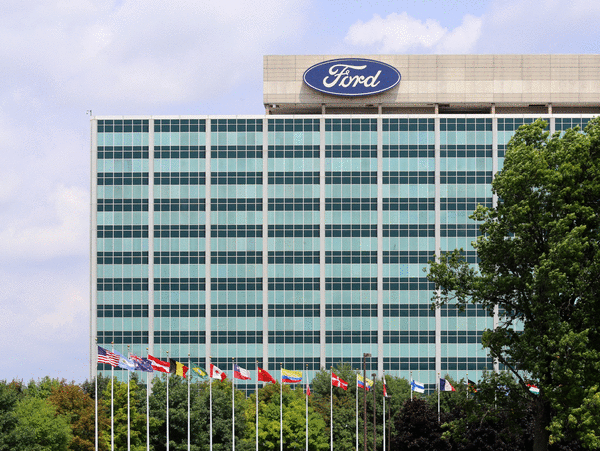
Ford Motor Co. and its South Korean battery partner are getting a divorce.
SK On said Thursday it's made an agreement with Ford to exit their electric vehicle battery joint venture that had invested $11.4 billion into Kentucky and Tennessee. It's another sign of the dissipation of EV momentum in the United States as it becomes clear consumer demand isn't where the industry had expected it would be and the Trump administration follows through on campaign promises to dismantle what the president called an "EV mandate."
The deal is expected to close in the first quarter of 2026. A Ford subsidiary will own and operate the two battery plants known as BlueOval Battery Park, a $5.8 billion investment, in Glendale, Kentucky, while SK On will get the battery plant at BlueOval City in Stanton, Tennessee, that was a part of a $5.6 billion project, including a fully owned Ford EV assembly plant. SK plans to continue supplying Ford, while also making use of the facility for energy storage systems to improve profitability because of low EV volumes.
"This agreement allows SK On to strategically realign assets and production capacity to improve its operational efficiency," SK On spokesperson Joe Guy Collier said in a statement. "It also enables the company to enhance productivity, operational flexibility, and respond more effectively to evolving market dynamics and diverse customer needs."
Ford spokesperson Ian Thibodeau said the automaker is aware of SK On's disclosure and has nothing further to add at this time.
Details on financial implications and how Ford plans to build batteries at the Kentucky site without SK On weren't available. The automaker is licensing technology from Chinese battery manufacturer Contemporary Amperex Technology Co. Ltd. to build lower cost lithium-iron-phosphate batteries at its wholly owned BlueOval Battery Park Michigan site in the state's south-central Marshall.
Also unclear is the decision's impact on employees. BlueOval SK External Affairs Director Keli McAlister said in a statement that the joint venture is working with its parent companies to determine details of what the announcement means.
The United Auto Workers didn't have immediate comment on the news. A hearing was expected next week over challenged ballots in a National Labor Relations Board vote by Kentucky plant workers on whether to organize with the Detroit-based union. With the end of the joint venture, it's unclear whether that will remain relevant.
Production at the first Kentucky plant began this year, but the other two battery plants have been delayed. Construction of the Tennessee plant is nearly complete, Collier said, but there isn't a production start date to share due to the ownership transition.
Ford's U.S. EV sales declined 61% in November year-over-year after the expiration of the up-to-$7,500 plug-in vehicle tax credit at the end of September. CEO Jim Farley had expected EV sales would halve across the industry with the boost.
The Trump administration also has made efforts to rescind a legal finding that allows the Environmental Protection Agency to regulate greenhouse gas tailpipe emissions, revoke California's waiver to set stricter emissions standards that close to a dozen states had adopted, and roll back fleet fuel economy requirements. That paves the way for the sale of more gas- and diesel-powered vehicle sales, prompting companies like General Motors Co. and Stellantis NV to continue to invest in engine production.
Ford hasn't abandoned EVs, with executives stating the automaker needs to compete globally with China's affordable EVs. It unveiled its Universal EV Platform and Production System, which will leave behind the moving assembly line that founder Henry Ford pioneered more than a century ago, and offer a midsize electric truck starting in 2027 for as low as $30,000 following a $2 billion investment in Louisville Assembly Plant. The company plans to build an electric full-size pickup at the new Tennessee assembly plant in BlueOval City, with sales expected to begin in 2028.
The automaker also announced this week a partnership with French rival Renault SA for EVs in Europe and that it would explore commercial vehicle collaboration.
SK On reported an operating loss of 124.8 billion won ($84.7 million) for the third quarter from slowing EV battery shipments. It's turned to energy storage systems that share similar chemistry to EV batteries. In September, the company signed a deal with Flatiron Energy Development to supply lithium-iron-phosphate batteries for that purpose. Rivals LG Energy Solutions and Samsung SDI have made efforts to repurpose plants for energy storage systems as well.
©2025 www.detroitnews.com. Visit at detroitnews.com. Distributed by Tribune Content Agency, LLC.









Comments