Minnesota anglers harvest 80 million pounds annually, far exceeding previous estimate
Published in Outdoors
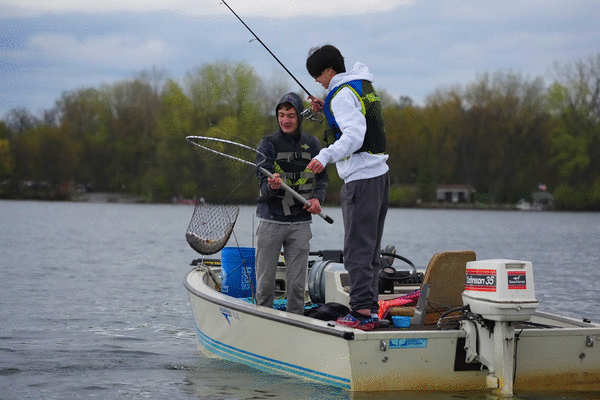
MINNEAPOLIS — Minnesota anglers say they are catching and keeping more fish than previously believed. A boatload more.
A new federal study published this month in the peer-reviewed journal Fisheries found that Minnesotans are bringing home an estimated 80 million pounds of freshwater fish annually. That’s more than twice the state’s official estimate of 30 million pounds a year and amounts to every Minnesotan taking home 14 pounds of fish every year, the equivalent of five to seven average-sized walleye.
Minnesota alone makes up about 10% of all national catch, the study found, making it the No. 1 state in the nation for catch-and-keep fishing.
“My first impression is, I’m really not surprised, but I’m very pleased,” said Brad Parsons, the Minnesota Department of Natural Resource’s fisheries chief. “I think it just demonstrates the tremendous fishing we have here, and how much people care about it.”
The findings are meant to provide more accurate guideposts for policymakers to identify which fisheries might need more interventions to ensure sustainable fishing for years to come, said Matt Robertson, the study’s lead author.
Underestimating how many fish are being taken from a lake could have cascading consequences down the road, he added.
“You could see an increase in their prey, which could lead to a reduction in predation rates on algae, which could then lead to algal blooms being more common,” Robertson said as an example.
The study was a collaborative effort between the U.S. Geological Survey, the University of Missouri, the University of Louisiana and Memorial University of Newfoundland. The team of researchers analyzed tens of thousands of angler surveys, including 370 from Minnesota, to estimate the catch-and-keep rate of every state in the Lower 48.
Those surveys also showed the top three fish Minnesotans take home each year: walleye, at 34%; perch, at 33%; and sunfish, at 16%. Altogether, Embke said, those three fish make up more than four-fifths of the state’s total catch each year.
Robertson said the biggest factor in a state’s catch rate was the number and size of its lakes. In that sense, he said, Minnesota stood out among the rest.
“When you have more water bodies, and they’re larger, that will inherently contribute to your state being estimated to have more catch,” Robertson said.
The study’s findings come as state regulators prepare to reduce the state walleye possession limit from six fish to four, beginning next March. The DNR has said the long-planned change is needed to sustain walleye populations threatened by warming waters, invasive species and more effective fishing technologies.
But Parsons said that even if Minnesotans are taking home more fish than expected, they shouldn’t feel guilty about it because the state has the natural resources to accommodate that.
“We have been looking at harvest over time, and we don’t see over-harvest generally as a problem,” Parsons said. “Even with the walleye bag limit change, this isn’t a crisis we are trying to address. This is … to be good stewards and to be proactive.”
The DNR is now conducting a similar study to update its estimate for annual fish catch. The last time Minnesota officials estimated the annual harvest was 2001.
Parsons said the agency just began that work and expects it to take a couple of years to finish. Parsons expects the state’s study to come to a similar conclusion — that Minnesotans are bringing home far more fish than previously believed — but he also noted that the study’s findings of 80 million pounds per year is likely inflated.
Sports fishing advocates say the gulf between the study findings and the DNR’s estimated harvest done decades ago illustrates that fisheries specialists need more funding to have a better understanding of fishing’s impact.
“I’m not pointing the finger at the DNR and saying they’re not doing their job,” said MN-Fish Executive Director Mark Holsten, who ran the DNR from 2007 to 2011. “What I’m saying is that they lack the personnel and the resources to continue to do the work that they once did.”
In 2023, state lawmakers earmarked $95 million to improve fish hatcheries and upgrade boating access at rivers and lakes. While advocates praised that funding, it still fell short of the $113 million requested by MN-Fish and the $315 million requested overall for the agency by Commissioner Sarah Strommen as a “once-in-a-generation” investment.
Last week, the Legislature approved $33 million to improve and maintain the DNR’s capital assets, including $3 million to rehab the St. Paul Fish Hatchery, which Holsten said is in desperate need of repairs. It’s unclear how much of the remaining $30 million will be used for fish hatchery improvements, he added.
Extra funding could help the state more quickly update its statewide fish harvest estimates, which require conducting tedious angler surveys that can take years to implement and analyze.
To establish the state’s previous estimate in 2001, the DNR surveyed 2,100 anglers, concluding that Minnesotans caught 47 million fish annually. Anglers’ biggest haul were sunfish, like bluegills (15.6 million) and crappies (7 million). They also caught 3.8 million walleyes.
Minnesota has used these creel surveys to gauge what is happening on waters and help manage fisheries since the 1930s. Anglers are interviewed on site. Data collected includes how many boats are on the water; the number of fish caught, released and kept; and the amount of time people fished.
“I think we have some of the best data in the country just because we’ve been doing it for a long time,” Parsons said.
Today, DNR fisheries specialists do from eight to 15 creel surveys annually on specific lakes. They mainly focus on big walleye fisheries where most of the action and harvesting occurs, Parsons said. Three are analyzed annually. Lake Mille Lacs and Red Lake (Upper and Lower) are part of state harvest agreements with the Mille Lacs Band of Ojibwe and Red Lake Band of Chippewa, respectively. The DNR also does a winter survey of Lake of the Woods, increasingly popular with anglers.
____
©2026 The Minnesota Star Tribune. Visit startribune.com. Distributed by Tribune Content Agency, LLC






Comments