What is the future of Maryland's horse industry? Here's the state's strategic plan.
Published in Horse Racing
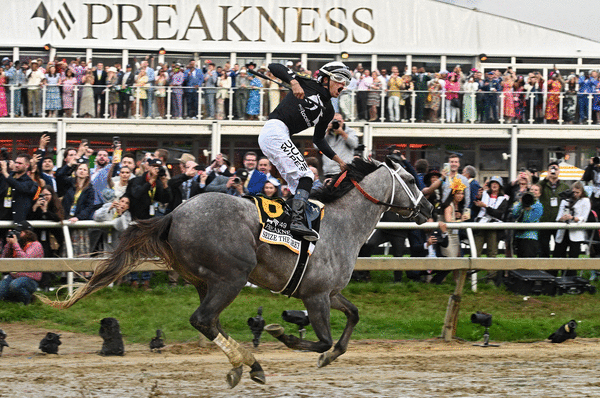
BALTIMORE — Maryland’s new horse industry strategic plan calls for expanding workforce training, improving racehorse welfare and promoting equestrian tourism as the state works to strengthen an industry that says it generates an estimated $2.9 billion in economic activity annually.
The plan, developed under an executive order issued by Gov. Wes Moore in November 2025, outlines recommendations for coordinating the state’s horse-related industries, from thoroughbred racing and breeding to veterinary medicine, recreation and land preservation. Turning those recommendations into action, however, could prove challenging.
The state is spending about $400 million to rebuild Pimlico Race Course in Baltimore and an additional $120 million to transform Laurel Park in Anne Arundel County into a year-round training center. Maryland also paid $85 million this summer to retain the intellectual property rights to the Preakness and Black-Eyed Susan after Churchill Downs sought to acquire them.
Frank Vespe, founder and publisher of TheRacingBiz.com, said Maryland’s racing industry faces the challenge of reversing national trends, including shrinking participation and increasing consolidation among fewer major players.
“The challenge for Maryland is, how do you buck those trends?” Vespe said in an interview with The Baltimore Sun. He said the state and industry must think strategically about how to position Maryland racing for the long term.
Vespe said Moore’s administration has committed resources to address problems the industry had struggled to solve, but the responsibility for making the changes work ultimately rests with the industry itself.
“The things the governor has done, the changes that have occurred as a result of the General Assembly’s action, those all put the onus on the thoroughbred industry itself to solve its problems,” Vespe said.
Vespe said Maryland has several assets that could help sustain racing, including a planned new Pimlico facility, a nearby training center that could also be used for racing if needed, and the Preakness, which he called the “nation’s second-most-important race” behind the Kentucky Derby.
“I think the tools are here,” Vespe said. “Do I think racing is going to look precisely the same as it does in five, 10 years? I do not. Do I think racing in Maryland’s going to still be here in five, 10 years? I do.”
Ross Peddicord, a former Sun horse racing reporter who covered the sport from 1977 to 1994 and a former executive director of the Maryland Horse Industry Board, said the strategic plan appears to address longstanding priorities for the state’s horse industry.
“There are many elements in the plan that the Maryland horse industry has been working on for years, and at first glance the report looks like an excellent attempt to address and move forward many of those initiatives,” Peddicord said.
He pointed to the state’s horse-breeding industry beyond thoroughbred racing, including the production of horses for other equestrian disciplines. The report recommends exploring the use of racing gambling revenues to support and incentivize that part of the industry, he said.
“It’s definitely worth exploring,” Peddicord said. “Many thoroughbred racing and breeding farms that have gone out of business are repurposed for other equestrian disciplines.”
Maryland has more horses per square mile than any other state. Its horse industry generates an estimated $2.9 billion in total economic impact, contributes $1.05 billion to the state’s gross domestic product, and supports 28,434 direct and indirect jobs, according to the American Horse Council Foundation’s 2023 Economic Impact Study, cited in the plan.
The plan recommends compiling an inventory of industry recruitment and training programs, developing industry-specific credentials, and expanding outreach to young people interested in horse-related careers.
It also recommends tracking Maryland racehorses from breeding through retirement to improve equine welfare and strengthening coordination among industry leaders and state agencies to promote horse-related tourism. It also calls for support for the Pimlico redevelopment, a statewide equestrian training center and the future of the Preakness Stakes and Preakness Festival under Maryland ownership and control.
Staffing shortfalls and total cost could prove a challenge to implementing the plan. The Maryland Horse Industry Board, which promotes the industry and oversees stable licensing, has one full-time employee and receives no state general fund support for operations, according to the report. The committee recommends adding staff and pursuing public-private partnerships to help advance industry programs and infrastructure improvements.
State agencies could contribute through economic and workforce development programs and by protecting the agricultural land and natural resources the industry uses. The Maryland Department of Agriculture, for example, provides resources to help horse operations improve pasture management, limit soil erosion and protect waterways.
The department plans to host an Equine Conservation Summit on Nov. 14 to bring together horse farm owners and industry partners to discuss conservation practices and land stewardship.
The Maryland Jockey Club, a major stakeholder in the state’s thoroughbred industry, expressed support for the plan and said it was ready to work with other equine organizations to carry out its recommendations.
“Maryland’s horse industry has always been bigger than any one track, farm, or discipline, and this plan reflects that,” Bill Knauf, the club’s president and general manager, said in a statement. He cited the planned redevelopment of Pimlico, a training center at Laurel Park and a racing future at Fair Hill as areas for collaboration.
The plan calls for coordination among Maryland’s horse-related industries, but its recommendations will require follow-through from state agencies and industry organizations. The report does not, by itself, establish new funding for the proposed initiatives.
©2026 The Baltimore Sun. Visit at baltimoresun.com. Distributed by Tribune Content Agency, LLC.




Comments