Mark Story: Horse racing's Triple Crown is not dead -- but it is in trouble
Published in Horse Racing
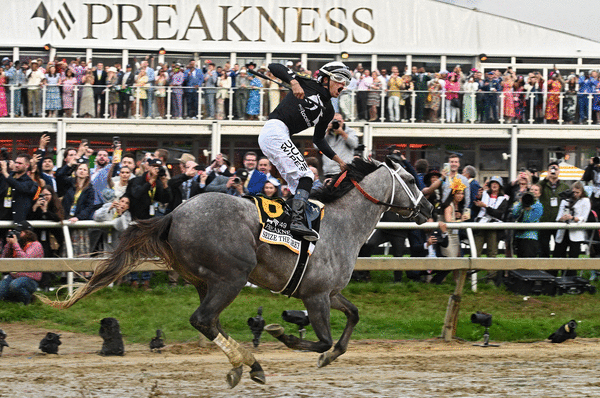
LEXINGTON, Ky. — As the headlines attest, we are living through one of the most consequential weeks in the history of North American Thoroughbred horse racing.
“The Triple Crown Passes Away At 107” sat atop a column written by veteran turf writer Bill Finley for the Thoroughbred Daily News.
“Horse racing’s Triple Crown may be dead” ran above a piece from Dan Wolken of Yahoo Sports.
An Associated Press news story was titled “Big changes in horse racing create new questions about the future of the Triple Crown.”
The projections of impending demise for the Triple Crown — the annual three-race series for 3-year-old Thoroughbreds consisting of the Kentucky Derby in Louisville, the Preakness Stakes in Baltimore and the Belmont Stakes in New York — were sparked by a pair of announcements this week.
On Monday, Churchill Downs, Inc., the company that owns the landmark Louisville racetrack, and the New York Racing Association announced joint sponsorship of a new six-race series for 3-year-olds — which will include the Kentucky Derby and the Belmont, but not the Preakness.
The following day, government officials in Maryland said that the 2027 Preakness Stakes will move back eight days on the calendar. Rather than its traditional spot two Saturdays after the Kentucky Derby and three Saturdays before the Belmont Stakes, the Preakness will run next year on the third Sunday after the Derby.
Over the course of 2026, the relationship between Churchill Downs, Inc., and the state of Maryland has seemed to grow increasingly fraught.
On April 21, Churchill announced that it had agreed to pay $85 million to “acquire the intellectual property, including all trademarks and associated rights, of the Preakness Stakes and Black-Eyed Susan Stakes,” from the company, 1/ST Maryland LLC, which owned and operated those races.
In June, however, the state of Maryland exercised an option it had previously been granted by 1/ST to match any offer for the sale of the Preakness and the Black-Eyed Susan.
Had the original deal gone through, it’s hard to imagine that Churchill Downs, Inc., would have signed on to a new race series that did not include the Preakness.
As it is, the new six-race series will be called the “Thoroughbred Championship Series.” It will begin next year with the Kentucky Derby (May 1); then include the Belmont Stakes (June 5); the Matt Winn Stakes (Churchill Downs in July); the Jim Dandy Stakes (Saratoga Race Course in late July or early August); the Travers Stakes (Saratoga, late August); and conclude with a championship race at Churchill Downs in September.
According to Churchill Downs, Inc., the idea behind the new series is to “extend fan engagement beyond the Triple Crown by connecting six premier races across five months through a unified points system and a $5 million championship prize pool” that will be in addition to the individual race purses.
In recent years, the Preakness Stakes has become increasingly marginalized. Many modern trainers prefer giving horses more time between races than the traditional two weeks between the Kentucky Derby and the Preakness.
Of the past five Derby winners, three — Rich Strike in 2022; Sovereignty in 2025; and Golden Tempo this year — have skipped the Maryland race.
In response, there have been increasing calls to put more weeks in between the Triple Crown races.
I have not been enthusiastic about switching those dates. To me, the prestige of winning the Triple Crown is largely tied to the achievement being the same for a future winner that it was for American Pharoah in 2015 and Secretariat in 1973.
Nevertheless, now that Maryland has started us down the path of altering the Triple Crown race calendar, the obvious plan would be to run the Kentucky Derby on the first Saturday in May, the Preakness on the first Saturday in June and the Belmont on the first Saturday in July.
Maryland officials moving the Preakness Stakes back eight days with the idea it will attract more horses to the race seems unlikely to work unless the date of the Belmont Stakes is also moved back. There has been no indication from the NYRA that it intends to do that.
So, even as Baltimore’s Pimlico Race Course is undergoing a $400 million renovation, its marquee event appears to be stuck in a no-man’s land.
The Preakness Stakes did get a smidgen of good news this week with the announcement of a new deal with NBC Sports to telecast the Preakness and the Black-Eyed Susan (the companion race to the Preakness Stakes for 3-year-old fillies) through 2032.
NBC has incentive to help keep the Preakness Stakes from receding into irrelevancy. Maybe the Peacock Network, which has broadcast the Kentucky Derby every year since 2001, can help get Churchill Downs, Inc., and Maryland officials onto the same page.
Moving forward, the risk is that, with the lucrative new racing series from Churchill Downs and the NYRA coming online, it will become even more acceptable for trainers in future years to skip the Preakness.
So, while it’s too soon to pronounce the death of Triple Crown, it is now very much in jeopardy.
©2026 Lexington Herald-Leader. Visit kentucky.com. Distributed by Tribune Content Agency, LLC.





Comments