Preakness shifts to Sunday in 2027 amid effort to reassure racing fans
Published in Horse Racing
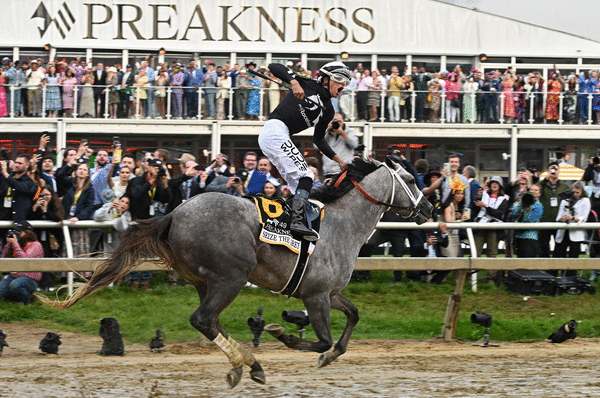
BALTIMORE — The Preakness Stakes‘ exclusion from a new season-long national Thoroughbred Championship Series has raised fresh questions about the future of Maryland’s signature horse race, even as state officials unveiled sweeping changes aimed at strengthening the event and attracting the nation’s top thoroughbreds.
Gov. Wes Moore, the Maryland Jockey Club and NBC Sports announced that the 152nd Preakness Stakes will be held on Sunday, May 23, 2027, at Pimlico Race Course, moving the race eight days later than its traditional spot on the third Saturday in May. The shift increases the gap between the Kentucky Derby and the Preakness from two weeks to 22 days, giving horses more time to recover before the Baltimore classic.
The Black-Eyed Susan Stakes also will move from Friday to Saturday, creating a two-day racing festival that concludes with the Preakness on Sunday.
Maryland officials said the additional week is intended to make the race more attractive to horses coming out of the Kentucky Derby while creating a larger Memorial Day weekend destination for Baltimore.
“By moving the date, you’re providing additional time and space for our horses and the people who compete in the Derby to then compete [in the Preakness],” said Moore during a Wednesday news conference in Annapolis. He did not take questions after making remarks.
The move comes as leaders warn Maryland must adapt quickly after the Preakness was initially omitted from the inaugural Thoroughbred Championship Series.
“We acknowledge the great history of this race, especially the Preakness being two weeks after the Derby.” Bill Knauf, president and general manager of the Maryland Jockey Club, said. “But we recognize that change should always be examined. Other professional sports constantly reevaluate the rules, and now is the time for change.”
Launching in 2027, the six-race competition is designed to extend interest in the nation’s top 3-year-old thoroughbreds beyond the Triple Crown. The inaugural series will include the Kentucky Derby, Belmont Stakes, Matt Winn Stakes, Jim Dandy Stakes, Travers Stakes and a season-ending championship race at Churchill Downs.
“The Preakness was already struggling to attract the best thoroughbreds to Baltimore,” said Anirban Basu, economist and CEO of Baltimore-based Sage Policy Group. “The emergence of this new series will likely make attracting those horses, their owners, trainers and jockeys all the more challenging.”
Basu said Maryland will need to be strategic to protect the Preakness and the state’s broader racing industry as it commits more than a half-billion dollars to reshape the future of horse racing.
The new Preakness schedule introduces a significant wrinkle to the Triple Crown calendar. The 2027 Belmont Stakes is already set for June 5, leaving only 13 days between the Preakness and the series finale. The Triple Crown has spanned five weeks, previously with a two-week gap between the Kentucky Derby and Preakness, and three weeks are separating the Preakness and Belmont.
Under the revised timeline, horses will have 22 days to recover between the Derby and Preakness, but just 13 days before returning for the Belmont, the 1.5-mile race that is widely regarded as the most demanding leg of the Triple Crown.
This change comes as the state plans is spending about $400 million to build a new Pimlico Race Course and another $120 million to transform Laurel Park into a year-round training center. Next year’s Preakness is set to be run again at Pimlico after a year in Laurel to make way for construction.
On top of that, the state paid $85 million in June to match Churchill Downs’ bid for the intellectual property rights of the Preakness and Black-Eyed Susan. Churchill Downs is one of two entities, along with The New York Racing Association, establishing the new thoroughbred series.
The governor said the investments will protect an industry that supports more than 28,000 Maryland jobs and generates roughly $3 billion in economic activity annually.
“You cannot control your future if you do not own it,” Moore said. “Maryland now owns the rights. Marylanders now own the assets. Marylanders will make the decisions.”
But the project’s long-term success depends on attracting horses, owners and fans to a modernized racing circuit at a time when thoroughbred racing continues to face declining participation nationwide.
“Moving the race to three weeks after the Kentucky Derby from two seems like an immediate and obvious response to allay fears of injury to horses,” Basu said. “But additional positioning will be required if the State of Maryland is to generate a proper return on its more than half a billion dollar investment in Preakness intellectual property, the new Pimlico, and Laurel.”
Thomas Rhoads, a sports business professor at Towson University, said the Preakness may have been squeezed out with a schedule change.
Training elite thoroughbreds has become increasingly precise, Rhoads said, and many owners are reluctant to run horses in all three Triple Crown races on such a compressed schedule. The Kentucky Derby winner has skipped the Preakness in five of the past eight years, opting instead to recover before later races.
“Unless the race can be rescheduled to fit into an optimal recovery timeframe, I expect Pimlico will be impacted negatively because of the Thoroughbred Championship Series,” Rhoads said.
Maryland also announced it has renewed its media rights agreement with NBC Sports, ensuring the Preakness will continue to air on NBC and Peacock through 2032.
Moore said moving the race to Sunday, combined with the renewed NBC Sports agreement through 2032, would expand the Preakness’ national audience.
“Millions more people will be able to tune in and watch this iconic race weekend,” he said. “More people will watch and witness the greatest show in the mid-Atlantic.”
Churchill Downs left open the possibility of expanding the championship.
“The inaugural Thoroughbred Championship Series was developed by CDI and NYRA around a shared vision for a season-long championship and a group of races that provided the right foundation to launch in 2027,” Officials with Churchill Downs said in a statement. “This is the first season of what we expect will be a long-term championship, not the last. As the series evolves, we are open to conversations with additional races and organizations that share our vision and would strengthen both the championship and the sport.”
But Moore dismissed suggestions that the new Thoroughbred Championship Series would diminish the race’s stature.
“Preakness can and will remain the second jewel of the Triple Crown, and nothing will change that,” he said. “If you want to win the Triple Crown, we’ll see you in Baltimore.”
©2026 Baltimore Sun. Visit baltimoresun.com. Distributed by Tribune Content Agency, LLC.






Comments