Joey Porter Jr. isn't the first Steeler to go through contentious contract talks. A couple even had happy endings
Published in Football
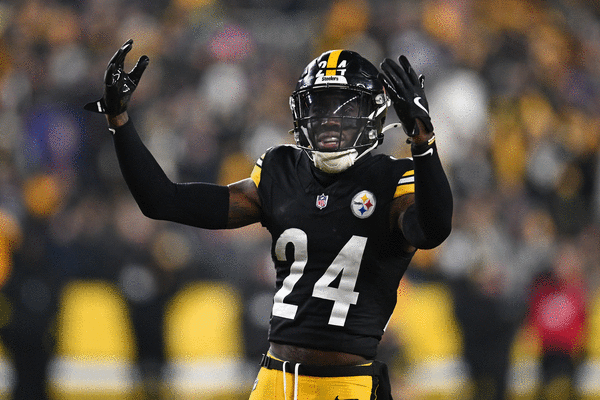
Rod Woodson sat out until midway through his rookie season in 1987 after the Steelers selected him with the No. 10 overall pick in the draft.
Woodson used his status as one of the fastest athletes in the world to his advantage in contract negotiations. He earned a bronze medal in the 110m hurdles at the 1987 USA Olympic Festival against athletes who would go on to compete in the 1988 Summer Olympics in Seoul, South Korea.
Woodson eventually joined the Steelers in late October, signing for $1.8 million, and he played in eight games as a rookie. It was the start of one of the greatest careers in franchise history.
Woodson’s story is one of the few examples in Steelers history of a protracted contract negotiation not ruining the player’s relationship with the organization.
One cautionary tale is Pro Bowl linebacker Mike Merriweather, who held out for the entire 1988 season and was later traded for a first-round pick. Another is running back Le’Veon Bell, who famously refused to sign the franchise tag, sat out the 2018 season then signed with the New York Jets in 2019.
The Steelers are now embroiled in another contentious contract saga with cornerback Joey Porter Jr., who has yet to play a game in 2026, the final year of his rookie deal.
Porter said Thursday he expects to suit up at some point this season, but he did not give an indication as to when. His status for Sunday’s home game against the Cincinnati Bengals remains up in the air.
As that saga dragged on, the Post-Gazette reached out to Woodson and ex-Steelers safety Darren Perry for their perspective on Porter’s situation. Are there any lessons learned from their own contentious negotiations with the Steelers that give hope there could be a happy ending with Porter, too?
“We all want players to get paid, but if I’m in that situation, I’m playing with my guys,” Woodson said last week. “We were all so tight in the locker room. We still talk to this day. I do want players to get their money. I just don’t know if I would do it this way.”
‘It’s a little different now’
Woodson is quick to point out the differences between his situation and what Porter is doing. Woodson was not under contract when he withheld his services, and the NFL and the players’ union were mired in a drawn-out labor fight.
When the players went on strike that September, the NFL used replacement players for three weeks. Woodson signed his rookie contract after the labor stoppage was over, agreeing on Oct. 28.
“It’s a little different now than it was back then,” Woodson said. “There was no free agency until 1993.”
Porter is under contract for the 2026 season for $3.9 million. The Steelers offered him more than $27 million per season, team sources told the Post-Gazette. The specific terms are not known, including the total guarantees, but the Steelers typically sign players coming off of rookie deals to new five-year contracts.
If the Steelers do not place the franchise tag on Porter following the season, he can become a free agent in March.
“Right now, it’s Joey Porter Jr., LLC,” Woodson said. “He is selling his goods to the Pittsburgh Steelers. After the season, he might be selling his goods to another team. The thing that’s unfortunate for the Steelers is there is a history there with the Porter family. You hope they can find a resolution.”
Perry was in a similar situation in 1995. The safety was entering the final year of his rookie contract. He contemplated holding out, but he decided to report on time to Saint Vincent College for training camp.
Like Porter, the Steelers and Perry could not come to terms on a new contract before the start of the season. But Perry made up his mind he was going to play.
“I decided I was going to show up and play it out and see how I could do in free agency,” he said this week. “When I showed up, a lot of the players were surprised I came to camp, but we were coming off a heartbreaking loss in the AFC championship game. And we just knew we were going to go to the Super Bowl.”
Perry’s willingness to report on time and play led to him signing three weeks into the season. It’s the one instance in the past 31 years when the Steelers broke their rule about negotiating with players once the season begins.
On Sept. 13, the day of the 2026 season opener, team sources said they had told Porter and his representatives they would not make another exception for him.
Relationships matter
Perry came into the NFL in 1992 as an eighth-round pick and earned a starting position as a rookie. Everyone was starting anew together. Bill Cowher was a first-time head coach in the league, and Dick LeBeau had been hired to run his secondary after a long stint as Cincinnati’s defensive coordinator.
“I had a lot of people in my corner,” Perry said. “Coach LeBeau and coach Cowher wanted me to sign.”
The 1995 season was one of the most anticipated in Steelers history. The team’s unofficial battle cry was “three more yards” after the Steelers fell three yards short of the end zone as time ran out in the AFC championship game loss to the San Diego Chargers six months earlier.
By then, Perry had become an almost indispensable member of the defense, emerging as the signal-caller of the vaunted Blitzburgh defense.
Perry believes those relationships with Cowher and LeBeau gave him some leverage in negotiations.
If Mike Tomlin were still the Steelers’ coach, Porter might have signed long ago.
Tomlin had a big hand in Porter being drafted No. 32 overall in 2023. Tomlin is close with Porter and his family. Joey Porter Sr. coached under Tomlin from 2015-18.
Porter does not have an established relationship with new Steelers coach Mike McCarthy or anyone on his staff.
They have all said the right things when asked about Porter — how he’s good in the classroom and has been a model citizen during the contract impasse — but McCarthy wanted Porter to practice in training camp this summer so he could get familiar with his game.
“This is a new staff,” said Perry, who coached under McCarthy in Green Bay from 2009-17. “They want to see you. Relationships go a long way.”
A couple of other things helped Perry get his contract done.
Woodson tore his ACL in the 1995 season opener, weakening the secondary. Perry said he’s never spoken to anyone with the Steelers about it, but he thinks the injury gave the team a sense of urgency to sign him.
“That, along with the support I had, I thought I had leverage,” Perry said. “I don’t think they wanted to lose me. I just made up my mind that I was going to come in and play my ass off. The leverage was a big part of it.”
Under the terms of the collective bargaining agreement, teams own the leverage in these situations because they can place the franchise tag on players and control their rights beyond the initial terms of their rookie contacts.
“It’s a tough situation for Joey because until they get exploited back there, I don’t know they’re going to say that they need him,” Perry said. “They have a lot of other problems they have to fix.”
No end in sight
You can hear it in the tones Woodson and Perry speak and in their words.
Their teammates played into their decisions to ultimately play. Money mattered, but those commitments mattered, too.
“At the end of the day, I love football,” Perry said. “And I wanted to be there. I would have been miserable watching my teammates go to battle without me. I didn’t want to be the guy who played a part in us not getting to the Super Bowl.”
This Steelers team isn’t a Super Bowl favorite like the one in 1995, but the defense is built to win now. Porter, the top cover corner on the roster, was expected to be a big part of the unit.
Porter’s teammates continue to have his back. Last week, linebacker Patrick Queen voiced his support, going as far as to say he was behind Porter whether his absence was related to injury or his contract.
“I’m with Joey whatever he is doing,” Queen said. “I respect it. I’m 100% behind him.”
Players and owners continue to be at loggerheads over the terms of CBAs past and present. The newest tactic has been to “hold in” rather than hold out. It worked for the likes of T.J. Watt, Cam Heyward and even Diontae Johnson, who had the good fortune of having Tomlin in his corner.
That was Porter’s original plan, but the Steelers held firm throughout the summer.
Then, on July 28, the day players reported to training camp, Porter was placed on the physically unable to perform list after he reported a back injury during mobility testing.
It’s impossible to say whether a different tact by Porter would have led to a deal, but the two sides have been at odds ever since. Porter did say Thursday he wanted to be on the field with his teammates — when he is healthy.
It has been, in almost every way, the complete opposite approach Perry had.
“For me, I just tried to be respectful as I could be because I knew the Rooneys were tough negotiators,” Perry said. “I didn’t want any distractions. I bet on myself. I remember being so relieved when it was done. And I remember the Steelers were telling me they were happy I signed, too.”
Porter’s contract impasse appears to be tied to guarantees. Porter’s agent, Andre Odom, did not respond to a request for comment. Joey Porter Sr. declined to comment.
Woodson is sympathetic to Porter’s plight, but he comes back to the tactics.
“I wouldn’t blame him if that’s case,” Woodson said of guarantees perhaps being at the root of the issue. “But it would be hard for me not to be with my guys.”
_____
©2026 PG Publishing Co. Visit at post-gazette.com. Distributed by Tribune Content Agency, LLC.





Comments