Sky missed the playoffs for a 3rd year in a row. How much longer can this cycle repeat?
Published in Basketball
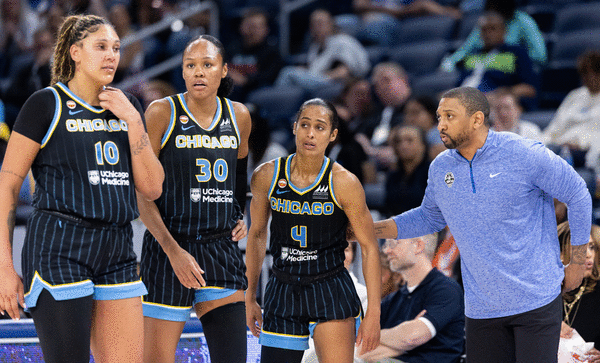
CHICAGO — For the third season in a row, the Chicago Sky will not compete in the WNBA playoffs.
It happened, rather fittingly, with yet another beatdown at the hands of the Indiana Fever, a team that has defeated the Sky the last nine times the two teams have met. The Sky spent the last week teetering on the edge, racking up a few last-gasp wins to hold off the looming inevitability of their own elimination. Now, the reality is settling in.
Missing the postseason once was a disappointment. Twice was a frustration. But the third consecutive missed postseason suggests a pattern of mismanagement and missed opportunities that has come to define the Sky under new ownership and leadership.
Although there are still six perfunctory games left to play out — which will take almost five more weeks due to the awkward timing of the FIBA World Cup break — now is as good a time as any to begin a postmortem on another wasted Sky season.
General manager Jeff Pagliocca has never wanted to lose. His insistence on winning is why the Sky overhauled the roster in earnest during each recent offseason, giving up a bevy of draft capital in the process. Like many aspects of the Sky’s failure, this ethos is rooted in a genuine desire to do good. This single-gear “win now” mode of operation is driven by a fundamental belief that Chicago can and should be a top competitor every season. But winning with immediacy and urgency is much easier said than done.
This year, the Sky’s biggest investments were also their greatest disappointments. Azurá Stevens, the franchise’s marquee signing worth just over $1 million a year, barely cracked a 10-point average while missing nearly a quarter of the season due to injuries and personal concerns. Skylar Diggins, the front office’s focal point in a truncated free-agency period, played only 19 games before publicly criticizing team leadership and holding out on the sidelines with a lingering knee injury. Rickea Jackson appeared to be the trade payoff the Sky had been seeking for several seasons, only to blow her knee four games in. Jacy Sheldon, the subject of a much-maligned trade that sent away yet another natural first-round draft pick, slid out of the starting lineup.
In a season defined by all this losing, it’s easy to lose track of what did work. Courtney Vandersloot successfully returned from ACL surgery at age 37 to average five assists per game. Sydney Taylor logged one of the best rookie performances in the entire league, dropping buzzer-beater game winners and racking up a 14.2 points per game average. Natasha Cloud offered a much-needed spark at times. These small victories don’t negate the negativities of the season, but they round out the full story for the Sky.
At its core, this roster was built on optimism. Pagliocca signed DiJonai Carrington despite knowing that she would be unavailable until after the All-Star break due to injury. He similarly chose to overlook the fact that Diggins, Stevens and Vandersloot were carrying injuries into the year. That combination laid the groundwork for disaster. The Sky spent most of this year bemoaning the bad luck of their injured players without ever acknowledging the reality that most of those ailments were preexisting, not a midseason fluke.
The Sky struggled outside of pure absences. They lost 14 of their 23 games that finished in the clutch. Their 3-point shooting once again ranked in the bottom rungs of the league. They struggled on the boards, bled points in the paint and failed to live up to their stated goals of forming a disruptive defense. In his second year as a head coach, Tyler Marsh once again struggled to cement a clear playing identity. But with a roster doomed from the start, it’s nearly impossible to diagnose whether issues stem from personnel or tactics.
Marsh took a hopeful tone after Sunday’s disqualifying loss to the Fever, insisting that the Sky could still grow through their final games of the season.
“We’re not just playing for the right now,” Marsh said. “We’re playing for the future too.”
It’s unclear how accurately that sentiment applies to this Sky team. It’s true that the majority of the roster will be under contract in 2027. Only three players — Carrington, Cloud, Rachel Banham— are on expiring deals, with Sydney Taylor expected to return as an exclusive rights free agent. Still, the Sky have not earned a reputation for sustaining a system from year to year — and the status of the remaining roster does not lend itself to a building process for the Sky.
Kamilla Cardoso’s and Jackson’s rookie deals end in 2027. Diggins’ long-term availability remains uncertain. Vandersloot is more dependable than many veterans at her age, but the guard is nevertheless in the final stage of her longevity. Without a draft lottery pick in 2027, the Sky don’t have the depth to build a winning culture from within nor the assets to tear down and try again. After three seasons of this cycle, the wheel might be stuck.
And that leaves the Sky — along with Pagliocca and Marsh — in no-man’s-land. With little remaining to play for, ownership will be left to use the rest of this season to decide whether the third strike is worth a reset from the top down.
____
©2026 Chicago Tribune. Visit chicagotribune.com. Distributed by Tribune Content Agency, LLC.






Comments