Mark Walter flipped the Lakers for a record price. Did Bob Iger and Josh Kushner overpay?
Published in Basketball
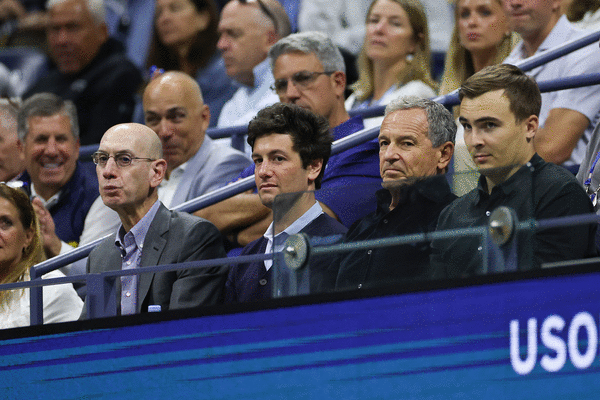
LOS ANGELES — Joshua Kushner and Bob Iger, successful businessmen by any measure, paid $12.5 billion for the Lakers, easily the highest price ever for a sports franchise.
It was a rare chance to acquire an iconic sports brand, and by all accounts, timing was everything.
The enormous sale price has implications for the rest of the NBA and raises a basic question: Did Kushner and Iger get a great deal or did they overpay?
Business titan Mark Walter owned the NBA franchise for only a year. Federal regulators are investigating Walter's financial empire, and he reportedly felt compelled to sell as he moves billions to help unravel undisclosed related-party loans from two of his insurance companies to multinational holding company TWG Global — an abbreviation for The Walter Group, where he serves as chief executive.
Before many learned Walter might be interested in selling the team quickly, Kushner and Iger, already pining for an NBA franchise, jumped at the opportunity.
The haste of the transaction would seem to have given the buyers superior leverage, yet Walter negotiated a 25% increase on the $10 billion he spent on the team last October.
Some experts argue the Lakers are worth every penny. A deep dive into the market for legacy sports franchises indicates to Sports Value Consulting co-founder and chief executive Michael Rapkoch that the investment is sound.
"How often do the Lakers come up for sale? Why wouldn't someone pay that amount if they were able?" Rapkoch said. "Are you going to be the person who says at a cocktail party that you could have bought the team but turned it down because you wouldn't pay more than $11 billion? This is likely your one and only chance. It's do it or lose it."
Twelve years ago, Steve Ballmer bought the Clippers for $2 billion and admitted he willingly overpaid. In 2025, the Boston Celtics — like the Lakers, an illustrious legacy franchise — were sold for $6.1 billion, which closely matched Forbes market estimates.
Less than a year later, the Lakers sold for more than twice that amount. Some experts were astonished by the price tag.
"You've got to buy things with some discipline based on the revenue potential, the cost takeouts, what does the P&L [Profit and Loss] look like," bestselling business author William D. Cohan said on a podcast. "You've got to believe that Iger and Kushner got caught up in wanting to own this thing.
"As usual with these kind of assets, you have to buy it smart, buy it right or else you overpay. If you get into 'deal heat,' which I have a feeling Bob Iger did ... it's hard to get a return when you way overpay."
Premium sports franchises have spiked in value so rapidly that sticker shock is nil. Shortly after Walter purchased the Lakers, sports business website Sportico determined that the average NBA team was worth $5.51 billion, a 20% increase in one year and a 113% surge since 2022.
The Golden State Warriors ranked first at $11.33 billion, the Lakers were second at $10 billion — reflecting what Walter paid for the team — and the Memphis Grizzlies ranked last at $4 billion. Collectively, the 30 NBA franchises were worth $165 billion.
Record-breaking purchases of NBA, NFL and MLB teams are often initially considered overpays, yet soon are deemed bargains.
Ballmer, like Iger, had come up short in earlier bids for teams, and wasn't going to let it happen again with the Clippers. He acknowledged succumbing to the "deal heat" Cohan mentioned, but never regretted it. Forbes estimates the Clippers are worth $7.5 billion today.
"I was all in, but then it got into the bid process. And I was still all in, and I just said, 'I'm gonna get this team,'" Ballmer said on a podcast in 2023. "People thought I way overpaid, but I got the team."
Experts say the value of top-tier sports franchises involves three factors that differ from most other companies: guaranteed revenue through long-term league media rights deals; regional and global branding that fuels steady ancillary revenue from sponsorships and team merchandise; and extreme scarcity that fosters deep fan allegiances.
Major franchises — the Lakers, Dodgers, Dallas Cowboys and New York Yankees, to name a few — don't change hands often. Kushner and Iger were mired in a lengthy battle to gain approval for an NBA expansion franchise Las Vegas and clearly viewed the Lakers as a better opportunity.
Recently approved NBA media rights deals are worth $6.9 billion a year from 2025 through 2036. They include the renewal of the league's partnership with Disney — which owns ESPN — and new agreements with NBCUniversal and Amazon under which ABC/ESPN, NBC/Peacock and Prime Video will telecast games.
Some financial experts consider the Lakers a less risky investment than, say, OpenAI, into which Kushner invested roughly $2 billion through his venture capital firm, Thrive Capital. That investment and others in the AI and tech sectors have paid off handsomely, but pivoting to a legacy NBA team with a locked-in elevated financial floor could be prudent. Iger just stepped down after two runs heading the Walt Disney Co.
"The NBA has more secured, annual retention revenue than most other investments," Rapkoch said. "You are buying into something stable. In 15 to 20 years the Lakers are going to be here. Will an AI company be here? Maybe so. But lots of companies have come and gone. We know with a high level of certainty the Lakers will be here."
Some who believe Kushner and Iger got caught up in the moment and overpaid point to the bidding war with Comcast for 21st Century Fox that Iger won for Disney in 2019. The price escalated from $54 billion to $72 billion and Disney was left with a debt load of $25 billion and mixed returns.
Iger rejected the notion that he experienced "buyer's remorse," maintaining on a November 2024 call with analysts that the deal was made "through the lens of streaming." He asserted that Disney would not have successfully launched and scaled Disney+ without Fox's immense content catalog, which included the "Avatar" franchise, "The Simpsons," FX and National Geographic.
NBA franchise revenue is not as diversified as Disney's, yet the league generated $12.25 billion in revenue — an average of $408 million per team — during the 2024-25 season, including events such as concerts at arenas owned or operated by teams. These earnings ranged from the Warriors' $833 million to the Grizzlies' $301 million.
But NBA teams also do not have some of the business challenges movie studios face in the streaming era.
Rapkoch pointed out that it is unclear precisely how much of the Lakers will be owned by Kushner and Iger. Walter's majority ownership share has not been publicly divulged. It has been widely reported that among minority owners, the Buss family owns 17.8%, Dr. Patrick Soon-Shiong 4% and Edward P. Roski Jr. 3%.
Jeanie Buss, the current governor of the Lakers and one of six children of the late longtime owner Jerry Buss, is fighting with her siblings, who voted to sell the family's remaining stake to Iger and Kushner. Buss said any such vote is void because the sale cannot be completed without her approval.
Soon-Shiong, a biotech billionaire and owner of The Los Angeles Times, said through his attorney that he is not interested in selling his stake, which he purchased from Magic Johnson in 2010 for an undisclosed amount.
What is it worth today? Four percent of $12.5 billion is $500 million. Roski, whose stake is worth $375 million, has not disclosed his intentions.
Whatever the minority owners decide should not impact the sale of Walter's majority stake, said Rapkoch, whose firm has provided valuation services and operational consulting to more than 50 professional sports franchises. Assuming they get the blessing of the NBA board of governors, Iger and Kushner will own the Lakers.
"Bob and Josh are going to do an amazing job," Rapkoch said. "They know L.A., and they will bring a fresh look to the franchise."
____
©2026 Los Angeles Times. Visit latimes.com. Distributed by Tribune Content Agency, LLC.





Comments