Mac Engel: Celebrating Don Nelson's life is a marker of Mark Cuban's era of Mavericks
Published in Basketball
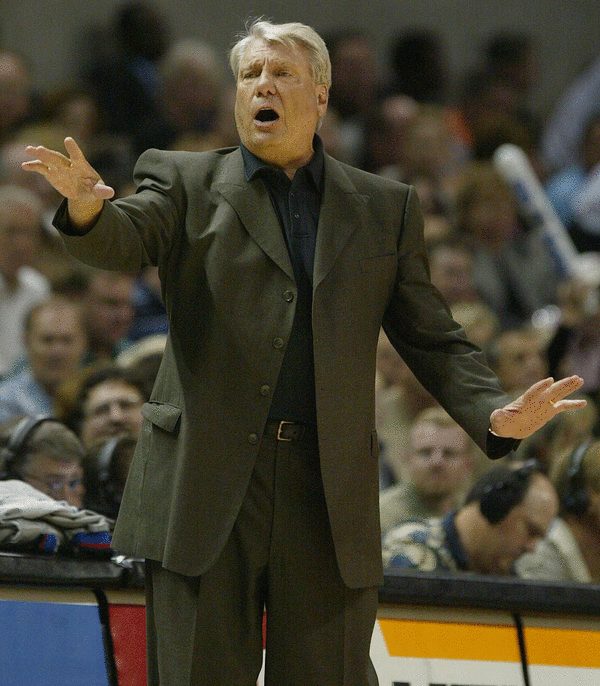
FORT WORTH, Texas — Life and death have a funny way of telling us what matters, because so little of what we do does, but what’s important is that we do it.
On Thursday in Dallas, friends turned enemies turned human beings gathered to celebrate a man whose contributions to a city, and a game, are difficult to quantify. The celebration of life for former Dallas Mavericks general manager and coach Don Nelson, who died on Sunday at age 86, brought a lot of people together who previously might have struggled to be in the same room.
Both Don Nelson’s and his son, Donnie’s, respective contributions to the Mavericks are numerous, and not possible without their former boss, with whom they so famously feuded. The Mavericks aren’t where they are today without Mark Cuban, and Cuban’s time with the team isn’t what it is without Don and Donnie.
There is no Dirk Nowitzki without Don. There is no Luka Doncic without Donnie.
There is some irony here that it’s now Cuban’s “turn” to take issue with, and to court, the current ownership of the Mavericks, something both Don and Donnie did when it was Cuban’s name on the check.
In 2007, Don Nelson sued Cuban for $7.1 million; “Nellie” alleged Cuban would not pay him the deferred compensation because he was upset that Nelson took the head coaching job of the Golden State Warriors. An arbitrator ruled in favor of Nellie.
In 2022, Donnie Nelson sued the team over wrongful termination, which later included some troubling allegations. People close to the situation believed Donnie wanted a greater compensation package because he’s the one who found Doncic; a confidential settlement was reached in 2024.
It’s 2026, Cuban is now a minority owner of the Mavericks, and he sued the team over an alleged lack of transparency regarding the details of the team’s new arena plans. He also alleged there was a violation of a handshake agreement when he sold the team in November 2023 that would have allowed him to remain in control over basketball decisions.
The suit has since been settled; of the mistakes Cuban made in his successful two-decade run as owner of the team, he should have taken a break from running the Mavericks rather than selling them.
Since he sold the Mavericks to Patrick Dumont in November 2023 for $3.5 billion, the valuation of major sports franchises continues its unobstructed rise into the absurd, and it sounds like Cuban really misses his “old job.”
Cuban agreed to a deal that would have allowed him to, basically, be GM. In theory, he would have had the final say on the players and coaches, which, much like Cowboys owner Jerry Jones, is one of the reasons Cuban bought the Mavericks in 2000.
Both men had the money, and interest, to operate their own real-life fantasy sports teams.
Years removed from the sale, it’s hard to believe that Cuban could not see what the late George Steinbrenner did when he was approached about selling the New York Yankees to Charles Dolan, in 1999.
According to New York Post columnist Mike Vaccaro’s new book, “The Bosses of the Bronx,” Steinbrenner was going to sell the Yankees to Dolan for $500 million, which in today’s dollars is $1 billion. The Yankees are currently valued, according to Forbes, at around $9 billion.
The terms of the potential agreement allowed Steinbrenner to be in charge, complete with a seven-figure salary. Minus the salary, it was a similar setup for Cuban’s sale.
“Look who they were talking to. My father knew better than anybody you couldn’t be appointed the boss,” Steinbrenner’s son, Hal, told Vaccaro. “You had to be the boss. If you had to look at a corporate directory to determine who was the boss was, then that’s not really a boss.”
Steinbrenner never sold.
Cuban did, and the influence that he loved so much on his favorite basketball team is gone. Minority owners get a say, but not the last one. It was always implausible to believe that Dumont, regardless of his naïveté to basketball, was going to allow someone else to determine the most important decisions of his franchise.
Of course, that would he proceed to allow his GM, Nico Harrison, to trade the Mavericks’ most valuable asset to the rival L.A. Lakers for essentially what amounts to Max Christie will remain one of the most astonishing basketball decisions of the 21st century.
More than the sale of the team, that deal marked the end of the Mark Cuban era of the Dallas Mavericks.
On Thursday in Dallas, Cuban, Donnie Nelson and so many other important figures in basketball gathered to celebrate a man, Don Nelson, whose arrival to the team in 1997 started the rebirth of the Dallas Mavericks.
However, the way their respective tenures ended no longer matters; what matters is that they all benefited from the other, and what they did ultimately was neither life nor death.
©2026 Fort Worth Star-Telegram. Visit star-telegram.com. Distributed by Tribune Content Agency, LLC.




Comments