Ira Winderman: Ranking Giannis-Bam in Heat power-play pantheon (already at top of NBA?)
Published in Basketball
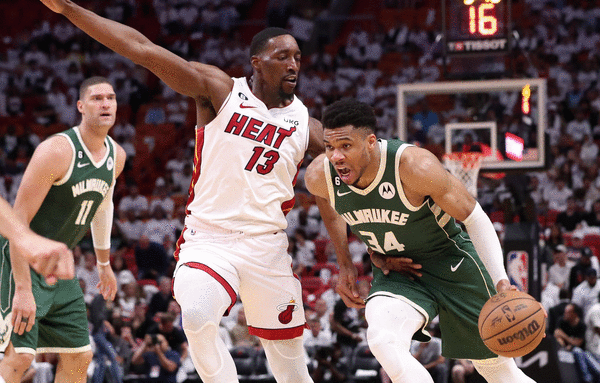
MIAMI — In terms of power play, a case could be made that the Miami Heat have never been better positioned when it comes to the two starters in their power rotation.
With this being the Heat’s 39th season, that certainly says plenty about the expectations with Giannis Antetokounmpo and Bam Adebayo.
Best one-two power punch in the current NBA?
A case certainly could be made for the Heat’s opening power pairing, certainly up there with:
— Denver’s Nikola Jokic-Aaron Gordon
— Philadelphia’s Joel Embiid-LeBron James
— Cleveland’s Jarrett Allen-Evan Mobley
— Boston’s Mitchell Robinson-Jayson Tatum
— Oklahoma City’s Isaiah Hartenstein-Chet Holmgren
— New York’s Karl-Anthony Towns-OG Anunoby
— Detroit’s Jalen Duren-John Collins
— Indiana’s Ivica Zubac-Pascal Siakam
— Golden State’s Kristaps Porzingis-Draymond Green
— San Antonio’s Victor Wembanyama-Tobias Harris
But in most of those cases, the second starter in a power role is more of a career wing, with the limited exceptions of, say, the Nuggets, Cavaliers and Thunder truly playing big-big.
Yet for all the hope of what Antetokounmpo and Adebayo might deliver from a position of power, it’s not as if the Heat haven’t had ample power play to rely upon over the years.
So before looking ahead this season to the Giannis-Bam possibilities, a look back at the previous most noteworthy Heat starting power pairings:
— 1. Chris Bosh-LeBron James (2010-14): No, neither a true center, but also part of how Erik Spoelstra transformed the Heat dynamic during the Big Three era, recognizing that one can only get so far on the championship stage going with the likes of Joel Anthony, Rony Turiaf and an aging Zydrunas Ilgauskas.
So Bosh took his game even further to the perimeter, LeBron took his game into the post, and the quality of the wing rotations was allowed to flourish.
This likely will be the Heat power standard that Antetokounmpo-Adebayo will come to be measured against.
— 2. Shaquille O’Neal-Alonzo Mourning (2004-08): Taking some liberties here, considering O’Neal and Mourning never started together during their two-plus seasons as teammates. But their shared tenure left the Heat arguably with their best-ever 1-2 punch at center.
Re-acquired in March 2005, Mourning provided the Heat with the needed boost during the run to the franchise’s first championship, in 2006, as arguably the Heat’s best-ever backup center, with all due respect to what Chris “Birdman” Andersen later would provide during the Big Three era.
— 3. Alonzo Mourning-P.J. Brown (1996-99): Among the most enduring of the Heat’s power pairings, the two started 241 regular-season games together and 34 Heat playoff games together.
With Brown’s shooting, it provided a needed inside-outside contrast in the power rotation on offense, with both All-Defensive talents on that end of the court.
To a degree, this will be the Heat defensive standard by which the Antetokounmpo-Adebayo pairing will be measured.
— 4. Rony Seikaly-Grant Long (1988-94): Even as the expansion-era losses mounted, Seikaly and Long provided a needed foundation in the power rotation, appearing in 424 games together and starting 280 together.
It was a unique study in contrasts, the graceful scoring and relentless rebounding of Seikaly, and the lunchpail work ethic of Long that was Heat culture long before the Heat started spelling Culture with a capital C.
— 5. Shaquille O’Neal-Udonis Haslem (2004-08): While Mourning was the muscle in reserve of O’Neal during the run to that 2006 championship, it was Haslem who provided the starting stability alongside Shaq.
Together, the two started 197 regular-season games together and all but one of the Heat’s 40 playoff games during their combined Heat tenure (with Haslem suspended for that game).
— 6. Bam Adebayo-Jimmy Butler (2019-2025): Because Butler wanted nothing to do with being classified as a power player, this is a bit of a stretch when it comes to the starting power pairings.
But at moments of truth, including the run to the 2023 NBA Finals against the Nuggets, it often was Adebayo and Butler surrounded by wings and shooters.
By Basketball-Reference’s accounting, Butler spent 83% of his time during the 2022-23 regular season at power forward, then 70% of his time that postseason at power forward.
— 7. Bam Adebayo-P.J. Tucker (2021-22): This in many ways was the long and short of it for the Heat in the Adebayo area, a surprisingly successful pairing with an undersized stretch four in Tucker, who officially was listed at 6-5 by the NBA.
Together the two started 52 games in their lone season together, including all 18 games in the Heat’s postseason run within one victory of the 2022 NBA Finals.
— 8. Brian Grant-Anthony Mason (2000-01): Although a staunch proponent of playing big, Pat Riley had no choice but to go smaller with Mourning sidelined by kidney illness.
Together, Mason (generously listed by the NBA at 6-8) and Grant (6-9) started 77 games together, with the Heat closing a surprising 50-32.
Riley then went back to Mourning as a playoff starter, with the Heat ousted 3-0 in the first round by Charlotte.
— 9. Brian Grant-Lamar Odom (2003-04): This time it was Stan Van Gundy who got creative with an undersized, versatile approach, starting Odom at power forward.
Grand and Odom started 76 games together as the Heat rallied to win 17 of their final 21 regular-season games, with the two also starting all 13 of that season’s playoff games.
— 10. Hassan Whiteside-Chris Bosh (2014-16): On paper this had a chance to be special. Instead, it was a mismatched pairing of a player needing to learn how to win (Whiteside) and one who already had won (Bosh).
The two were 4-6 together as starters in 2014-15, but then improved to 25-16 while starting together in 2015-16 before Bosh was sidelined in February 2016 by blood clots.
©2026 South Florida Sun-Sentinel. Visit sun-sentinel.com. Distributed by Tribune Content Agency, LLC.




Comments