Noah Hiles: Late-season collapses are what the Pirates do best
Published in Baseball
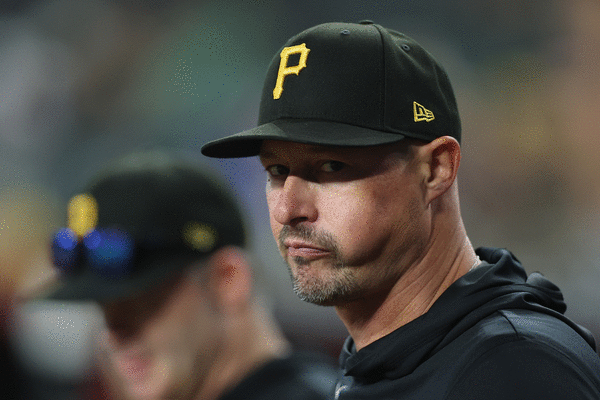
PITTSBURGH — I was really hoping I wouldn’t have to write this column.
While I’ve had my doubts about this Pirates team from the very beginning, there was a part of me that always wanted to see it overcome its obvious flaws. I tried my best to fight that feeling. Although the idea of covering October baseball was thrilling, I had to keep myself grounded.
I remained skeptical throughout the entire first half, maintaining Don Kelly’s club was the definition of average. I thought the Pirates would never survive the injuries they suffered throughout June and July. Yet, somehow, at least temporarily, they did.
As the Pirates remained afloat throughout a slew of adversity, I let my guard down. I started to believe. I’m sure many of you did the same, as well.
Shame on me. Shame on all of us. We should’ve known better.
If you’ve been paying any sort of attention over the past few decades, you’d know this is par for the course. While the baseball world knows this franchise to be nothing more than a perennial loser, those who’ve been along for the ride understand it’s far deeper than that.
Yes, this team loses consistently — more than just about any other North American professional sports franchise. But more often than not, it occurs in excruciating fashion.
No franchise collapses better down the stretch than the Pirates. It’s what they do best.
I know most of you don’t need a reminder, but let’s be honest — if you’re reading this, you’re probably miserable anyway. What’s another punch to the gut at this point?
Since 2010, I can easily think of six times the Pirates got this city’s hopes up, only to stumble well before the finish line.
— 2011: A win against the Atlanta Braves on July 25 lifted the Pirates to 53-47, tying them with the St. Louis Cardinals for first place in the NL Central. The infamous Jerry Meals game happened the following night. That loss marked the first of 12 over their next 13 games. They finished the season 72-90.
— 2012: The Pirates ended Aug. 1 with a record of 60-44. They were three games out of first place and held a wild-card spot. They won just 20 of their 59 remaining contests, finishing 79-83 to secure their 20th straight losing season.
— 2016: A victory on July 27 lifted the Pirates to 52-48 on the year. They were getting hot, having won 14 of their 21 games that month. A team that had reached the postseason in each of the past three seasons was now just 2 1/2 games out of the wild card. They went on to lose five of their next six and finished 78-83-1.
— 2017: In a year when nothing seemed to go right, the Pirates were finally putting it together in late July. A .500 record on the 24th (50-50) was good enough to have them only 2 1/2 games out of first place. They lost six of their next seven games and finished 75-87.
— 2018: No team was hotter than the Pirates that July. Clint Hurdle’s club ended the month with a record of 56-52, thanks in large part to an 11-game win streak that ironically inspired one of the worst trades in franchise history. The Pirates lost six of their first seven games in August and finished 82-79 on the year.
— 2024: A 15-9 run throughout July lifted a young Pirates club to 55-52 heading into the final day of July. Derek Shelton’s team was two games out of a wild-card spot and poised to buy at the trade deadline. The Pirates did buy but also lost 12 of their next 13. They finished 76-86.
There’s still plenty of season left, but I’m more than comfortable enough to say 2026 will be no different. It will be the seventh time in the past 16 years the Pirates let everyone in this city down.
Again, we should’ve known better. The signs were there all along. Poor relief pitching and team defense prevented them from ever building any notable momentum. The lineup was productive, but it was only a matter of time until it hit a collective slump, especially due to the amount of injuries it suffered.
When that time came, the supposed “strength” of the team wasn’t good enough to pick up the slack.
This young starting rotation, the group of top prospects we’ve drooled over for years, proved to be unfit for the long haul. We were told they’d be the ones who’d lead the charge. Right now, it’s a miracle if they reach the sixth inning. Nearly every one of them looks to be running out of gas, most notably the group’s headliner, a man the baseball world once believed to be the best pitcher in the sport. Talk about a disappointment.
Following the trade deadline on Aug. 3, many, myself included, praised the Pirates for the additions they were able to make. They rebuilt a bullpen on the fly and managed to do so without adding much of anything to the payroll. In hindsight, perhaps this past week would’ve gone differently had a few more dollars been available for an additional starting pitcher or a right-handed bat.
Nonetheless, here we are.
The shame of it is this: The 2026 Pirates could’ve been a fun story. The front office made some solid additions over the offseason. They called up the game’s top prospect in the first week of April and extended him to the largest contract in franchise history. Their starting rotation had the tools to be elite, perhaps one of the best units in the sport.
There were concerns, but even the biggest doubters could be convinced they at least had a chance to do something relevant this year. A few things just had to break their way. That just didn’t happen. Once again, the Pirates will be an afterthought come September. Once again, October baseball will be something that doesn’t include the city of Pittsburgh.
As a young millennial, someone who was born in 1995, I can’t help but feel jealous when hearing about successful Pirates teams of the past. The clubs from the 1960s and ’70s are almost too good to imagine. Even the early ’90s teams seem more fable than fact to those of us who weren’t around to experience it.
I simply can’t imagine what it’s like to watch a division-winning Pirates team, so I have to do my own research. I’ve learned quite a bit over the years. One of my favorite discoveries pertains to the 1990 team. That club was the first of three straight division winners in the Jim Leyland era. It had star power. It had swagger. It had the city buzzing — and, perhaps most notably, it had its own theme song.
Real Pirates fans know Ernie Pontiere’s “You Gotta Believe” is an absolute banger, a must listen for nostalgia if nothing else. But it also offers meaningful advice.
The song’s opening lyrics tell us to “remember the heart breaks,” to “remember the tears.” That’s all Pirates fans of today need to hear. The rest of the song — especially the parts where it becomes a positive, uplifting tune — should be turned off.
There’s no reason to believe anymore. Not this year, not in this team. I’ll look like a fool if they prove me wrong and reach the postseason. I dare them to do so because I know it’s not going to happen.
Fans would be better off remembering the heartbreaks and tears from 2011, 2012, 2016-2018 and 2024. That’s what this is. That’s what we’re witnessing again.
The Pirates are simply doing what they do best.
____
© 2026 the Pittsburgh Post-Gazette. Visit www.post-gazette.com. Distributed by Tribune Content Agency, LLC.




Comments