Jim Alexander: What happens now for the Dodgers … and baseball?
Published in Baseball
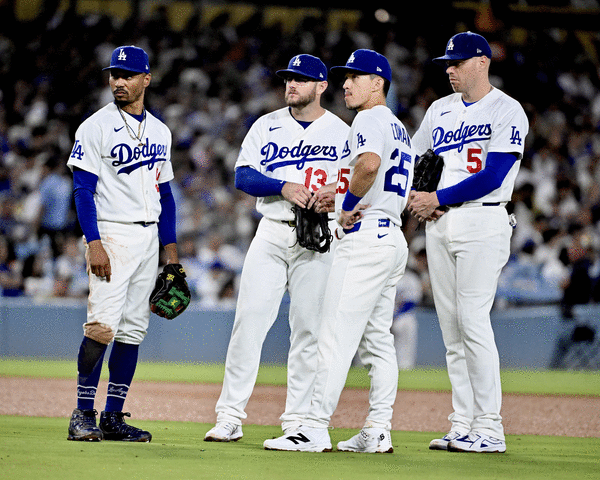
In other years, the answer would be straightforward. The Dodgers were swept out of the postseason, they have multiple free agents on which to make decisions, so what do they do now?
This is, obviously, not other years.
We are staring at a potentially long, bleak baseball winter, with no guarantees or even forecasts about when it will end. We know for a certainty that MLB plans to lock its players out on Dec. 2, the first negotiating tactic in the battle over whether the sport will institute a salary cap, or whether such a financial device is even necessary.
Which is an argument for another day.
But the lockout, which would bar team officials or employees from contact with players and would close all team facilities to the athletes, also would shut down all transactions. That, in turn, creates a shortened window for teams to make moves.
As of Tuesday morning, teams will have 28 days to sign and trade players before that window closes. The winter meetings, scheduled to begin Dec. 7 in San Diego, almost certainly will not take place barring a collective bargaining miracle.
So Dodgers president of baseball operations Andrew Friedman and VP/general manager Brandon Gomes have decisions to make quickly. First up: Do they go to the mat to re-sign Tarik Skubal? He’s the most desirable of their free agents, he’ll command lots of attention from other teams, and he’s a Scott Boras client, meaning that he will be, as the late Don Sutton once quipped, “the most loyal player money can buy.”
Boras’ modus operandi historically has been to let the market play out and the bidding go higher before his guys sign. But with one month before an uncertain future, is that truly the way to go this time?
And, from the other side of the equation, will teams make decisions on signing players now? They would do so with no certainty of what the economic rules will be once an agreement is reached. The last time management locked the players out, in December 2021, there was a last-minute rush to get players signed – some $1.4 billion in contract agreements were reached on Dec. 1, the day before the lockout was to take effect. However, the Dodgers didn’t re-sign Clayton Kershaw, or sign then-free agent Freddie Freeman, until after the 99-day stoppage ended on March 10.
(And yes, I’m writing with cautious optimism – OK, mostly hope – that at some point the sides careening toward this confrontation will quickly realize the absurdity of shutting the game down and will reach an agreement. Worth noting, though: In 2021, a salary cap wasn’t an issue. Now, it’s a management obsession.)
Kiké Hernandez, aka Señor Octubre, is the only position player among the Dodgers’ free agents, since Miguel Rojas has retired and is now working for the Dodgers in a player development capacity. Kiké is immensely popular among the fan base, he’s known for his postseason exploits (thus, the nickname), and he’s considered a good teammate.
But he is also 35 years old, and if an aging team is to get younger, more energetic and more athletic, the utility man might be allowed to go.
The rest of the potential free agents are bullpen pieces, and the view here is that it’s worth the effort to keep Alex Vesia and Evan Phillips, and less so where Kris Bubic, Eric Lauer and Blake Treinen are concerned.
And it’s uncertain whether bringing back Brusdar Graterol is even feasible, given that his last Dodgers mound appearance was in Game 5 of the 2024 World Series. He had only pitched 7 1/3 innings that season because of injuries, and shoulder and back surgeries have kept him sidelined the last two years.
Are the Dodgers reaching a tipping point with the rest of an aging roster? One quick postseason series might be too small a sample size, but within the sweep by the eventual champion Milwaukee Brewers in the National League Championship Series there seemed to be signs that this lineup looked its age.
Freddie Freeman turned 36 in September. Max Muncy is 35, Teoscar Hernandez is 34, Mookie Betts is 33, Will Smith, Shohei Ohtani and Tommy Edman are all 31. The speculation is that Teoscar Hernandez, whose outfield defense has been generally suspect anyway and seemed to have worsened this season, is the most likely to be traded, largely to create a spot for Josue De Paula.
The 21-year-old outfielder, who was promoted from Double-A Tulsa – bypassing Triple-A Oklahoma City – not only had positive moments in his September callup (.323, a home run and seven RBIs in 31 at-bats) but showed serious plate discipline and little if any fear after making the jump from Double-A to the majors.
But is it worthwhile, or even feasible, to consider breaking up this old gang just yet?
“It wasn’t that they were fatigued,” Manager Dave Roberts said after Milwaukee had completed its NLCS sweep. “We have off days going into series. I just don’t think that our age of our ball club reflected this series. We got beat. There’s no because we’re too old or whatever. Every facet of the game, if you kind of unpack it, we were bested.”
And getting swept, and having their shot at a three-peat derailed, might have created more motivation for this nucleus to take another shot at one more ring. (Among other things, a September-October surge might have suggested that they’ll see a better Kyle Tucker, whose production was disappointing for most of last season.)
The other question to be answered might already have been answered. Shohei Ohtani’s determination to remain a two-way player might have backfired late last season, since he was physically compromised going into the playoffs and was not his usual dynamic self because of it.
He has indicated he still intends to both pitch and hit next season. Is that wise? If it interferes with his health will Roberts or Friedman step in and try to discourage him?
Or … well, here’s the bottom line: Will there be a season?
Let’s hope so.
____
©2026 MediaNews Group, Inc. Visit ocregister.com. Distributed by Tribune Content Agency, LLC.




Comments