Could Nick Martinez return? And other questions as Rays look toward 2027.
Published in Baseball
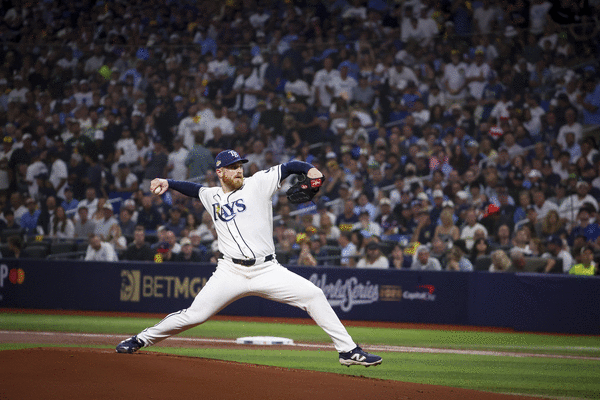
TAMPA, Fla. — With Tampa Bay Rays baseball operations chief Erik Neander and his counterparts from the other 29 MLB teams gathering this week for the GM meetings in Las Vegas — and the traditional winter meetings expected to be canceled due to the looming Dec. 2 lockout — this could be an offseason when deals start happening fast and furious.
The theory, which played out somewhat when this happened in 2021, is that teams would rather do business, especially free-agent signings, under the rules they know (and presumably grandfathered in) by Dec. 1 rather than on the other side of the eventual labor agreement and whatever changes that brings.
If so, Neander said the Rays, even though their season lasted until Game 5 of the World Series on Oct. 28, will be ready.
“We like to go,” he said at Tuesday’s season wrap-up media session. “Our staff does a really good job even this year of having us in a position to kind of know where potential sweet spots in the market might be, what the trade opportunities might be. I don’t think we have a ton of patience. We’re happy to get it all done this afternoon if anyone wants to, for better, for worse.”
From the sound of what Neander said over nearly an hour, the Rays don’t go into the offseason with a particularly long list.
Losing veteran free-agent starters Nick Martinez and Freddy Peralta to free agency — “for the time being,” Neander tossed out — creates a lack of depth in the rotation that likely needs to be addressed externally. The bullpen, as usual, can use an upgrade or two.
The position player group can return mostly intact, with the potential goal to add an impact bat, ideally right-handed, in either the outfield or at second base.
And Neander doubled down on his comments about planning to keep ace Drew Rasmussen after picking up the 2027 option that includes a franchise-record $20 million salary, noting that the team being so good and the amount of young and thus lower-cost players on the roster factored in.
“I think we’re in a position where we can accommodate that and make it work and make another run at this, because our position player group isn’t as expensive as some years,” Neander said.
As a result, he said, “we have a real opportunity to run back this group in as close to its current form as possible and then find the right tweaks to it.”
Perhaps that’s the benefit of hosting eight postseason games (averaging 38,728 fans) or new ownership willing to spend more to build on the momentum heading toward the planned 2029 new stadium. But it would seem the payroll ($85 million on 2026 opening day, around $100 million by season’s end) is likely to grow, perhaps to franchise-record heights, surpassing the 2024 opening day total of $96.6 million.
So, what are the Rays’ three biggest questions?
Is there any shot to bring back Martinez and/or Peralta?
Probably not Peralta, who seems to have regained most of his value as one of the top free-agent starters with his strong showing following his Aug. 2 trade from the New York Mets. Four national media sites doing free-agent projections see him getting at least $110 million over five years; three others predict shorter-term deals but with an annual average value of at least $24 million.
Martinez, though, could be an option pending how the other teams view him. There is no question how much he meant in the Rays clubhouse, Neander saying, “Just a tremendous, tremendous talent, tremendous human. This year was an absolute blast, and he deserves as much or more credit than anybody, any singular force for that. And that’s not lost on us.”
Martinez seemed to have mutual affection for the team and staff, saying after the Game 5 loss, “Love it here. It’s been great. Love the guys. Love the organization.”
It’s an interesting situation, given he’s coming off a career-best season at age 36 where he made $13 million after making $21.05 million in 2025 with the Cincinnati Reds. The national projections are widespread, from $17.5 million for one year (espn.com) to $44 million over two (Sportsnet.ca).
Could a two-year deal to stay with the Rays and in his home (and income tax-free) state for $32 million-$34 million work?
Neander, for his part, wouldn’t rule anything out.
“When you’re as close as we were to getting over the hump, the Nicks, the Freddy Peraltas, you wouldn’t mind running it back with those guys,” Neander said. “So we’ll see what happens.”
What does the rotation look like now?
Ryan Pepiot (who missed all of 2026 following May hip surgery) and Shane McClanahan (who threw 118 innings in his first action since August 2023 but was shut down in early September) are fully healthy and will be joined by Griffin Jax (who transitioned from reliever to starter in April), Ian Seymour (who bounced between the bullpen and rotation) and, from what Neander said of having “every intention right now” of keeping him, Rasmussen.
“Those are five that we feel really good about,” Neander said.
But that seems a little light, given Seymour’s home run issues (29 allowed in 142 2/3 regular season and postseason innings), the standard uncertainty accompanying returns from injury, Jax and Rasmussen coming off career-high workloads, the uncertainty of when spring training will start and how long it will be, and the usual need for depth.
Also a factor: Jax and McClanahan are headed into their final seasons before free agency, which normally would make them trade candidates. Especially with hefty projected raises via arbitration — Jax to $5.7 million, McClanahan to $6.6 million.
For internal options, the Rays could shift prospects Brody Hopkins and/or Ty Johnson back to starting after getting them to the majors in September as relievers.
If they go outside, the question is whether to sign a veteran on a short-term deal or seek to trade for a controllable young starter.
So, what position player changes might they make?
They don’t really need to do much, as the group they have returning is pretty good, relatively young, fairly athletic and, as Neander pointed out, not very expensive.
After designated hitter Yandy Diaz at $13 million, the next highest-paid position players are first baseman Jonathan Aranda (projected to make $4.1 million via arbitration by mlbtraderumors.com), backup catcher Nick Fortes (projected at $3.4 million) and shortstop Taylor Walls ($3.1 million). Given the progress of prospects Caden Bodine and Kenny Piper, they could survive without Fortes and his salary.
Ideally, an impact right-handed bat at second base seems like the best fit, but that guy may not be out there. Including lefties, after the high-end free-agent options (anyone know anything about this Brandon Lowe guy?) there isn’t much else. Among top trade options, the price for Nationals star CJ Abrams is likely exorbitant. Ketel Marte, given his past clubhouse issues in Arizona, could be a risk to the Rays’ good culture and vibes.
With Cedric Mullins a free agent, the Rays could upgrade in the outfield, targeting a complementary right-handed hitting piece — maybe someone like Tyrone Taylor — to join the core group of Chandler Simpson, Jonny DeLuca and Victor Mesa Jr.
“Ideally, we find a way to create a few more favorable matchups for us against left-handed pitching,” Neander said.
Their priority, copying from the World Series champion Brewers, is to focus on continuing to develop their own young players, Neander said. “If we do that well, then this is going to be a very, very good club and it’s probably a little more about how do you supplement and how do you polish it, how do you find the right players.
“Obviously, anytime you can get your hands on impact talent — don’t get me wrong, those are calls and efforts we will happily make. But it’s not lost on us what we have and what’s coming back. It’s a heck of a starting point. We need to make sure that’s as ready to go as possible.”
____
©2026 Tampa Bay Times. Visit tampabay.com. Distributed by Tribune Content Agency, LLC.





Comments