US fuel exports to Cuba's private sector reach $96 million amid island's energy crisis
Published in News & Features
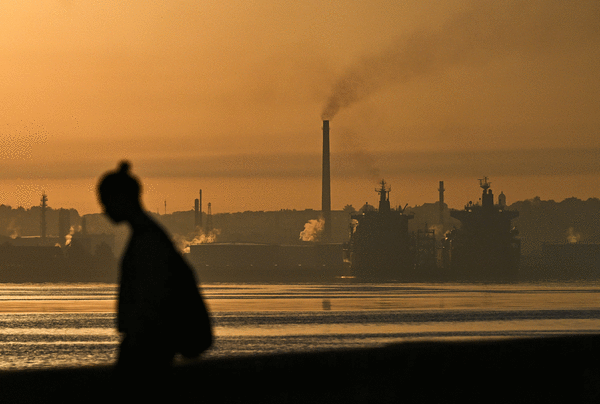
Amid a crippling energy crisis in Cuba, U.S. companies have exported about $96 million in fuel to the island’s private sector in the first half of this year while the Trump administration has cut off oil supplies to the island’s government, according to U.S. port data.
According to the data compiled by the U.S. Cuba-Trade and Economic Council, most of the imports are gasoline and diesel shipped from Miami and Houston in special containers known as ISO tanks that can go aboard ships.
Fuel exports to Cuba ramped up after the Trump administration relaxed the trade and financial embargo against Cuba to authorize sales of gasoline and diesel to the island’s private sector and humanitarian organizations without the need for a special authorization. In June alone, Cuban private entities imported $47,842,674 worth of fuel.
The current regulations authorize fuel exports to private enterprises or individuals for individual use or economic activities, “including for addressing humanitarian needs in Cuba.” The regulations strictly prohibit selling to the government, state-run entities and individuals under U.S. sanctions.
The fuel has allowed private entrepreneurs and other organizations to weather the island’s worst energy crisis in decades. Private entrepreneurs importing fuel from the United States have been supporting the logistics to distribute the humanitarian assistance sent by the U.S. government to Cubans on the island.
The country is plagued with blackouts that can extend for days because of the lack of generation capacity and the poor state of the Soviet-era power stations. The country’s entire electrical grid has collapsed several times this year, including this past Sunday.
Compounding the problem is a de facto blockade the Trump administration has imposed on oil sales to the Cuban government in an effort to pressure it to enact economic and political reforms. The Cuban government says the lack of fuel has also affected electric power because it prevents the use of backup diesel generators.
Adapting to the new reality, Cuban authorities have authorized concessions to private importers to operate gas stations on the island. But some private entrepreneurs are seeking guidance from the U.S. to avoid running afoul of sanctions against Cuban energy company Cupet and the military conglomerate GAESA, whose subsidiary CIMEX runs the gas stations. The prohibition to sell to the government and sanctioned individuals would make compliance very difficult for private entrepreneurs running a gas station.
In June, the Trump administration blocked a deal that Coral Gables company Vanguard had struck to send fuel to Cuba’s private sector on oil tankers because it involved storing the fuel in Cupet facilities.
The fuel shortage has almost halted public transportation on the island. The government has rationed fuel sales, and on the black market a liter of gasoline sells for as much as $10.
Other data compiled by the economic council shows that U.S. exports to Cuba in general have decreased 10% as of June compared to the same period last year, amid the island’s severe economic contraction.
Exports of food and agricultural products, which are authorized under the U.S. embargo, fell 22% in the first six months of this year, compared to the same period in 2025. The council’s president, John Kavulich, links the decline to a decrease in sales to the Cuban government. But authorized exports to the private sector continue to grow, he pointed out, including the sales of vehicles and parts worth $72 million so far this year as of June.
At the same time, humanitarian donations by charities, churches, non-governmental groups and others have amounted to $118.5 million in the first six months of this year, compared to $147 million in all of 2025. For comparison, in 2016 that number was $4.7 million.
_____
©2026 Miami Herald. Visit miamiherald.com. Distributed by Tribune Content Agency, LLC.






Comments