Army blows up 5 tons of chemicals in controlled explosion in Iowa, calls detonation a success
Published in Science & Technology News
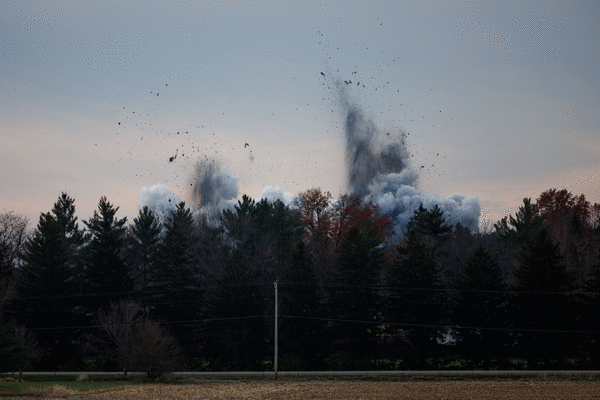
OQUAWKA, Ill. — From their home on a bluff overlooking the serene Mississippi River, Shirley and Jim Brown looked in the direction of Middletown some 20 minutes before the U.S. Army detonated 5 tons of toxic lead azide at an Iowa ammunition plant Wednesday morning.
“I think we’ll hear it more than see it,” Shirley Brown told the Tribune over the faint chatter of morning television.
Shortly after 9 a.m., nothing was visible or audible from the bluff in Oquawka. On U.S. Route 34 near Middletown, two loud bangs in quick succession were followed by thick white smoke and flying debris.
According to The Associated Press, the Army blew up the nation’s entire stockpile of lead azide. Officials had advised people nearby to be ready to evacuate to avoid toxic dust in the air but also sought to assure them that barriers around the blast zone should limit much of the plume.
Adam Telle, acting secretary of the Army, in a post on X, called the operation a huge success, noting that officials are continuing to monitor EPA sensors. “The threat of an uncontrolled spontaneous detonation has been eliminated,” Telle said.
In a neighborhood in Middletown, shortly before 11 a.m., a woman with a local emergency agency and a man in an Army uniform walked door to door, asking people if they were all right. When asked how the detonation went and if all military personnel were OK after the blast, the woman told a Tribune reporter, “Everyone is accounted for.”
Close ties to Iowa
Between Monmouth in Illinois’ Warren County and Oquawka, which is northeast of the detonation site, farm fields extend as far as the eye can see. Some cows dot the landscape, grazing outside. Frost has formed on corn stalks as morning temperatures stay below freezing.
The Browns, who have been married for 42 years, moved back to her hometown, a city of over 1,000 people in Henderson County, a few weeks ago.
She said she wasn’t too worried, even when it was initially slated for Friday and winds would’ve blown the dust their way.
“They gotta do it. They have to do it,” Shirley Brown said. “We’ll d eal with it.”
Environmental advocates and Illinois officials have criticized the detonation plan for a lack of transparency and for being moved along too quickly for a problem the Army knew about for eight months.
In a statement posted Wednesday morning on X, Democratic U.S. Rep. Mike Quigley, who represents Illinois 5th District, said: “... it is unfair that our military leaders are releasing 9,500 pounds of unstable lead azide on our friends in Iowa the day before Thanksgiving. Controlled detonations are not uncommon, but scheduling it with little warning and communication regarding the risks is unconscionable.”
After the blast, the Federal Emergency Management Agency said residents within 20 miles of the site should remain sheltered in place. Oquawka is right on the edge of that radius, local resident Laura Lewis pointed out. She sat on the passenger seat of a white truck parked on the bluff by the river, where she and her partner were hoping to catch a glimpse.
Ten minutes after the explosion, not having seen or heard anything from their vantage point, they drove away — “we’re headed straight home,” she told the Tribune a few moments before 9 a.m.
“I’m freaked out over here,” Lewis had said. “And you think about the river and wildlife and the health of people.”
But now that public outcry over the last few days means more people are watching, she said she feels there are more mitigating steps in place.
“I’m glad we at least got it delayed from Friday,” she said. Children are home from school for the holiday and can stay indoors.
Scott Lox, Lewis’ partner, said he did road maintenance at the plant years ago. With a planned expansion of the facility, which the Army broke ground on this past July, the agency finally said ‘let’s take care of the problem we’ve ignored for so long,’ ” Lox said.
“The whole thing is a superfund site anyways,” he added.
Further south on the eve of the detonation, a group of men had gathered around the bar inside the Landing at Dallas City, a restaurant on the Illinois side of the Mississippi River.
They discussed how the Army’s plan and its delays have affected them in recent days — even 13 miles as the crow flies southeast of Middletown — as well as the shifting weather forecasts and official modeling of the path of a toxic lead plume that the detonation might cause.
“Everyone who lives around here knows someone who works there” at the plant, said Dustin Detherage.
The school board president of nearby La Harpe, a city of over 1,000 people, Detherage said the district canceled school Monday and Tuesday after the first delay, as winds could’ve blown lead dust right into the area.
Then the detonation was rescheduled again for 9 a.m. Wednesday, which the students already had off for Thanksgiving.
“It’s so frustrating,” Detherage said. But the material needs to be disposed of: “They have to do it. They have no choice. That’s not even the worst thing buried there.”
Detherage was referring to the ammunition plant’s former use in the development and testing of nuclear weapons between the 1940s and 1975.
Army officials called a controlled detonation “the only viable method to permanently eliminate the hazard” in a Tuesday news release, echoing earlier statements that the lead azide, which is used as an explosive to trigger bombs and rockets, is too unstable — and that below-freezing temperatures threaten to cause it to explode on its own.
Next to Detherage, Rusty Dowell, a commercial truck driver from nearby Lomax, listed the stops on his Wednesday route in Iowa: Starting in Burlington just east of Middletown, arriving at Fort Madison at around 9:45 a.m., which is right downwind of the detonation site, and then 30 miles west to Bonaparte. When asked whether he was concerned about his safety, he shrugged.
“I’ll just turn the heat off,” he said. Drivers in the area have been advised to limit travel, avoid affected locations and use vehicle air recirculation.
Over beers, the Illinoisans seemed in good spirits and ready to deal with the aftermath.
Detherage, for one, has already made sure the La Harpe Fire Protection District will hose down the school after Wednesday.
Ongoing monitoring
The EPA reported that it has collected more than 1,200 air, soil and water samples and would have more than 300 staff members at the site Wednesday.
“Before, during, and after detonation, EPA is fully tackling our sampling and monitoring mission on behalf of all local families and communities,” the EPA’s Tuesday statement said. “To whatever extent necessary, we are just as prepared to jump on any environmental remediation work as well.”
At Arrow Café, a cozy diner in downtown Oquawka, cook Joanie Harpes was one hour into her double shift when the detonation occurred.
“We didn’t feel anything, we didn’t smell anything, we didn’t see anything,” she said. A single waitress, Debra Bailey, said they wouldn’t have known it had already happened if it weren’t for the news on TV.
Bailey said the café was initially not going to open Wednesday, but some employees did not want to lose a day’s worth of their salary.
“I need the money,” Harpes said, citing recent car troubles. She is doing a 12-hour shift Wednesday since the other cooks can’t come in — one is worried about her health, the other is staying home with her husband, whose construction company near Middletown gave them the day off.
Bailey said “everyone’s been worried” about the detonation. But the diner was only slightly less busy than normal — down three tables, give or take. Earlier in the morning, she had already waited on a group of area farmers who regularly come in before work. At 11 a.m., more clients trickled in, and she warmly greeted them all by their first names.
It was a mostly normal day in the small border city.
—Chicago Tribune’s Finnegan Belleau contributed. Adriana Pérez reported from Oquawka and Dallas City and Armando Sanchez from Middleton, Iowa.
____
©2026 Chicago Tribune. Visit at chicagotribune.com. Distributed by Tribune Content Agency, LLC.






Comments