With Iowa detonation imminent, Illinois residents ready to deal with aftermath
Published in Science & Technology News
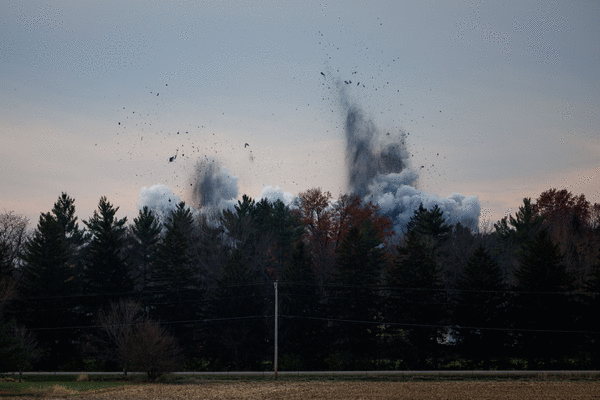
DALLAS CITY, Illinois — On the eve of a planned detonation of almost 5 tons of lead azide at a U.S. Army ammunition plant in Iowa, a group of men gathered around the bar inside the Landing at Dallas City, a restaurant on the Illinois side of the Mississippi River across the state line.
They discussed how the Army’s plan and its delays have affected them in recent days — even 13 miles as the crow flies southeast of Middletown, Iowa, where the base is located — as well as the shifting weather forecasts and official modeling of the path of a toxic lead plume that the detonation might cause.
“Everyone who lives around here knows someone who works there” at the plant, said Dustin Detherage.
The school board president of nearby La Harpe, a city of over 1,000 people, Detherage said the district canceled school Monday and Tuesday after the first delay, as winds could’ve blown lead dust right into the area.
Then the detonation was rescheduled again for 9 a.m. Wednesday, which the students already had off for Thanksgiving. As of Wednesday morning, modeling showed little to no impacts in Illinois as light winds are blowing southwest.
On Facebook, the school district posted about the canceled classes, citing “an abundance of caution” and “the lack of definitive information” regarding the date and time of detonation. ”
“It’s so frustrating,” Detherage said. But the material needs to be disposed of: “They have to do it. They have no choice. That’s not even the worst thing buried there.”
Detherage was referring to the ammunition plant’s former use in the development and testing of nuclear weapons between the 1940s and 1975.
Army officials called a controlled detonation “the only viable method to permanently eliminate the hazard” in a Tuesday news release, echoing earlier statements that the lead azide, which is used as an explosive to trigger bombs and rockets, is too unstable — and that below-freezing temperatures threaten to cause it to explode on its own.
The U.S. Environmental Protection Agency said in a Tuesday news release that it had collected more than 1,200 air, soil and water samples and will have more than 300 staff members at the site Wednesday.
“Before, during, and after detonation, EPA is fully tackling our sampling and monitoring mission on behalf of all local families and communities,” the statement said. “To whatever extent necessary, we are just as prepared to jump on any environmental remediation work as well.”
Another one of the men sitting at the Dallas City bar, who charters boats, said he is set to lose over $1,000 after clients coming in from Peoria canceled their Wednesday visit due to safety concerns.
Next to Detherage, Rusty Dowell, a commercial truck driver from nearby Lomax, listed the stops on his Wednesday route in Iowa: Starting in Burlington just east of Middletown, arriving at Fort Madison at around 9:45 a.m., which is right downwind of the detonation site, and then 30 miles west to Bonaparte. When asked whether he was concerned about his safety, he shrugged.
“I’ll just turn the heat off,” he said. Drivers in the area have been advised to limit travel, avoid affected locations and use vehicle air recirculation.
Over beers, the Illinoisans seemed in good spirits and ready to deal with the aftermath.
Detherage, for one, has already made sure the La Harpe Fire Protection District will hose down the school after Wednesday.
____
©2026 Chicago Tribune. Visit at chicagotribune.com. Distributed by Tribune Content Agency, LLC.






Comments