AI companies look to the ocean as a place to put more data centers
Published in Science & Technology News
The artificial intelligence boom is driving unprecedented demand for data centers, raising concerns about their growing energy consumption, water use and carbon footprint. These challenges are making companies look beyond traditional land-based data centers.
Some developers are now exploring the ocean as a new location for AI infrastructure in the hopes that underwater data centers could improve energy use and cooling efficiency while using less fresh water and land area than onshore buildings.
My research focuses on the societal, organizational and environmental implications of emerging technologies, particularly artificial intelligence and the digital infrastructure – including data centers – that supports its development and deployment. I see underwater data centers as a promising new approach for supporting the growth of AI.
But moving servers into the ocean does not make other underlying environmental challenges such as energy consumption and carbon emissions disappear. And it creates new concerns about harm to the marine environment, as well as questions about how these data centers can be regulated – and how companies can maintain and expand them if needed. Whether underwater data centers can become sustainable alternatives to traditional data centers depends on solving these economic, technical and environmental problems.
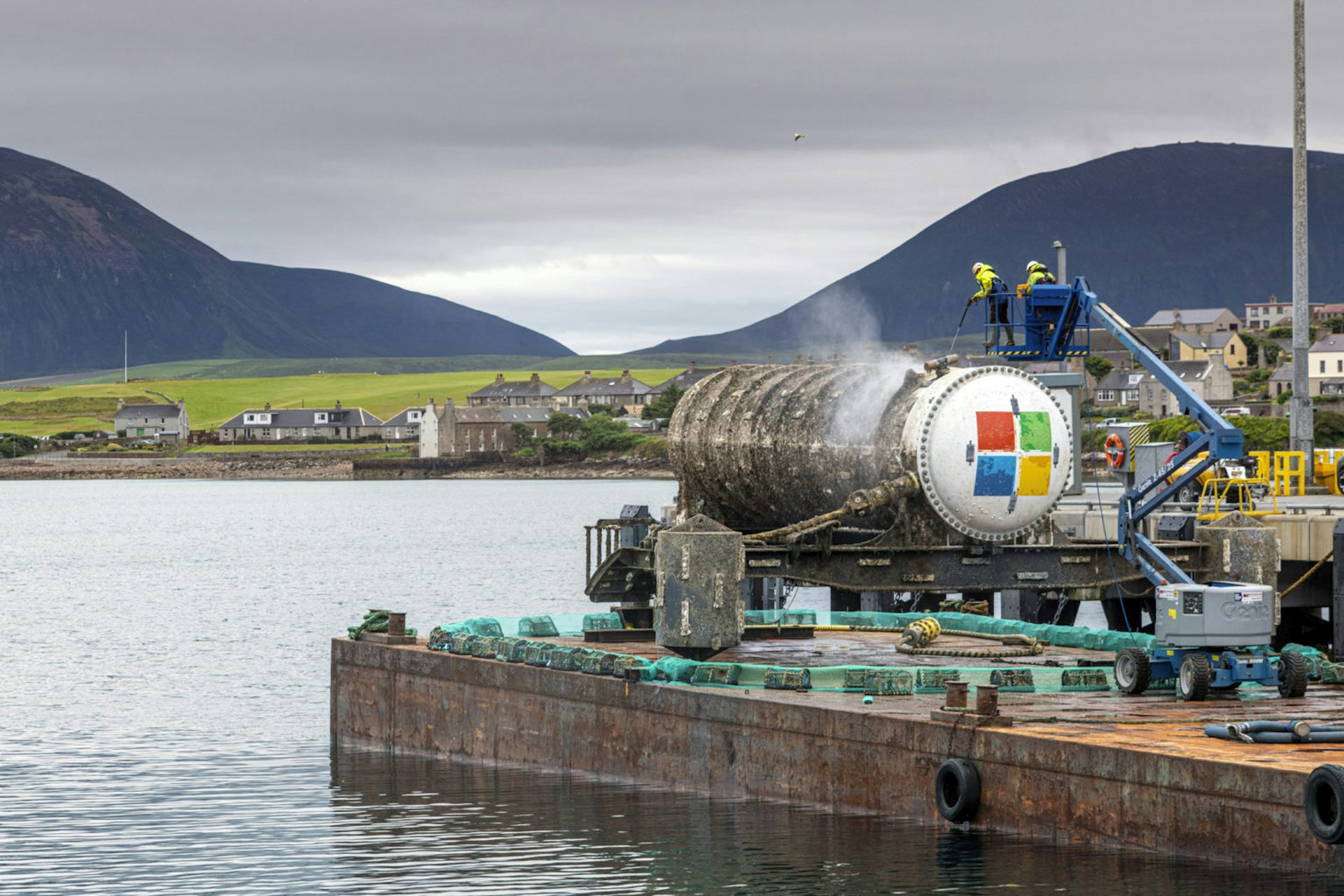
In 2015, Microsoft launched a research project to explore the feasibility, benefits and challenges of underwater data centers. Part of that effort included setting up a waterproof data center on the seafloor near Scotland’s Orkney Islands in 2018. It contained 864 servers and was connected to shore by an underwater cable.
After two years, Microsoft reported that the servers in the underwater data center failed at about one-eighth the rate of servers in comparable land-based data centers. The company is still studying the possible reasons but hypothesizes that in a sealed underwater environment the equipment is less exposed to oxygen, humidity and temperature fluctuations – as well as less jostling from people working to replace broken components.
However, Microsoft ended the project in 2024 and chose not to build more underwater data centers. The company didn’t say why, but others’ analyses suggest the reasons could include regulatory concerns, including the need for environmental permits, as well as a desire for faster upgrades and replacements for the computer equipment inside.
Instead the company has focused on land-based data centers, which can be larger and easier to expand, and also easier to access to repair or replace equipment.
Others have moved ahead, though. China built what may be the world’s first wind-powered underwater data center in Shanghai. The facility launched in June 2025 and began full commercial operations in May 2026.
The US$226 million project uses seawater as a coolant rather than have to refrigerate fresh water, reducing the electricity required to cool the computers. It uses at least 30% less electricity than traditional data centers, and offshore wind turbines reduce reliance on fossil fuels and cut the data center’s carbon emissions.
Japan is testing a different approach: Data centers housed in containers on floating platforms at sea can use seawater for cooling, have unobstructed conditions for solar panels and wind turbines, and reduce demand for land. In 2025, a data center in shipping containers opened on a floating platform near Yokohama. Its power comes from solar panels installed on the same floating platform, with batteries providing energy storage. The test will continue through March 2027.
Singapore is also moving toward commercial-scale floating data centers. In 2026, infrastructure company Keppel began building a four-story floating data center, scheduled to open in 2028. The project will use seawater for cooling, reducing reliance on treated water and improving cooling efficiency. And the fact that it floats means it won’t take up any of Singapore’s limited land availability.
In 2025, Ulsan, South Korea, began planning an underwater data center that could house more than 100,000 servers and use 30% less power than land-based centers by using seawater for cooling.
In Maine, DeepGreen Western Passage has proposed a submersible AI data center in the Bay of Fundy, powered by tidal turbines designed to harness the area’s strong tidal currents.
Land-based data centers could also take advantage of seawater cooling. In Portugal, the SIN01 AI data center in Sines uses seawater from the Atlantic to cool its servers before returning it to the ocean.
These various approaches offer ways to reduce demand for grid-supplied electricity for powering data centers’ computers and cooling equipment, as well as using less fresh water.
The distance from people’s homes could also be an advantage for data centers in or on the ocean. A Gallup poll in March 2026 found that 70% of Americans oppose building AI data centers in their communities. However, more than half of the world’s population lives within 120 miles of a coast. Underwater could be another way to keep data centers physically close to users for speedy service.
Maintenance, though, is a major challenge. If a computer fails underwater, it cannot be repaired or replaced on site. The entire sealed data center module may need to be brought to the surface, even if just one computer needs work.
The main environmental concern about ocean-based data centers involves the seawater used for cooling. Discharging warm or hot water can potentially affect oxygen levels, pH and marine life in the surrounding waters.
That heat is already apparent at the few seaborne data centers now operating. HiCloud, the engineering contractor for China’s Hainan underwater data center, has reported a temperature increase of less than 1 degree Celsius (1.8 degrees Fahrenheit) in the seawater near the facility. SIN01 in Sines, Portugal, also returns seawater about 1 C warmer.
Many marine species depend on stable water temperatures for breeding, feeding and migration, raising concerns that heat released by multiple underwater data centers could create localized thermal pollution and alter marine ecosystems. And the ocean is already under pressure. UNESCO, the United Nations agency for international cooperation, including in conservation, estimates that about 60% of marine ecosystems are already degraded or used unsustainably.
The ocean is already warming along with the atmosphere, without additional waste heat from data centers. That additional heat is already threatening coral reef and mangrove ecosystems, seagrasses and other aspects of the marine food web. As that warming continues, ocean waters will be less useful for cooling electronic equipment in some regions.
Underwater data centers could help AI grow while easing some of the pressure on land, energy and water. But the real test is whether the ocean can become AI’s next computing frontier without becoming its next environmental problem.
This article is republished from The Conversation, a nonprofit, independent news organization bringing you facts and trustworthy analysis to help you make sense of our complex world. It was written by: Nir Kshetri, University of North Carolina – Greensboro
Read more:
How Pennsylvania towns are protecting themselves from the noise, heat and utility costs of massive data centers
Building data centers in space is an intriguing idea on paper, but major engineering challenges must be solved
Data centers consume massive amounts of water – companies rarely tell the public exactly how much
Nir Kshetri does not work for, consult, own shares in or receive funding from any company or organization that would benefit from this article, and has disclosed no relevant affiliations beyond their academic appointment.







Comments