As Las Vegas grows, Clark County looks to protect its burrowing owls
Published in Science & Technology News
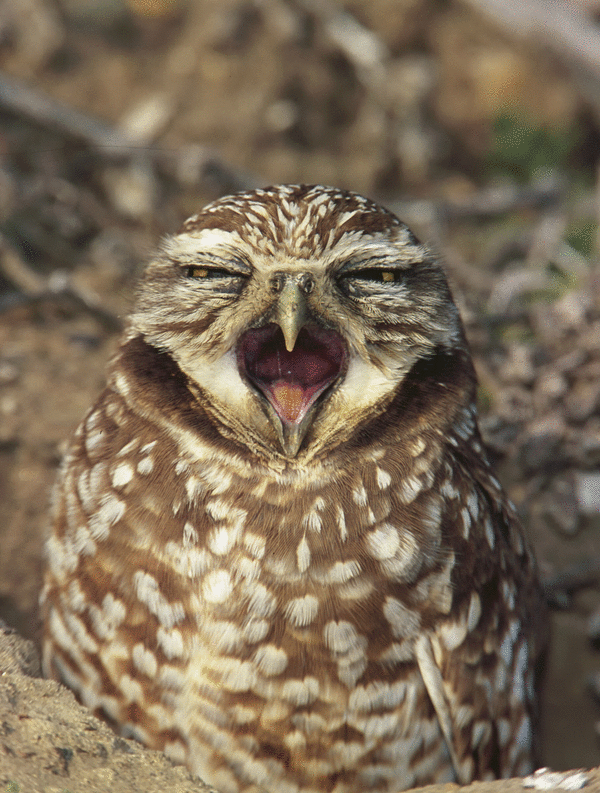
Before Rick Walker retired and became an owl monitor at the Rainbow Owl Preserve in the northwest valley, he was a dentist in New Orleans.
Walker said there’s a common thread between the two pursuits: watching his patients and the western burrowing owls grow up.
“It was great because you got to see families grow up,” he said. “Same thing. People pass away, you wind up treating the kids as adults and they have kids. It’s nice.”
Walker has spent years documenting burrowing owls at the Rainbow Owl Preserve, which sits on six acres across two lots near Jo Marcy Drive and Rainbow Boulevard, and has watched the landscape around them change dramatically. As development pushes farther into the desert, habitat loss has contributed to declines in western burrowing owl populations across the valley.
Matt Flores, a biologist at the Nevada Department of Wildlife, pointed to data from a continent-wide breeding bird survey demonstrated an estimated decline in burrowing owl populations of about 35% between 1970 and 2014.
More locally, Flores said the Las Vegas Valley has expanded into places where burrowing owls reside, leading “predictably” to a loss of habitat.
Walker has seen this phenomenon firsthand.
“It’s just because of the sprawl of Las Vegas,” Walker said. “That’s what’s happening all over.”
Clark County is taking steps to address the issue. In March, the Clark County Board of Commissioners voted to include burrowing owls in its amendment to the Multiple Species Habitat Conservation Plan. Commissioners approved the submission of the MSHCP amendent for federal review on Tuesday. The amendment would take effect in 2031.
Kimberley Goodwin, principal environmental specialist for the Clark County Desert Conservation Program, said that under the proposal, developers would be required to conduct preconstruction surveys and use passive relocation techniques to move the owls away from project sites.
These guidelines are intended to protect owls and help developers by providing “certainty in the process for moving forward with development activities,” Goodwin said.
The western burrowing owl is not listed as a protected species under the Endangered Species Act, but it is protected under the Migratory Bird Treaty Act. Goodwin said uncertainty over how federal protections are interpreted can create challenges for developers, which county officials hope to address by establishing a clear process for identifying owls before construction begins.
“By covering it under the MSHCP, we have an identified process up front where properties that are slated for development will be cleared in advance so there’s no interruptions to their development schedule and there’s no surprises when somebody reports that there’s an owl present after development has already started,” Goodwin said.
Still, some have questioned whether the new requirements would create additional burdens for builders.
At the March board meeting, Commissioner April Becker expressed skepticism about the protections and said she wanted to ensure that developers were able to voice their opinions about the proposal.
“It’s more than just permitting, it’s slowing down development, it’s slowing down their worksites — it puts everything on hold,” Becker said.
According to Goodwin, developers were part of the work group that devised the proposed amendment to the MSHCP and most supported including burrowing owls in the conservation plan.
She added that the surveys would generally be completed at the same time as desert tortoise clearance surveys, minimizing additional costs.
In a statement, the Nevada Builders Alliance said it supports “practical, science based conservation” that balances wildlife conservation with the need for new housing.
“Clear, predictable requirements and early coordination are key to avoiding unnecessary delays and costs,” the statement read.
In addition to requiring preconstruction surveys, Goodwin said the county is looking to establish new conservation areas for the species, like the Rainbow Owl Preserve.
Walker said the preserve was established by a couple seeking to maintain land for burrowing owls near Gilcrease Orchard, a 70-acre nonprofit farm, before the surrounding area was developed for housing.
According to Goodwin, the county has applied for funding to buy the preserve under the Southern Nevada Public Land Management Act.
The preserve is an ideal habitat for the owls, in large part because of its proximity to the orchard, Walker said.
“It has lots of insects and rodents and it’s got hundreds of gophers and squirrels and all sorts of stuff,” he added. “It’s like living next to Costco.”
Scattered throughout the preserve, there are several artificial burrows: three-foot deep pipes with entrances that are covered with rocks and branches. Walker said these are necessary because the owls are unable to build their own burrows.
Some owls decorate their burrows with bones, feathers and shiny human trash. They’re diurnal, meaning they operate in the daytime, and often perch near their burrows for hours. Walker affectionately described them as the “couch potatoes of birds.”
“They’re amazingly cute to look at,” Walker said. “They have an awkward kind of comical walk. They’re very endearing.”
_____
©2026 Las Vegas Review-Journal. Visit reviewjournal.com.. Distributed by Tribune Content Agency, LLC.





Comments