Increased 'gunk' in Boise River led to Dept. of Environmental Quality testing. It's 'rock snot.' Huh?
Published in Science & Technology News
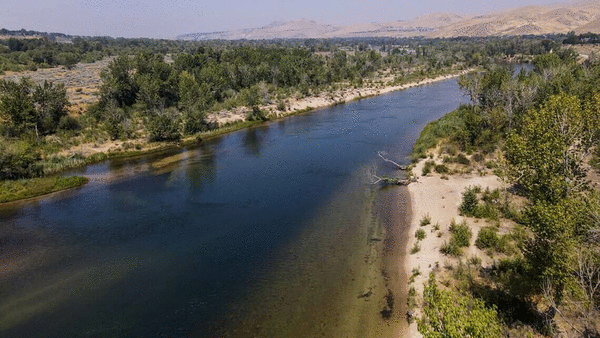
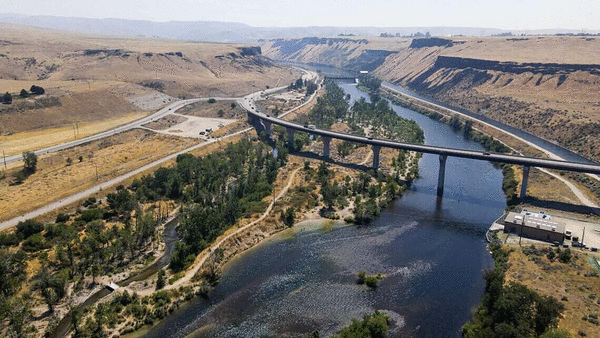




Chandler Bondurant fly-fishes in the Boise River every day, but since the first week of July, the only thing he’s caught is slime.
“It’s pretty much unfishable in town,” Bondurant told the Idaho Statesman.
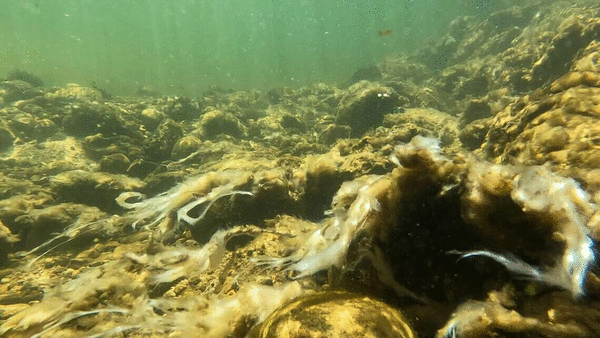
As soon as he casts his line, brown globs floating through the water get caught on his hook and the knots in his line. “If you are standing in the river and you pay attention, you’ll see that there are little pieces of gunk just consistently floating through, and it doesn’t stop,” he said.
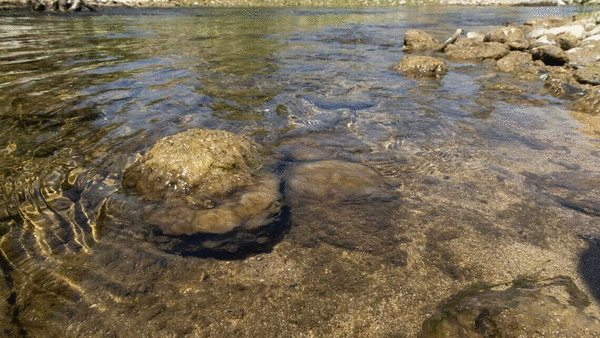
Even when walking around in the river, Bondurant was alarmed to find that in some areas, “when you step on them, it just explodes with this algae stuff.”
He posted about the issue on Reddit and spoke with other people who had been regularly fishing and swimming in the river near downtown Boise for decades, and many agreed that something was off.
One commenter mentioned that the gunky conditions were reminiscent of a river in Colorado overrun by didymo, an algae that can form thick mats, making the water unpleasant for fish, animals and people.
Hoping that wasn’t the case, Bondurant gathered his photos of the bothersome clumps and contacted the Idaho Department of Environmental Quality.
DEQ spokesperson Nick Schofield confirmed that the agency “received multiple calls and notices regarding the river gunk.” DEQ sent staff to investigate and sample the water at four Boise River sites: the Ann Morrison floating takeout, Barber Park, Barber Pool and the Beaver Dick fishing access near State Highway 21 and the Diversion Dam.
In a statement this week, DEQ delivered the results: “Didymo was observed at all four locations, with mats covering portions of the riverbed from Barber Park upstream.”
The dangers and debates surrounding didymo
Didymosphenia geminata is a diatom — a unique single-celled algae species with cell walls made of glass. Commonly referred to as didymo or the less-lovely moniker “rock snot,” this algae thrives in cold, low-nutrient freshwater environments with plenty of sunlight. Individual cells excrete stalks that stick to submerged rocks and, despite its slimy appearance, typically feels like wet wool.
In small quantities, didymo is harmless. The problem begins when it blooms, rapidly producing a large amount of biomass that can form dense, suffocating mats. In its statement, DEQ said that based on observations, “the Boise River is experiencing a significant didymo bloom.”
What exactly triggers these blooms is still an active area of research and debate, according to Brad Taylor, associate professor at North Carolina State University and investigator at the Rocky Mountain Biological Laboratory. Taylor explained that the earliest prevailing theory, put forth in a 2009 paper titled “On the Boots of Fishermen,” suggested that blooms were the result of didymo introduction into new areas by contaminated fishing gear, particularly felt-soled waders.
That paper also suggested that low levels of phosphorus could trigger the invasive algae to bloom.
Since then, the discovery of didymo blooms in water with high levels of phosphorus and in streams too small or remote to have been fished has made it clear that other factors are at play, said Taylor. “With didymo I think we are seeing a change in growth-form for reasons we do not fully understand,” he said.
Didymo in its nonblooming form occurs naturally in more water bodies than previously thought, and is native to the Intermountain West, including Idaho, according to Taylor. USGS data shows that didymo was also detected in the Boise River in 2019.
Rather than classifying didymo as an invasive species, Taylor refers to the algae as a native species that has an invasive-like growth form.
Taylor’s research on didymo blooms in Colorado has led him to believe that the growth is triggered by a combination of environmental conditions and, potentially, infection by another microorganism.
DEQ’s statement suggested that historically low snowmelt in Idaho might be behind the nuisance overgrowth.
“While the exact cause is still being evaluated, DEQ suspects the bloom has been exacerbated by unusually low river flows,” it said in a report. “Current flows are the lowest observed for this time of year in approximately 30 years.”
Low flows could be a factor, but would not be the sole cause, said Taylor. He noted that “some of the blooms will occur in the wettest years on record.” That’s why Taylor believes there must be a combination of factors at play, as “linkages to environmental variation have been pretty tough to show.”
The Boise River may stay like this for a while
Whatever the cause, there are likely to be consequences, and Bondurant thinks he’s started to see them. Even when he can get a cast off in the river, the fish don’t seem to be biting, and there is some science to support that hunch.
Didymo blooms use up a lot of oxygen and alter the food web, according to Taylor. The thick mats cover up the rocky streambed where invertebrates like mayfly nymphs like to live, and instead creates habitats for smaller insects, chironomids and worms. This includes worms that are more likely to carry the parasite that causes whirling disease in salmon and trout.
Taylor said this leaves fish with smaller prey that are harder to get at because they’re hiding in algae, and some fish then choose to feed elsewhere.
“It’s unfortunate,” Bondurant said after hearing about the didymo from DEQ.
The gunk Bondurant observed was likely didymo disturbed off the bottom of the river by people swimming and walking around. “I’ve decided I’m not going to fish in town until things change,” he said.
The bad news is that the river might stay like this for the time being. Unlike most algae, which tends to peak in summer months, didymo does well in cold water, so the blooms could persist through the fall and even winter, according to Taylor.
Without knowing what causes the blooms, there is little that can be done to rid a river of them, Taylor said. In some areas, phosphorus was added to water to try to excise the blooms, but it didn’t always work, and the algae sometimes returned the next year.
“It’s not a long-term control measure, and you’re essentially polluting the system,” Taylor said.
Even though the answer from DEQ wasn’t what he wanted to hear, Bondurant said he was glad he raised the issue.
“A lot of people were experiencing the same thing,” said Bondurant, and at least now there is an explanation — about rock snot.
_____
©2026 The Idaho Statesman. Visit idahostatesman.com. Distributed by Tribune Content Agency, LLC.






Comments