On the prowl for invasive pythons, researchers are interrupting snake orgies
Published in Science & Technology News
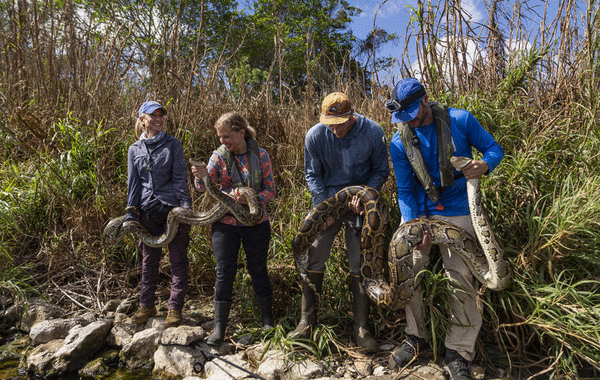
Brandon Welty eased his airboat named “Python Patrol” onto the rocky edge of a man-made island carved from the spoil of a canal near Everglades Holiday Park. His team was on a mission.
A 10-foot female Burmese python was guarding her clutch of eggs on the other side of the island. Nesting mothers can be more defensive, and reaching her meant bushwhacking through dense vegetation with mosquitoes swarming for blood.
Welty, who stands 6-foot-4, ducked beneath tangled tree branches and pushed through rugged lantana to lead the way. For months, he and his team had watched the snake using a transmitter and a trail camera.
“I’m just kind of following this path. I don’t know if it’s gonna work, but we’ll try,” he said. “Got bug spray all over my GPS.”
Burmese pythons are an invasive nightmare in Florida. They’re eating their way up the food chain, swallowing everything from marsh rabbits, wading birds, to deer — and robbing panthers, bob cats and raptors of their food.
Python removal programs remain the most effective way to slow the invasion, but finding the snakes is painstaking, time-eating work. Researchers with the University of Florida’s “Croc Docs” team hope to make that job easier. By studying how Burmese pythons move, breed and choose nesting sites, they’re giving hunters better clues for tracking one of the Everglades’ most elusive predators.
“People are finding more nests. They’re finding these nesting females more frequently than they were previously,” said Jenna Cole, an invasive animal biologist with the South Florida Water Management District. “As time goes on, the people who are doing the removals and our boots on the ground are getting better.”
The researchers pulled back branches and dead leaves around the base of a tree until the python’s glossy scales caught the sunlight. As they brushed debris from her face, she lunged, but missed.
Female pythons rarely leave their nests during the roughly 54-day incubation period, Welty said. The researchers left her undisturbed until the eggs were nearly ready to hatch, monitoring the nest closely to make sure they could collect them first.
“She’s going to sit on those eggs, and she’s going to defend them, barely drinking, definitely not eating,” Welty said.
“I always feel bad for them this time of year. They’re good moms. I don’t like pulling them off their eggs.”
But removing a nesting female also prevents dozens of hatchlings from entering the Everglades. One nest found in the Everglades and Francis S. Taylor Wildlife Management Area contained an eyebrow-raising 111 eggs, according to the Florida Fish and Wildlife Conservation Commission.
Clutch size usually depends on the size of the snake. The eggs are bound together by a super-glue-like mucus the mother produces while laying them, making an exact count difficult. This female had roughly 15 to 20 eggs.
Croc Docs researcher Eric Suarez and Cole with the SFWMD restrained the python while Welty drew blood from a vein near the base of her tail. It took several attempts. Like people, dehydrated snakes are harder to draw blood from.
They packed her blood in a cooler and her eggs in a white sack to take back to the lab to be used for other experiments. The eggs will not be hatched in the lab.
Before leaving, the team dug through the remaining leaf litter to make sure no additional eggs or snakes were hidden nearby. Researchers have occasionally found multiple nesting females denning in close quarters, behavior they don’t yet understand but are continuing to investigate.
They are also studying where the python goes after laying her eggs.
“What happens if somebody goes and finds a nest, and then the female leaves and they can’t find her?” Suarez said. “Well, we’re getting data on where that female might go afterwards. Are they going to stick around for a while?”
In this case, she slithered away without a second glance. Within seconds, she disappeared into the tall grass.
Scout snakes
The researchers found the mother python through their “scout snake” program, which uses surgically implanted radio transmitters to lead them to other snakes.
This year, the team has 25 tagged pythons that have led them to 30 new snakes.
The transmitters emit a high-frequency signal that researchers track using a directional antenna and receiver, with the beeping growing louder as they get closer to the snake.
During mating season, from late November through the end of March, the scout snakes become especially valuable. Female pythons bask in the sun while releasing pheromones that attract males, and the tagged males often lead researchers straight to them.
“We can actually just watch her move, and he just follows her along for months at a time, even out in the marsh,” Welty said.
The tagged males are frisky players and don’t stop after finding one mate. Researchers may capture a female, release the male, and days later he’ll lead them to another.
In March, the Miami Herald also joined Welty and the Croc Docs on a trip deep in the interior of the northern Everglades to track down lustful male pythons.
When the researchers found the spot, they didn’t find the tagged male they were looking for, but caught two other snakes red-handed with their cloacas entangled (an all-in-one exit for their eggs, poop and.... reproductive fluids.)
Burmese pythons have two penises, called hemipenes, and it’s common for multiple males to gather around a single female to get it on during breeding season. Yes, like a snake orgy.
“One girl. Bunch of guys,” Welty said. “I don’t know if they’re all trying to mate at once, if they all try to take turns, but it’d be really interesting to find out.”
Similar scout snake programs operate in Big Cypress, Southwest Florida and the Florida Keys, but the Everglades and Francis S. Taylor Wildlife Management Area, which stretches across Miami-Dade, Broward and Palm Beach counties, presents unique challenges because so much of it is underwater.
Many of the snakes live far from roads or trails, deep in the interior of the Everglades, accessible only by boat.
Even there, researchers have found that pythons are making their way toward developed areas.
“We suspect they’re probably using the canals as a path of least resistance. They could be used like highways for pythons to disperse,” said Melissa Miller, who oversees the invasive species program for the UF Croc Docs team.
Representative Debbie Wasserman-Shultz, who was on the March trip with the researchers, expressed interest in getting the researchers more funding opportunities.
“We’re spending hundreds, we’re spending billions of dollars on Everglades restoration. If a, you know, an invasive species ends up upending all the work we did, or much of the work we did – that’s a problem for us down the road,” she said.
Researchers are still learning how far pythons travel. They locate each tagged snake every other day. Some barely leave a small home range, while one male traveled roughly 40 miles in six months.
None of the 25 tagged pythons have moved beyond the habitat they’re currently tracking. A warming climate could potentially expand the range of suitable habitat for pythons in Florida, Welty said, but measuring that is extremely complex.
There’s no telling exactly how many pythons are out there. Accurately estimating the population would require hundreds, if not thousands, more tagged snakes, but that’s not practical with an invasive species.
“There’s so much to do, but we’re getting this little picture of what’s actually happening,” Welty said.
_____
©2026 Miami Herald. Visit miamiherald.com. Distributed by Tribune Content Agency, LLC.






Comments