Wisk, Boeing's air taxi firm, rushed software testing, ex-employee claims
Published in Science & Technology News
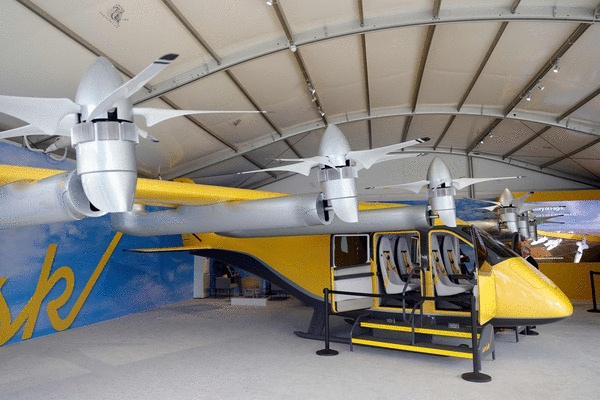
A former software manager at Wisk Aero, Boeing’s autonomous air taxi subsidiary, has accused Wisk of rushing software testing and retaliating against her for raising safety concerns.
Briahna O’Neill said she was fired from Wisk in March 2025 after filing two internal safety reports alleging company executives pushed engineers to reduce testing on flight-critical software. O'Neill claims they did so to stay on track for the first flight of its sixth-generation aircraft later that year.
O’Neill’s firing led to internal protest, with some employees sending messages to Wisk’s management warning them to heed O’Neill’s concerns, according to screenshots of the messages included in court records and other messages shared with The Seattle Times.
On Monday, O’Neill sued Wisk and Boeing in superior court in Santa Clara, Calif., alleging discrimination, retaliation and wrongful termination.
“I spent years at Wisk believing in the company’s mission and in the future of this technology,” O’Neill said in a written statement to The Times. “When I raised safety concerns to the company, I did so because I believed it was the right thing to do, not just for myself but for every passenger who would one day fly with this technology.”
“Wisk’s response was not one of accountability, she continued. "It was retaliation."
Wisk, headquartered in California, has been a wholly owned subsidiary of Boeing since 2023. Boeing declined to comment on the litigation. Wisk did not respond to multiple requests for comment.
Wisk is one of several companies working to develop a so-called air taxi. The term doesn’t actually refer to flying cars; the aircraft would operate more like airborne taxi services than commercial airplanes.
The aircraft are small, usually seating fewer than 10 people, fly short distances and take off vertically, like a helicopter, instead of accelerating down a long runway. And they are electric, relying on rechargeable batteries instead of jet fuel. In the aerospace industry, they are broadly called electric Vertical Takeoff and Landing aircraft, or eVTOLs.
The industry has been promising to bring eVTOLs to passengers for years, but the process has been slow, with some startups running out of money and dropping out of the race, and others missing their own deadlines. Wisk's financial information is not public. Now owned by Boeing, Wisk secured two funding rounds from Boeing, including one worth $450 million, and an earlier joint funding round between the aerospace giant and Kitty Hawk Corp., which was backed by Google co-founder Larry Page.
The Federal Aviation Administration has yet to certify any eVTOLs to carry passengers. Earlier this year, the FAA launched a pilot program to spur development of eVTOLs by pairing companies, including Wisk, with state governments to streamline testing.
Wisk hopes to certify its first eVTOL by the end of the decade. Unlike most of its competitors, Wisk is developing an autonomous aircraft that does not need a pilot in the cockpit. Its aircraft can seat four passengers and travel 90 miles.
In December, Wisk celebrated the successful first flight of its sixth-generation aircraft, marking another step toward FAA certification and bringing the company closer to transporting passengers.
In the months leading up to that first flight, O’Neill, then a manager in Wisk’s software division, alleged her team had significant concerns with some of the aircraft’s systems that would make it difficult to conduct necessary testing. When she raised the concern with Wisk's leaders and asked for additional time, leadership repeatedly told her the company could not delay its first flight, according to the lawsuit.
In one conversation, Wisk’s vice president of aircraft development proposed working two shifts and weekends to meet the original deadline, according to a screenshot of the messages shared with The Times. O’Neill’s proposed timeline would take too long, the messages read.
O’Neill’s concerns focused on Wisk’s vehicle management system, the software controlling the aircraft’s flight and navigation.
Her team was tasked with integrating Wisk's ground-control software with the air-control software that was part of the vehicle management system. But when her team got to work in fall 2024, they found the system was “spaghetti code,” a term for disorganized programming that makes it difficult to spot failures and fix errors, according to the lawsuit. Because of that disorganization, she worried her team would not be able to complete FAA-required testing.
O’Neill, who had been at Wisk since 2022, filed two internal complaints, one in February 2025 reporting her concern that Wisk’s vehicle management system software did not comply with the FAA’s testing requirements and another that March alleging Wisk leadership had decided to reduce software testing in order to meet its first-flight deadline.
She was fired less than two weeks after the second report, according to the lawsuit.
Her manager at the time said O’Neill had created an “environment that hinders collaboration” and created “inefficiencies and program delays,” the lawsuit read.
Wisk’s decision to fire O’Neill rattled the company, according to the lawsuit, and prompted other employees to write to company executives defending O’Neill's leadership and expressing concerns that her termination would prevent others from raising safety concerns.
In a message sent to Wisk’s then-CEO Brian Yutko in 2025 and included in the lawsuit, a senior engineer wrote: “Our software is in a terrible state. … The hardware teams may be on track for first flight, but software very much is not.”
Yutko, no longer Wisk’s CEO, is now vice president of product development for Boeing commercial airplanes. He still serves as chair of the board for Wisk.
O’Neill alleges she faced retaliation for raising safety concerns as well as gender discrimination during her time at the company. She filed a discrimination complaint with California’s Civil Rights Department in March 2025, shortly after she was fired, and the agency determined she had a right to sue.
O’Neill is seeking compensation but, in the lawsuit, does not request that she be reinstated to her former role.
After O’Neill’s firing, another employee drafted a letter to leadership with an explicit request to encourage constructive challenge ... to the status quo” and maintain an environment “where all voices are heard, especially as related to safety,” according to a screenshot shared with The Times.
Among themselves, employees began to question the long-term vision of the company, according to a screenshot of another conversation shared with The Times.
In that exchange, one software engineer messaged a colleague saying, “I was trying to have faith but now I’m lost.”
The engineer then sent a second message that read, “what are we doing here?”
The colleague responded, “taking Boeing’s money.”
©2026 The Seattle Times. Visit seattletimes.com. Distributed by Tribune Content Agency, LLC.





Comments