California takes step toward reintroducing grizzly bears as Assembly bill advances
Published in Science & Technology News
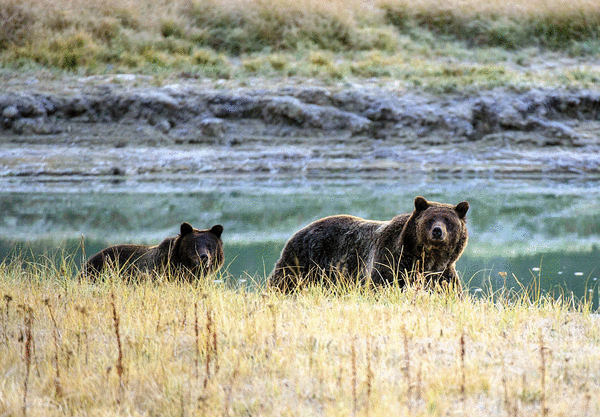
SACRAMENTO, Calif. — California on Tuesday moved a step closer to reintroducing grizzly bears, the quarter-ton predators that once roamed the Golden State but have been locally extinct for more than a century.
A bill to study the feasibility of bringing back the omnivorous animals passed the Assembly Water, Parks and Wildlife Committee 8-2. It passed the Senate on May 27.
The measure specifies that grizzlies would not be introduced to California unless a study shows they can be brought back safely for residents, livestock and pets. But it comes at a time when California is struggling to manage other predator populations — particularly those that, like the grizzlies, are protected from hunting and harassment by environmental laws.
The proposal to study grizzly reintroduction — authored by state Sen. Laura Richardson, D-San Pedro, and backed by two tribes — drew strong opposition from parts of the state where residents have experienced problems with wolves, mountain lions and black bears.
Gray wolves have stirred fear in rural communities, peaking last year after three adult animals in a single pack killed about 100 calves and cows over seven months. The predations in the Sierra Valley ranchlands north of Truckee led state wildlife officials to euthanize four wolves, essentially removing the entire Beyem Seyo pack.
Wolves were driven to local extinction in California around 1924 but have been slowly returning for the past 15 years.
They are protected under federal and state endangered species laws, limiting actions that ranchers, residents and even local law enforcement can take to control them.
In 2023, a Downieville woman was attacked and killed in her home by a black bear, state and local officials said. In 2024, a mountain lion attacked and killed Taylen Brooks, 21, and severely wounded his brother, Wyatt, 18.
Like wolves, grizzlies were last seen in California in 1924, but they still live in other parts of the United States and Canada. If reintroduced to California, they would likely come from the area around Yellowstone National Park, where about 1,900 grizzlies live in the contiguous United States, experts said.
The bill is backed by the Yurok and Tejon tribes. The Yurok Tribe considers grizzlies to be relatives who can teach humans lessons, Tiana Williamson-Claussen, a biologist who directs the tribe’s wildlife department, previously told The Bee.
But Assemblymember Heather Hadwick, R-Alturas, who represents much of the North State where wolf conflicts have affected ranchers and other residents, said other tribes in her district view grizzlies differently and do not support reintroducing them. She and Assemblymember Juan Alanis, R-Modesto, voted against the bill.
Ranching groups also oppose the proposal, pointing to the difficulty the state is already having managing other predators.
California’s problems with predator management were described as a crisis by Natural Resources Agency Secretary Wade Crowfoot in January, but the state budget passed this week did not restore previously cut funding for those efforts.
The state has for years failed to fully fund its human-wildlife conflict program, prompting concerns that grizzly conflicts could not be properly managed even as encounters with wolves, mountain lions and black bears continue to occur, Hadwick and others said at Tuesday’s hearing before the Water, Parks and Wildlife Committee.
In response, Richardson said she would accept amendments requiring the state to develop a way to fund any roadmap for reintroducing grizzlies before taking such a step.
A related bill requiring the state to expand and fully fund programs aimed at reducing encounters between humans and mountain lions also advanced Tuesday. The bill, introduced by Sen. Marie Alvarado-Gil, R-Jackson, after the attacks on Taylen and Wyatt Brooks, passed unanimously.
____
©2026 The Sacramento Bee. Visit at sacbee.com. Distributed by Tribune Content Agency, LLC.






Comments