SpaceX moonlit launch marks year's midway point as pace slows on Florida's Space Coast
Published in Science & Technology News
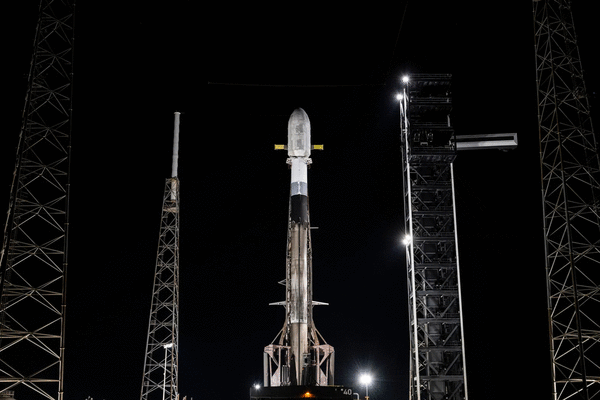
A SpaceX launch Sunday night sent up a Sirius XM satellite under a nearly full moon, capping off the final launch planned from Florida in the first half of the year.
A Falcon 9 rocket on the SiriusXM SXM-11 mission headed to geosynchronous transfer orbit lifted off from Cape Canaveral Space Force Station’s Space Launch Complex 40 at 10:25 p.m. EDT.
The first stage booster flew for the 17th time and made a recovery landing downrange on the droneship A Shortfall of Gravitas stationed in the Atlantic.
It was the 43rd launch from all providers on the Space Coast in 2026, with all but six flown by SpaceX.
That number is much lower than those set during the the frenetic pace of launches seen in 2024 and 2025.
While Space Launch Delta 45, the Space Force outfit in charge of the Eastern Range over which the rockets launch, was prepared to break 100 launches again this year, it’s likely that number will only land at around 80.
There were a record 109 orbital launches from the combination of missions from Kennedy Space Center and Cape Canaveral Space Force Station in 2025, which built off 93 launches in 2024 and 72 in 2023.
So why has the Space Coast launch pace fallen off?
One reason is SpaceX decided to halt its Falcon 9 launches from KSC’s Launch Pad 39-A this year, and rely on that pad solely for Falcon Heavy launches. There has only been one Falcon Heavy launch so far in 2026. That has allowed Elon Musk’s company to focus on building out its Starship and Super Heavy launch tower adjacent to the 39-A pad as it seeks to bring the behemoth rocket to Florida before the end of the year.
For now, it has only launched on suborbital flights from Texas, but plans future operations at both the KSC site and from two towers being constructed at Canaveral’s Space Launch Complex 37, which formerly hosted United Launch Alliance Delta IV Heavy missions. The first Canaveral launches of Starship are not expected to come until 2027.
Also, Jeff Bezos’ Blue Origin has only managed one launch this year because of the massive explosion that did severe damage to Canaveral’s Launch Complex 36.
A New Glenn rocket blew up on the pad on May 28 during a static hot fire test as the company was preparing for what would have been its second launch of the year and fourth ever for the heavy-lift rocket.
Blue Origin CEO Dave Limp had said earlier in 2026 that he hoped the company would be able to hit at least eight launches in 2026. Now the company is racing to rebuild the pad. Limp has said the damage was not as bad as originally feared, especially considering the size of the fireball the explosion generated and the fact it measured 2.5 on the Richter scale, according to the U.S. Geological Survey.
Limp said debris from the wreckage was cleared within nine days, and over the weekend, he posted video of more than 600 feet of crane being assembled in preparation to remove a launch support tower in segments that the company plans to modify before building it back up.
He said the company is on track to get New Glenn back to launching before the end of the year.
ULA has managed four launches this year, and has its fifth planned for Thursday, but its manifest for the year also has limitations because of issues of its newest rocket Vulcan. For now it has only been launching Atlas V rockets.
That’s what’s on tap for the Amazon Leo 8 mission, carrying 29 satellites headed for low-Earth orbit launching from Canaveral’s Space Launch Complex 41 targeting 12:03 a.m. liftoff.
This would be the last of nine Atlas V launches purchased by Amazon. The first was used on a pair of test versions of the Amazon Leo satellites, previously known as Project Kuiper, in October 2023 with eight more Atlas V launches sending up 27, then 29 operational satellites at a time on missions launched since April 2025.
After this launch, though, the Atlas V launches for Amazon are complete. All six remaining Atlas V rockets are set aside for Boeing’s Starliner, but that spacecraft does not have a solid return to flight yet.
That leaves Vulcan, but just when that will try to fly again is uncertain.
ULA continues to work through problems on its last Vulcan launch related to its solid rocket booster. The next-generation rocket for ULA has only launched four times since its 2024 debut. It had previously been lined up to have already sent up its first Amazon Leo batch. Vulcan can hold 42 of the satellites and ULA has 38 Vulcan launches under contract.
The rocket also has a backlog of more than two dozen national security missions awaiting its return to flight.
The only other launch from the Space Coast this year has been NASA’s Space Launch System rocket on the Artemis II mission. The SLS is not slated to fly again until mid 2027 on Artemis III.
SpaceX, meanwhile, continues to plug away with a lineup of Falcon 9 launches from SLC-40. But the pace has been more like once every five days from SpaceX, compared to the once every two to three days it had in 2025.
Still, SpaceX’s next launch is also planned for Thursday. The Starlink 10-50 mission loaded with 29 more Starlink satellites is targeting liftoff during a window that runs from 7:20-11:20 a.m.
The first stage booster for this mission is flying for the 13th time and will attempt a recovery landing downrange on the droneship A Shortfall of Gravitas stationed in the Atlantic.
_____
©2026 Orlando Sentinel. Visit orlandosentinel.com. Distributed by Tribune Content Agency, LLC.






Comments