Money was sought to restore Tampa Bay's coastal habitat. Gov. Ron DeSantis just vetoed it
Published in Science & Technology News
TAMPA, Fla. — A suite of habitat restoration goals on a federal wildlife refuge offshore Pinellas County promised big benefits for human and animal residents alike:
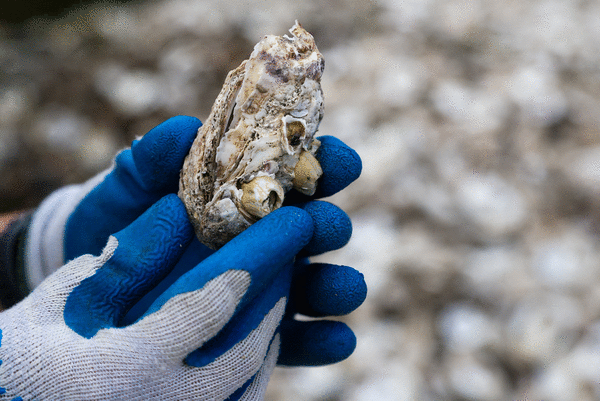
More eastern oyster reefs to clean Tampa Bay’s water and curb erosion; more marsh grasses to soften storm surge and give shelter for nesting birds; more hardened shorelines for wary coastal homeowners in the wake of the region’s worst hurricane season in a century.
The $750,000 sought by the nonprofit Tampa Bay Watch would have indirectly helped all residents living around Florida’s largest open-water estuary, the group said in its funding request.
But on Monday, Gov. Ron DeSantis vetoed the money.
“This is very disappointing,” said Dwayne Virgint, the nonprofit’s chief executive officer.
Virgint said in an interview that the money would have helped refurbish the Pinellas National Wildlife Refuge, a string of federally protected islands — including Tarpon, Indian and Mule Keys — hit particularly hard in 2024 by Hurricanes Helene and Milton.
“These islands serve as critical nesting areas for birds. They act as barrier islands for us, they create oyster habitat. It would have been a win-win-win,” Virgint said.
Virgint said he had just learned about the vetoed funds an hour earlier, and hadn’t yet heard of any rationale for the veto from the governor’s office. DeSantis last year did not veto a separate $750,000 request from the nonprofit, Virgint said. A spokesperson for the governor’s office did not immediately respond to a request for comment Monday afternoon.
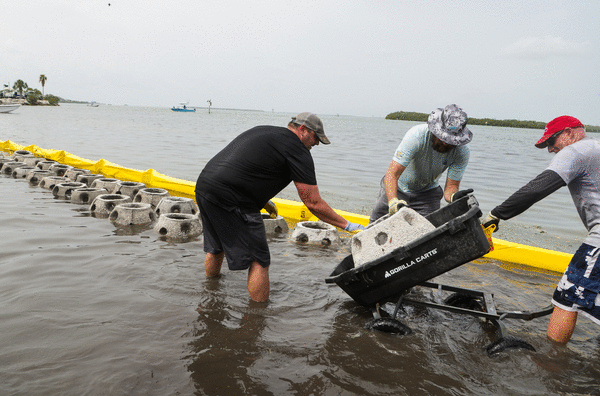
The funding request didn’t identify a specific project the money would have benefitted, but Tampa Bay Watch said the $750,000 would have helped the group continue its overall mission: Mobilizing the community’s help with its slate of “living shoreline” projects that use nature — native plants, shellfish and sand — to build wildlife habitat and fend off major floods.
About 40% of the money would have gone toward the salaries of a restoration specialist, an oyster reef and native plant coordinator, scientists and more, according to the funding request first introduced by Sen. Ed Hooper, R-Clearwater, in October.
About $280,000 would have gone toward engineering and field work, and another $161,000 for equipment, oyster shells for artificial reefs, plants, travel and more, according to the funding request.
Virgint said there are funds from private donors and corporations that could help fund restoration initiatives, but it’s not yet clear where the money might come from.
“We’re now looking at a larger gap we’re going to have to fill,” he said.
Tampa Bay Watch was founded in 1993 and leads volunteer-driven restoration projects and marine education and outreach, according to the nonprofit. Its main campus is on the shores of Tierra Verde and the group also oversees a discovery center on the St. Pete Pier.
DeSantis is cutting funds for nature-based solutions in Tampa Bay just months after he held a celebratory bill-signing ceremony for a coastal resiliency bill that encouraged their adoption across the state. That measure included a provision that hindered plans to build a cruise port near the mouth of Tampa Bay.
“This is a project that helps to protect and preserve natural islands, waters and wildlife of Tampa Bay,” said Pat Mundus, president of Friends of the Tampa Bay National Wildlife Refuges. Mundus said the work may now have to be scaled down.
“The bay is the best asset we have as a metropolitan area - it is the reason most of us live here, and we need to take care of it.”
________
©2026 Tampa Bay Times. Visit at tampabay.com. Distributed by Tribune Content Agency, LLC.






Comments