Bio-Techne will be sold for $11.3B, one of largest deals in Minnesota history
Published in Science & Technology News
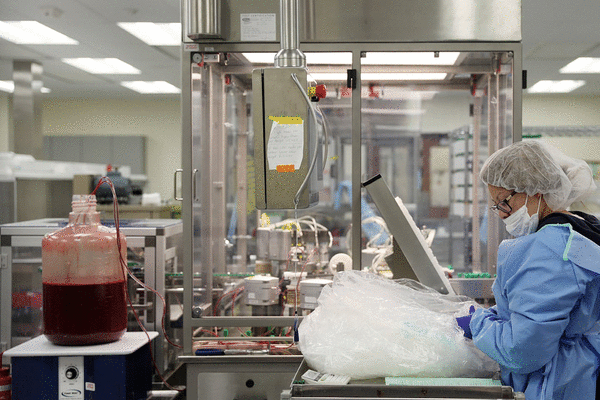
Germany’s Merck KGaA will buy Bio-Techne Corp. in a deal worth $11.3 billion, one of the largest acquisitions in Minnesota history.
The sale follows investor pressure on Minneapolis-based Bio-Techne, which makes lab materials and equipment used to develop drugs.
Bio-Techne’s stock had fallen nearly 50% in five years while Merck KGaA — one of Germany’s largest pharmaceutical companies that is unrelated to New Jersey-based Merck & Co. — was looking to grow through acquisitions under a new CEO.
The deal rewards shareholders, but means Minnesota will lose another corporate headquarters.
Despite the recent pullback in U.S. medical research funding, life sciences remains an attractive growth industry as reflected in the sale price. If approved by regulators, Bio-Techne will be among Minnesota’s top five largest acquisitions ever in raw dollar value.
The largest deals, in raw dollars, were Wells Fargo merger with Norwest and Abbott Labs’ 2017 purchase of St. Jude Medical for $25 billion .
In February, investment firm Thoma Bravo completed its acquisition of Dayforce for $12.3 billion.
Other large deals include the acquisitions of Valspar by Sherwin-Williams and Pillsbury by General Mills. The Bio-Techne deal comes a few months after Allegiant completed a $1.5 billion deal to buy Minnesota’s Sun Country Airlines.
Bio-Techne ranked 31st on the Star Tribune’s latest list of largest public companies in the state. The company did not immediately respond to questions inquiring if the deal may lead to layoffs or a relocation.
The deal, which would pay $73 a share, is subject to shareholder and regulatory approvals. The stock prices of both companies spiked after the announcement, and at midday shares of Bio-Techne were still up nearly 20%.
Darmstadt, Germany-based Merck makes life science tools and drugs treating maladies such as cancer. It is separate from an American company that shares the same name, which broke off more than 100 years ago after the United States seized its U.S. assets during World War I.
“This transaction is an important milestone towards delivering on our mid- to long-term strategic agenda,” Merck CEO Kai Beckmann said in a statement. “Bio-Techne is an outstanding fit.”
The announced transaction comes less than two weeks after Bloomberg reported that activist investor Ananym Capital Management built up a stake in Bio-Techne and called on the company’s board to consider a sale.
“While we are a new investor, shareholders have suffered for years as the company has continued to destroy value,” Ananym said in the letter, according to Bloomberg. “A failure to act now risks further value destruction and even permanent capital impairment, which the board has a duty to avoid by exploring all potential paths to preserving and enhancing value.”
Kim Kelderman, CEO of Bio-Techne, said in the statement that the deal is a “testament to the remarkable company our team has built and to the enduring value we create for our customers and stakeholders.”
Bio-Techne was founded as R&D Systems in 1976, and innovation in inflammation research and development drove the company’s 50-year history.
The company makes recombinant proteins, antibodies and immunoassay kits used to develop drugs. It has more than 3,000 employees, with 2,300 of them in the U.S., and has 15 manufacturing facilities. Last year, its revenue was $1.2 billion.
The company has underperformed the S&P life sciences index in recent years, though, with it reporting declining revenue and adjusted profits for the third fiscal quarter, which ended on March 31.
The company said low spending on emerging biotechnology research was pulling down its fiscal results.
“While biotech funding remains healthy, it has not yet translated into broad‑based demand across our portfolio,” Kelderman said in a news release.
Bio-Techne’s board chair, Robert Baumgartner, said in a news release the transaction will quickly generate value for the company’s shareholders and allow for further expansion.
The German drugmaker is one of the world’s oldest chemical and pharmaceutical companies. Its health care portfolio includes the cancer therapy Erbitux (cetuximab), the multiple sclerosis treatment Mavenclad (cladribine) and prescription fertility treatments.
The company also generates revenue from supplying equipment, filtration systems, and chemical compounds used in drug development and scientific research laboratories. Merck also has a foothold in the electronics business, where it provides materials used in digital displays and semiconductor chips.
In 2025, Merck also completed a $3.4 billion acquisition of U.S.-based SpringWorks Therapeutics, giving the company rights to SpringWorks’ portfolio of rare tumor therapies. Its recent acquisition of Bio-Techne is one of the largest acquisitions in Merck’s history.
It also marks the first major acquisition for the firm after company veteran Beckmann was appointed as its chief executive in May. The board gave him a mandate to grow the company, and a huge purchase is one way to achieve this.
Bio-Techne is attractive to Merck because its product portfolio includes several proteins, antibodies, lab test kits, diagnostic materials and other tools that are critical to modern biological research.
In a presentation, Merck said the transaction promotes a “highly innovative” portfolio led by “consumables” — a term used in science industries to describe products that need frequent replacement. This replenishment helps companies pull in ongoing revenue. Consumables make up more than 80% of Bio-Techne sales.
The large proportion of consumables making up Bio-Techne’s product portfolio and high margins have long made it an acquisition target for other companies, Leerink Partners analysts said in a research note. Evercore analysts called the Minnesota company an “attractive asset” in a separate note.
Merck’s CEO said during an investor call that the U.S. is one of the company’s largest global hubs because of the development and research of many blockbuster drugs.
“We remain committed to strengthening our U.S. presence because it is an essential innovation and manufacturing market,” Beckmann said to investors.
©2026 The Minnesota Star Tribune. Visit at startribune.com. Distributed by Tribune Content Agency, LLC.






Comments