Mosquitos carrying West Nile virus found in 3 Twin Cities counties
Published in Science & Technology News
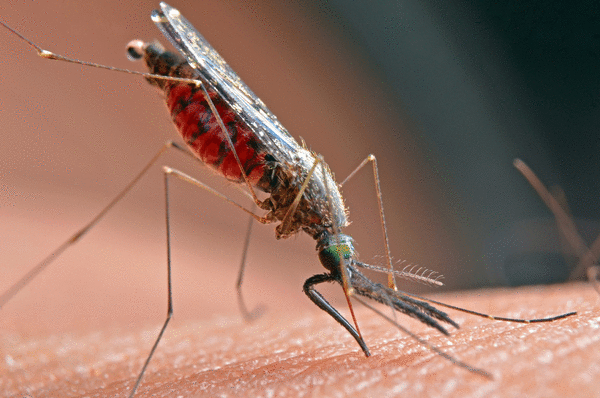
MINNEAPOLIS — Mosquitos carrying the West Nile virus have been detected in three metro counties and are the first samples of the insects carrying the disease to be found this year.
Mosquitos in Hennepin, Ramsey and Dakota counties tested positive for West Nile, which in mild cases can bring on a fever, headache and body aches, and occasionally a skin rash and swollen lymph glands. In the most severe cases, the illness can lead to death, though only 1 out of 150 people infected with West Nile develop a serious illness, the Metropolitan Mosquito Control District said.
Most people infected with West Nile virus do not develop any symptoms. Symptoms usually start two to six days after being bitten by an infected mosquito, the Centers for Disease Control and Prevention (CDC) said.
West Nile is the most common mosquito-borne disease in the contiguous United States, according to the CDC.
The samples were found on June 17 in northeast Minneapolis, St. Paul, Maplewood and near Lakeville, MMCD spokesman Alex Carlson said.
The appearance of West Nile comes right on schedule, Carlson said, noting the first cases of the illness in Minnesota usually turn up the first week of July.
Last year was a record year for West Nile virus in Minnesota, with over 120 human cases, including 50 in the Twin Cities, the MMCD said.
The primary disease-carrying mosquito species is the Culex tarsalis. Last year brought out an elevated number of Culex tarsalis, which is likely one of the causes of the record year, MMCD said.
So far in 2026, Culex tarsalis mosquito numbers have been lower compared to last year due to lower rainfall totals, Carlson said.
With the discovery, “we have already begun additional surveillance in the areas where the positive samples were found to determine if there are breeding sites that have a lot of Culex tarsalis mosquitoes,” Carlson said. “We are in investigation mode right now and in the coming weeks, our findings will direct our actions.”
Overall, including all species, mosquito numbers are quite a bit below average for the season, the MMCD said.
Mosquitoes become infected with West Nile when they feed on infected birds and then spread it when biting humans and animals, the CDC said.
There are no licensed vaccines or medicines available to prevent West Nile, the CDC said. But there are steps people can take to reduce the chances of contracting the disease, the MMCD said.
Those include:
—Staying indoors at dawn and dusk when most mosquitoes are active.
—Wearing loose-fitting long-sleeved shirts and long pants when outdoors.
—Apply an EPA-registered insect repellent to exposed skin.
—Remove any water-holding containers from your property, as they can produce mosquitoes.
©2026 The Minnesota Star Tribune. Visit at startribune.com. Distributed by Tribune Content Agency, LLC.






Comments