Cape Canaveral could get new launch site only 2 miles from the port
Published in Science & Technology News
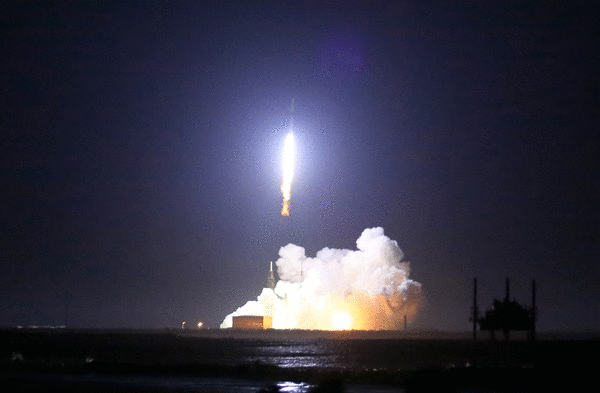
ORLANDO, Fla. — A new launch pad could be constructed at Cape Canaveral Space Force Station — if the military has its way.
The Department of the Air Force, which oversees the facility, is gathering information for an Environmental Assessment for a proposed Space Launch Complex 51 that would be about 2 miles from Port Canaveral.
The goal of the new site would be to give the U.S. Army and Navy a place to test launch missiles instead of relying on the existing Space Launch Complex 46, which falls too close to Blue Origin’s launch site, according to a public notice published in April.
The purpose of the proposed pad is the move Army and Navy operations “to a location outside all commercial space launch providers’ explosive clear zones.”
This move was made before Blue Origin’s massive explosion at Launch Complex 36 last month, but the public notice cited the proximity of the two pads made it so simultaneous operations were not possible.
“This relocation would ensure safe and efficient use of launch infrastructure, reduce scheduling conflicts, and support both military and commercial space activities while safeguarding national security missions and enhancing overall launch capacity,” the proposal stated.
It also touts that it would benefit not only Department of Defense operations, but also NASA, which will be relying on commercial providers like Blue Origin and SpaceX for its Artemis plans. It allows all players “to conduct operations safely, with minimal disruptions and with greater operational flexibility,” it stated.
SLC-51 would be constructed about 2.5 miles south of SLC-46 just south of Pier Road and include “the complete construction of new infrastructure, utilities and structures” across 50 acres. This would be close to two launch sites previously used by the Navy’s Naval Ordnance Test Unit, Space Launch Complex 25 and 29, both of which are inactive.
SLC 25 was dismantled in 1979 and most recently converted to the Strategic Weapons System Ashore site for the Navy to test weapons systems, but not launch them. SLC-29 was deactivated in 1980.
Missile launches under the Army and Navy’s purview had shifted to SLC-46. The two partnered for hypersonic missile tests from the pad in the last two years, but the pad has also hosted commercial launch providers, including a pair of Astra Space launches, under a lease agreement with Space Florida, the state’s aerospace finance and development authority.
The public notice detailed the “the proposed infrastructure improvements could potentially impact wetlands, if present within the project area, and would occur within the floodplain. A wetland survey has been initiated; however, field investigations and impact determinations are not yet complete, and the presence, extent, and magnitude of potential wetland impacts have not been fully defined.”
Because of this, the Air Force initiated the Environmental Assessment and request public input for 30 days, since closed, for a draft that has yet to be published, after which public comment will be allowed once again. An EA is a less-rigorous review of a proposal than the Environmental Impact Statement.
Examples of recent EIS actions have included both the SpaceX Starship launch site proposals on the Space Coast, one located on Kennedy Space Center at Launch Complex 39 and the other at the former United Launch Alliance Delta IV Heavy launch site at Cape Canaveral Space Force Station’s Space Launch Complex 37.
“The EA is currently under development in accordance with the Air Force National Environmental Policy Act (NEPA) to evaluate potential environmental impacts. No decision has been made at this time,” according to an emailed statement from Space Launch Delta 45, the Space Force unit that oversees CCSFS.
The unit maintains an archive of NEPA-related findings for the military installation on a page for Patrick Space Force Station’s website.
Space Florida also confirmed the EA was in the works.
“We’re working with the Air Force on an environmental assessment for that, which is a process required for infrastructure projects of this scale and the necessary next step toward implementation. Nothing more to share at the moment,” reads an emailed statement.
Part of the initial call for comment included comments submitted by Port Canaveral, details of which were outlined by port CEO Capt. John Murray at the most recent port commission meeting.
He noted the Air Force’s “environmental assessment requests for public comment of the proposed Space Launch Complex 51 This is a NOTU facility that’s relocating on the Space Force base.”
NOTU is the Naval Ordnance Test Unit, which was born out of a unit first created by the Chief of Naval Operations in 1950 at the US Joint Long Range Proving Ground in Cape Canaveral. It was redesignated as NOTU by the Secretary of the Navy on June 1, 1956. The Navy also uses Port Canaveral for several vessels including nuclear submarines.
“NOTU conducts flight tests of the Trident II strategic weapons system and serves as the launch area for submarine-launched ballistic missiles assigned to the Navy’s nuclear-powered ballistic missile submarine fleet,” according to the Navy.
From Port Canaveral’s perspective, Murray noted that SLD 51 would be located about 2 miles from the federal channel and harbor entrance.
“It’ll be the closest active launch facility to the port. So we’re looking at launch-related safety and exclusion zones that could temporarily or intermittently restrict navigation, and our concerns include potential impact of port vessel traffic, including commercial crews and military operations, and the Canaveral Sand Bypass Project disruption,” he said. “So this is in process, and we’re just part of the overall process of the relocation.”
Currently, the closest launch site to Port Canaveral is Blue Origin’s Launch Complex 36, located 5 miles north of the inlet. That’s the site of a massive explosion of a New Glenn rocket during a test static fire last month. The Space Force stated that debris flew a half mile from the pad from that incident, which measured 2.5 on the Richter scale, according to the U.S. Geological Survey.
There are eight other launch pads north of there within the Space Force station that are either active or gearing up for launches soon. Those include SpaceX’s SLC-40, United Launch Alliance’s SLC-41, Relativity Space’s LC-16, Stoke Space’s LC-14, Phantom Space and Vaya Space from LC-13 and the future SpaceX Starship and Super Heavy launch towers at SLC-37.
The Navy last year did release details about several infrastructure improvements to modernize the Cape Canaveral presence.
That includes a 19 planned facilities that directly support the Trident II D5 Life Extension and future D5LE2 submarine-launched ballistic missile programs to be deployed on the Columbia-class ballistic missile submarine.
“The office is also expanding its staff and capabilities to execute larger upcoming military construction projects, including a new engineering test facility and improvements to the Cape Railhead,” according to a Navy update in November 2025.
“This project is essential to modernizing NOTU’s infrastructure and ensuring the unit has the facilities needed to continue its crucial test flight mission,” said Lt. Cmdr. Pete Fovargue. “These improvements directly contribute to the reliability of our strategic weapons systems and, ultimately, to global security.”
SLC-46 had also the subject of a 2025 EA proposing the future launches of the Navy’s Trident missiles in the 2030s, which would move to the new launch site potentially.
There is no SLC-51 designated among the pad histories maintained by the US Space Force Historical Foundation, which runs the Cape Canaveral Space Force Museum.
The highest numbered launch complex mentioned in recent DOD documents has been SLC-50, currently a green space on the site on the northern half of the Space Force station that was considered for a launch site for SpaceX’s Starship plans, but ultimately discarded in favor of re-use of the former Delta IV Heavy launch site at SCL-37.
©2026 Orlando Sentinel. Visit at orlandosentinel.com. Distributed by Tribune Content Agency, LLC.






Comments