Newsom commits $46 million to Tijuana River sewage and pollution cleanup
Published in Science & Technology News
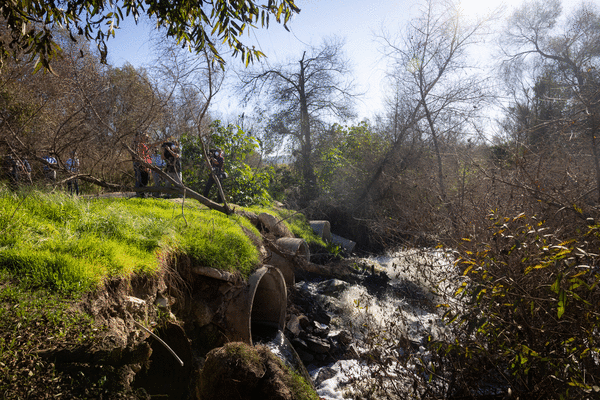
As South Bay communities continue to grapple with closed beaches, toxic air and raw sewage, California Gov. Gavin Newsom announced Thursday that $46 million in voter-approved funding is now available to help clean up the polluted Tijuana River that flows from Mexico into the U.S. — though local officials caution relief won’t come overnight.
The Proposition 4 funding — drawn from the Safe Drinking Water, Wildfire Prevention, Drought Preparedness, and Clean Air Bond Act approved by California voters in 2024 — adds to approximately $38 million the state has previously allocated for Tijuana River water quality improvements since 2019, bringing California’s total investment to roughly $84 million.
Imperial Beach Mayor Mitch McKay welcomed the announcement, but he urged caution about what the funding can realistically deliver and how quickly.
“While it sounds encouraging and it certainly is great to see the state putting some of that money forward towards our situation, it’s not the magic pill,” McKay said. “It’s not going to fix things overnight. So I’m cautiously optimistic that we’ll get our fair share and that it’ll be used wisely and efficiently.”
The announcement came one day after the California Coastal Commission approved a county-funded project to address a major air pollution hot spot at the Saturn Boulevard crossing of the Tijuana River, and as the U.S. International Boundary and Water Commission faced pointed questions from local officials and advocates about the pace of progress on the crisis.
The $46 million will be distributed through a competitive grant process administered by the State Water Resources Control Board, meaning local agencies and organizations must apply before any money changes hands. The board’s deputy director holds authority to approve individual implementation grants of up to $20 million. At least one project from each river — the Tijuana and the New River, a severely polluted inland waterway that flows north across the border and through the city of Calexico — will be selected.
Despite current movement by Newsom’s office on this issue, many residents and local officials have pressed his office to act for years — action that had largely been met with little urgency.
McKay said the delay in state action has had real costs for residents.
“It just feels like it would’ve been much easier and faster had a state of emergency been declared by the governor two years ago, three years ago,” McKay said. “We still have the federal efforts going on and they’ve been timelined through the end of 2027. So maybe all these things will ultimately meet at the same end point, but I think the fact that it’s been so drawn out has been very disappointing for the residents here in the South Bay.”
The governor’s announcement takes direct aim at the Trump administration, calling on it to repair and expand the South Bay International Wastewater Treatment Plant — the federally managed facility in San Ysidro operated by the U.S. International Boundary and Water Commission that treats Tijuana sewage before it reaches the Pacific Ocean.
“People in San Diego County shouldn’t have to worry about getting sick, losing access to their beaches, and living with polluted air,” Newsom said in a statement. “California has stepped up repeatedly, but we can’t solve a decades-long federal failure on our own.”
The South Bay International Wastewater Treatment Plant has faced repeated challenges as aging infrastructure struggles to keep pace with the volume of sewage flowing across the border from Tijuana. The facility, operated by the U.S. International Boundary and Water Commission, has undergone upgrades in recent years — expanding capacity from 25 million gallons per day to 35 million gallons per day — with a target of 50 million gallons per day by December 2027, according to the EPA.
Despite EPA Administrator Lee Zeldin’s commitment to a “100% solution” in July 2025, Newsom’s office said the federal government has yet to deliver a permanent fix. Newsom traveled to Washington, D.C., in May to press Zeldin directly.
“The Tijuana River is one of the most polluted waterways in the country, and getting dedicated funding into Prop. 4 was essential to finally driving real investment here,” Assemblymember David Alvarez said in an email. “California is doing its part. Now it’s time for Donald Trump and the federal government to do theirs, and for Mexico to meet their commitment.”
San Diego County Supervisor Paloma Aguirre, whose District 1 includes the most heavily impacted communities, called the funding “a good and positive step in the right direction,” and said her team has spent months preparing projects to be shovel-ready.
“I’m just proud that we at the county have been able to build a foundation that will bring relief immediately as soon as some of these projects are completed to the tens of thousands of people being harmed by that pollution,” Aguirre said. “We don’t have to wait for the federal government. We don’t have to wait for Mexico to implement the solution that is attainable and that we’ve been working towards.”
Among the projects likely to seek funding is the Saturn Boulevard culvert fix the Coastal Commission approved Wednesday. That project would extend two of five existing culvert pipes below the river’s surface during low flows, eliminating the turbulence caused when water discharges roughly 6 feet above the channel onto rocks below — a process that has been identified as the primary driver of hydrogen sulfide off-gassing at a site that sits within 1.5 miles of 11 schools.
Aguirre’s office said the county has already completed a feasibility study and secured the coastal permit, and is prepared to move quickly once grant funding is in hand.
“Not only did we do a feasibility study, but we’re getting the permits,” said Diane Castañeda, Aguirre’s director of communications. “So things are already moving forward and once we get that money, we’re ready to go.
Local agencies and officials, including Aguirre and the city of Imperial Beach, have pushed the governor’s office to declare a state of emergency, arguing the situation is analogous to cases where California has acted on environmental threats that originate outside the state.
In April, Aguirre took to Instagram to call on Newsom to declare a state of emergency for the Tijuana River, saying in her post that the “San Diego County Board of Supervisors has declared this an emergency 22 times and sent a letter to our governor asking him to follow suit. Governor (Gavin Newsom) it is time. We can’t keep passing the buck to another country even if they’re the source.”
Waylon Matson, executive director of 4 Walls International, a nonprofit specializing in cross-border improvement and aid efforts, took a blunt stance on Newsom’s track record.
“Everyone’s passed the buck because no one really wants to assume responsibility or liability for it,” he said. “I think we as a region are really looking forward to the next iteration of leadership at the state level because of the lack of commitment from the governor’s office.”
Still, he said California deserves credit for stepping up.
“Are we going to come close to a 100 percent fix on this without really addressing some of the watershed concerns? No,” Matson said. “But it is the coordination with Mexico that I think we’d really like to see done, especially at a state level.”
Castañeda said communication between the county and the governor’s office has been productive recently, though Newsom has yet to visit the South Bay. Several gubernatorial candidates have made the trip, including Democratic candidate Xavier Becerra, who toured the area April 29 with Aguirre and pledged to declare a state of emergency if elected.
McKay said Imperial Beach held a call with the governor’s office last week, where officials cited jurisdictional limitations as a reason for not declaring a state of emergency — an argument McKay said the city finds unconvincing.
“It seems like sometimes it’s convenient to use jurisdictional limits as an explanation for a lack of action,” McKay said.
In response to the criticisms, the governor’s office reiterated its position about who is accountable for addressing the crisis. “Let’s be clear: The federal government is responsible for the wastewater treatment facility at the center of this crisis, and they have fallen far short of their obligations to our communities.”
©2026 The San Diego Union-Tribune. Visit sandiegouniontribune.com. Distributed by Tribune Content Agency, LLC.






Comments