Space Force digs in to uncover extent of Blue Origin New Glenn explosion
Published in Science & Technology News
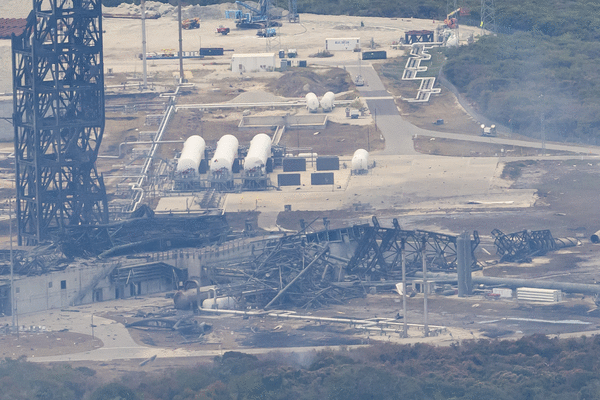
The explosion of Blue Origin’s New Glenn at Cape Canaveral Space Force Station was massive, but the response by the Space Force emergency crews was quick and well-prepared.
“I had just gotten home and sat down in the living room, talking to my kids and wife, and looked out the window and saw the explosion,” said Space Launch Delta 45 Commander Col. Brian Chatman, who lives about 10 miles south on Patrick Space Force Base.
“Saw the explosion and called over to the fire team and activated the EOC (Emergency Operations Center),” Chatman said. “From there, I ended up heading up to the Cape, joining the emergency operations center as the personnel started coming in, and then we started making real-time decisions on what the next steps were.”
The explosion came at 9 p.m., the EOC activated by 9:05 p.m., and it was fully up and running by 9:19 p.m., he said.
“By 9:30 (p.m.) we had 100% accountability of all personnel in and around the areas. What we saw was from the conservative safety measures that we employ with each and every hazardous activity we do out here, from the blast damage assessment roadblocks that we had put in place, we had no casualties, no injuries associated with this this anomalous event,” he said.
Disaster response continued through the night, but the scope was such that other SLD 45 personnel were able to focus on the job of putting rockets into space. While crews fought fires and cleared areas of explosive dangers at Launch Complex 36, teams focused on a launch 6 miles to the north by SpaceX at Space Launch Complex 40 less than 12 hours later. They continued that work less than 24 hours later when a United Launch Alliance Atlas V launched from Space Launch Complex 41, also on the north side.
“In this instance geography was our friend,” he said, noting LC-36 is the southernmost active launch pad at CCSFS while SLC-40 and SLC-41 are the most northern pads. “That geographic separation allowed us to work through the anomaly, work through the firefighting, work through the reentry to pad 36 while still facilitating launch operations up north with ULA and SpaceX.”
Had a similar incident occurred at one of the other launch pads, such as Kennedy Space Center’s Launch Complex 39-A, where SpaceX is building out its Starship launch tower adjacent the existing Falcon 9 and Falcon Heavy launch pad, it could have been a different story.
“A lot of variables go into that with regards to how much fuel would have been on the pad, what type of explosion, where the anomaly would have occurred that would have driven impacts to the surrounding area,” he said.
While the explosion caused a mushroom cloud over the Blue Origin launch pad and it measured 2.5 on the Richter scale, according to the U.S. Geological Survey, the damage seems to have been not as severe. Blue Origin’s CEO stated he thought the company could be back to launching from the pad before the end of the year.
“New Glenn is the biggest rocket we’ve launched here off the Eastern Range, and with that, it had the most fuel,” he said. “It makes it the largest explosion that we’ve had out here.”
Damage was not limited to just LC-36, though. Chatman said they had found debris as far as 1/2 mile from the launch site, and the over-pressure damage hit surrounding facilities at the Space Force station.
The blast damage assessment (BDA) for the incident expands to 7,172 feet in diameter from the site.
“We just dropped that BDA, and my teams are just going out now to take a look at some of the other facilities,” Chatman said. We do know from an overpressure perspective, we did have damage over the Hangar C where some of the windows were blown out in that area.”
Hangar C is a historic facility that is now part of the Cape Canaveral Space Force Museum. Also damaged was part of the weather balloon release facility.
“The garage door was banged up pretty good on that, but we still had access,” he said. Teams were able to get into the facility, access weather balloons and use them for the ULA Atlas V launch the next day.
“As the interim safety board team goes out and assesses the other government facilities in and around the area outside of the BDA, we’ll get a better feel for what that damage looks like,” he said.
Despite its size, Chatman looked at the bright side of the incident.
“The safety analysis that went into the modeling allowed us to put the BDA up where we had it, and allowed us to keep everybody safe when this anomaly occurred,” he said. “We hope anomalies never occur. We hope we have 100% success rate across the board, but I mean, this is a good reminder: space is hard.”
The Space Force’s safety parameters change for each rocket type. New Glenn, just like SpaceX’s Starship, uses a methane and liquid oxygen mixture (lox-methane) that Chatman for now treats as if it were TNT.
“What this event showed us is that we have the right approach,” he said. “The fact that nobody was injured, nobody was killed in this event, we have the right approach and the right measures in place.”
He expects the data from the explosion will help refine the safety zones for launch support of these larger rockets.
“We can feed back into our models and really fine tune the models that we have. We know we have a conservative approach to lox-methane,” he said. “We know that we will be able to bring in that BDA, that blast damage area, to some level.”
For Starship, that blast damage area at launch will be even larger at 12,000 feet, which is more than 2 miles. Since safety is his primary concern, he’s OK with the conservative approach.
“We just validated that from our roadblocks that we had out at the edge of our blast damage area to the personnel that we had sheltering in place in our flight caution and flight hazard area,” he said. “We had zero casualties, zero injuries across the board.”
--------
©2026 Orlando Sentinel. Visit at orlandosentinel.com. Distributed by Tribune Content Agency, LLC.






Comments