Politicians cited his research to discredit Gulf whale protections. He says that's wrong
Published in Science & Technology News
Over his decades as a marine biologist, Randall Davis’ research has taken him across the world. He’s studied otters in Alaska, sea turtles in St. Croix and sperm whales in the remote Ogasawara Islands hundreds of miles south of Japan.
But in recent weeks, Davis’ science has taken him to a place few career researchers want to be: at the center of a political debate in the halls of Congress.
Comments made by a top federal official during an April Senate committee hearing have thrust Davis’ recent scientific opinion paper into the spotlight.
In it, the Texas A&M professor argues the 2021 decision to name the Rice’s whale as its own species may have been premature based on available evidence at the time. Experts estimate there are around 50 of the animals left, all of which live exclusively in the Gulf of Mexico.
The 74-year-old scientist says he wrote the paper, published in December in the peer-reviewed journal Marine Mammal Science, strictly to broadly discuss the scientific rigor of naming new species in the future. Rice’s whales, he said, were simply the species he chose as a case study.
What he hoped would remain an academic discussion quickly turned political when U.S. Secretary of Commerce Howard Lutnick cited Davis’ paper to sow doubts about needing to protect the Rice’s whale.
“We need to study that, and if it is not (a separate species), we need to stop the nonsense of treating something as if it’s endangered when, of course, it’s plentiful,” Lutnick said during a hearing last month, asserting that marine scientists within his own agency who’d concluded otherwise were biased.
But Davis says Lutnick is drawing the wrong conclusions from his paper.
“My paper should be understood as a scientific argument about taxonomic standards, not as support for dismissing previous researchers as biased, delisting (the) Rice’s whale (from the endangered species list), reducing environmental protections, or expanding oil and gas activity in its habitat,” Davis said in a written statement to the Tampa Bay Times.
In a statement, a spokesperson for the U.S. Department of Commerce said the agency is still gathering information about the Rice’s whale before it makes a determination whether it remains on the endangered species list.
Lutnick’s comments, responding to a question from U.S. Sen. Katie Britt, R-Alabama, follow a string of recent rollbacks from the Trump administration to weaken endangered species protections in the Gulf — decisions that the oil and gas industry have long sought, records show.
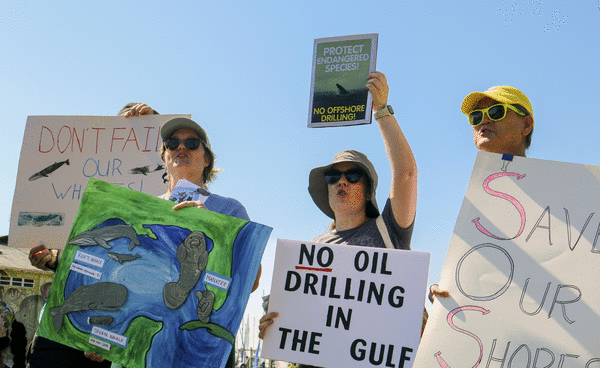
They also raise questions about whether the federal government could soon move to invalidate the Rice’s whale as a unique species, potentially freeing up the Gulf to more oil drilling at a time when the administration is actively proposing to drill closer to Florida shores.
During the hearing, Lutnick committed to use federal research funding to dig deeper into whether the Rice’s whale is a species of its own.
“We don’t want something that is inappropriate in the way of our fishermen and our energy,” Lutnick said.
The oil industry takes notice
Researchers who disagree with Davis’ opinion paper say the science is settled around the Rice’s whale being a unique species.
Davis said he wrote his opinion piece on his own, and that he wasn’t approached by the offshore oil industry or any private company, governmental agency or official before beginning or writing the article.
That changed, though, once the article was published.
About two months ago, Davis said he was contacted by EnerGeo Alliance, a Houston-based trade association representing oil and gas companies. He joined a Zoom call with the group’s top leaders, he said.
“They were trying to, in my opinion, get me to advocate for them and I told them I wasn’t going to,” Davis said. “I could see where it was potentially going: into a situation where I would be asked to give expert testimony in an advocacy position for them. And I said I wouldn’t do that.”
Davis said he would give them scientific advice at no charge, but wouldn’t take a political stance.
Federal records show EnerGeo has fought expansions of Rice’s whale protections in the past. In October 2023, the group’s scientific director, Alex Loureiro, advocated against expanding habitat protections for the Rice’s whale in the Gulf.
A proposal to establish a broad protected zone in the Gulf for the whales was “unscientific, overly broad,” Loureiro wrote.
Emails show that the industry group tried to push the bounds of Davis’ findings to a conclusion that would be more favorable to oil and gas companies in a “literature summary” of his work, which was provided to its industry members.
At one point, an EnerGeo representative asked Davis if they could summarize his work as saying that Rice’s whales could not be considered their own species without further analysis.
Davis, who has worked at Texas A&M for nearly four decades, pushed back on that framing in the emails, which he shared with the Times.
“The proposed revision materially alters the meaning of the statement,” Davis wrote back to the industry group in March, saying EnerGeo’s proposed wording “goes beyond the interpretation presented in my article.”
Nikki Martin, president and CEO of EnerGeo, said the group ultimately accepted his feedback and never intended for Davis to testify in Washington, D.C., or anywhere else.
“As part of our role representing the industry, our science team engages with scientists and academics on topics relevant to the industry,” Martin said in a statement.
Davis said he first learned about the exchange between Lutnick and Britt when the Times emailed him a video clip. In the video, Sen. Britt cites Davis’ paper and asks Lutnick whether his agency would consider removing the whale from the endangered species list.
“I can’t emphasize enough the implications of misclassifying these whales as endangered,” Britt said. “The listing created a substantial national security risk.”
Davis’ first thoughts when he watched the interaction?
“It was a sham question so Lutnick could get his ideas out into the committee,” Davis said. “Now the administration has waded into this without proper understanding, and they’ve jumped into an academic discussion and kind of blown it up.”
“And that’s bad,” he continued. “There’s no reason for them to do that right now, except from a political perspective.”
_____
©2026 Tampa Bay Times. Visit at tampabay.com. Distributed by Tribune Content Agency, LLC.





Comments