Sonic booms in store Monday morning with 1st SpaceX Falcon Heavy launch since 2024
Published in Science & Technology News
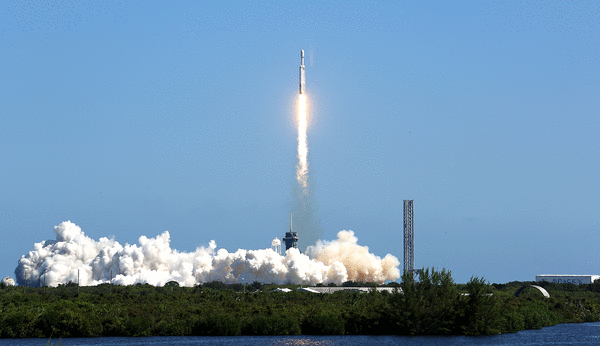
Central Florida could be in store for pair of double sonic booms Monday morning with the planned returned landing of both of the side boosters for the first SpaceX Falcon Heavy launch since 2024.
The company is targeting an 85-minute launch window that opens at 10:21 a.m. for the heavy-lift rocket flying on the ViaSat-3 F3 mission from Kennedy Space Center’s Launch Pad 39-A. A backup window falls to Tuesday opening at 10:17 a.m.
Space Launch Delta 45’s weather squadron forecasts a 70% chance for good conditions, which climbs to 90% in the event of a 24-hour delay.
Of note, there is a second launch slated for later Monday, of a United Launch Alliance Atlas V rocket on the Amazon Leo 6 mission, slated for a window from 8:52-9:21 p.m. from Cape Canaveral Space Force Station’s Space Launch Complex 41. SLD 45 forecasts an 85% chance for good conditions Monday night, and 90% chance if delayed to Tuesday.
For the Falcon Heavy launch, the two side boosters are targeting landings at two different launch complexes on neighboring Cape Canaveral Space Force Station, with one set to touch down at the new Landing Zone 40 adjacent SpaceX’s regular launch site for its Falcon 9 rockets, and the other heading back to Landing Zone 2, a few miles south within what had been Launch Complex 13. SpaceX’s lease of the use of LZ-2 ended last year, and a new landing zone at KSC’s 39-A complex has yet to be completed.
This is the 22nd flight for one of the boosters and second for the other side booster.
The loud crack-crack of the rocket boosters’ return breaking the sound barrier could be in store for parts of Central Florida about eight minutes after liftoff.
“There is the possibility that residents of Brevard, Orange, Osceola, Indian River, Seminole, Volusia, Polk, St. Lucie, and Okeechobee counties may hear one or more sonic booms during the landing, but what residents experience will depend on weather and other conditions,” SpaceX stated in an advisory.
SpaceX early on in the rocket’s career gave up trying to recover the center stage on Falcon Heavy flights, so that middle booster will instead fall into the Atlantic after its finishes the job of pushing the ViaSat payload on its way to a geosynchronous transfer orbit. This is ViaSat’s third and final communications satellite for a constellation that when operational will cover the entirety of Earth from about 22,000 miles altitude. The ViaSat-3 F3 is targeting coverage of the Asia-Pacific region.
“Once ViaSat-3 F3 is in service, the completed ViaSat-3 constellation will become a cornerstone of our unified, global, high-capacity network,” said company Chairman and CEO Mark Dankberg. The first satellite launched in 2023, also on a Falcon Heavy, and entered service in 2024 while the second that launched on a United Launch Alliance Atlas V last November remains in testing. It has both civil and government customers.
This marks only the 12th time Falcon Heavy has launched. It made its debut to much fanfare launching Elon Musk’s Tesla roadster to space in 2018. But it has not flown since October 2024, when it launched the Europa Clipper mission for NASA headed for Jupiter’s moon Europa.
Falcon Heavy is the second-most-powerful active rocket launching from the Space Coast behind NASA’s Space Launch System rocket, which recently flew only its second mission with the Artemis II launch on April 1.
The Falcon Heavy, essentially three Falcon 9’s strapped together outfitted with 27 Merlin engines across the three first stages, produces 5.1 million pounds of thrust on liftoff, more powerful than Blue Origin’s New Glenn or ULA’s Atlas V and Vulcan rockets.
This will be sixth different type of rocket to launch from Florida this year, following missions flown on Falcon 9’s, the SLS, ULA’s Atlas V and Vulcan rockets and Blue Origin’s New Glenn. It marks the 30th mission from the Space Coast for 2025 and only the second from KSC following the Artemis II launch since SpaceX moved all of its Falcon 9 missions over to its Canaveral site at SLC-40.
Falcon Heavy’s presence on the Space Coast has been sporadic, with long droughts between launches before. It went more than three years between its third and fourth launches from 2019-2022. And it has now been more than 1 1/2 years since the last launch.
But there are several more flights on tap this year:
Astrobotic Technology will try for the moon again with its Griffin lander. This is a much larger lander than Astrobotic’s Peregrine lander, which launched on the debut mission of ULA’s Vulcan in 2024, but suffered damage after deployment so it never made it to the moon. It was also NASA’s first Commercial Lunar Payload Services mission, which has since been followed by landers from Intuitive Machines and Firefly Aerospace. All have at least made it to the moon, although only Firefly’ lander stuck its landing successfully. That flight could come as early as July.
Also on the docket is NASA’s Nancy Grace Roman Telescope, designed to study dark energy, dark matter and exoplanets on a five-year mission during which scientists expect to catalog and study more than 100,000 planets among hundreds of millions of galaxies and billions of stars. Originally targeting launch in 2027, NASA recently announced the telescope will be ready for launch as soon as early September, coming in about eight months ahead of schedule and under budget.
And the Space Force has a classified payload on the USSF-75 mission, which would be the fourth national security mission flown on a Falcon Heavy, and could fly before the end of the year.
Falcon Heavy may have a limited lifespan in the coming years as SpaceX continues to develop the new Starship and Super Heavy rocket, which would take over the heavy-lift responsibilities for Falcon Heavy.
While those launches for now remain test missions from SpaceX’s launch site Starbase in Texas, the company continues to build out what will be its first operational launch tower at KSC’s Launch Complex 39-A adjacent to the pad from which Falcon Heavy will launch.
Just this week, SpaceX announced it was retiring one of its two Atlantic-based droneships it had been using for booster recoveries. The ship named Just Read the Instructions brought back to Port Canaveral one final booster after 156 landings. SpaceX announced the droneship will now be focused on Starship operations.
“With 39A becoming a primarily Falcon Heavy and Starship pad, we don’t actually need two operational droneships on the east coast to maintain our Falcon manifest,” said SpaceX vice president for launch Kiko Dontchev on X. “Think of pads/drone ships like airplane runways where you need a landing runway for each takeoff runway (ideally they are the same runway I.e. starship).”
The remaining droneship, A Shortfall of Gravitas, can support four-day launch cycle time while SpaceX will continue to use primarily LZ-40 for return-to-launch-site missions, Dontchev said.
Just Read the Instructions will now join SpaceX’s ship You’ll Thank Me Later to transport Starship and Super Heavy hardware from Texas to Florida. SpaceX has said it would have its first operational launch from KSC before the end of the year from KSC while it continues to also build out two more launch towers at Canaveral’s Space Launch Complex 37.
Work also continues on the Florida version of the Gigabay rocket manufacturing site, part of SpaceX’s $1.8 billion infrastructure investment. Once complete, Florida-based launches will get their hardware from that rocket factory, but for now, all the boosters and upper stages come from Texas’ Gigabay site, and have to sail over to the Space Coast.
When it does launch, Starship and Super Heavy will dwarf the power of both Falcon Heavy and NASA’s SLS. The massive rocket produces nearly 17 million pounds of thrust on liftoff, and produces a more potent sonic boom when its booster returns to the launch site.
The Super Heavy booster is designed to be caught by the two swiveling arms called “chopsticks” on the launch tower, while the upper stage is designed to potentially land back at the launch site as well after making at least one orbit of the Earth. Those return flights will also bring potential sonic booms across Central Florida with a return trajectory that will take it across the state from West to East, similar to how the space shuttles used to land back at KSC.
SpaceX, though, has been delaying its most recent attempts to launch a new version of Starship from Texas called Version 3. SpaceX founder Elon Musk most recently indicated it would try for a May launch from Texas on what would be the rocket’s 12th suborbital flight. The 11th launch came in October, the final launch of the Version 2 Starship.
NASA’s SLS, meanwhile, won’t fly again until at least mid 2027 on the Artemis III mission.
So for now, the Falcon Heavy remains the big rocket show in town.
_____
©2026 Orlando Sentinel. Visit orlandosentinel.com. Distributed by Tribune Content Agency, LLC.






Comments