South Carolina school reportedly built on land coated with polluting industry's waste
Published in Science & Technology News
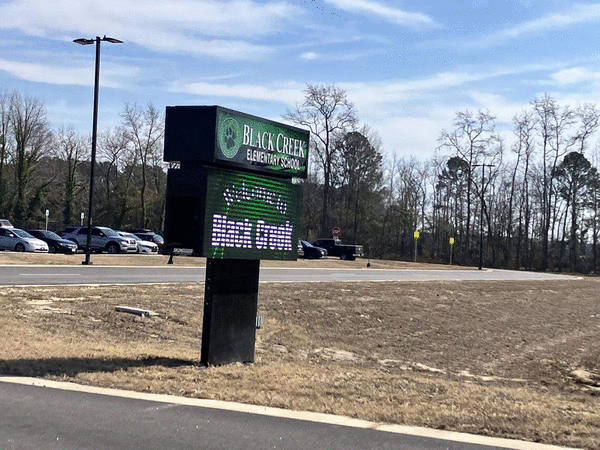
COLUMBIA, S.C. — South Carolina’s environmental agency plans to test the soil at an elementary school near Darlington for toxic forever chemicals after learning the property may have been a disposal site for a textile plant’s contaminated sewer sludge.
The S.C. Department of Environmental Services says it has records showing that 91 tons of Galey and Lord’s waste sludge were spread on part of the property where Black Creek Elementary School now stands. Sludge basins at the Galey and Lord plant have been found to contain elevated levels of forever chemicals.
In 1998 and 2001, Galey and Lord representatives deposited sludge on about 55 acres of what later became the Black Creek school property, the agency says, as the company sought places to dispose of the waste generated at the textile factory in nearby Society Hill. Department records indicate sludge may also have been spread there in 2006.
The entire tract where Black Creek Elementary was built last year is on more than 100 acres that a Darlington County businessman sold to the county school district in 2022.
Environmental Services will begin testing property in coming weeks, while the U.S. Environmental Protection Agency is continuing a broader investigation of more than 10,000 acres Galey and Lord targeted for sludge disposal more than 25 years ago.
Among other things, the EPA is trying to determine if farmland that received sludge as fertilizer from Galey and Lord should become part of a federal Superfund cleanup effort already underway at the abandoned factory. State and federal agencies said the sludge was safe to use in the 1990s and early 2000s. But it has since been discovered that sewer sludge often contains toxic chemicals, including PFAS.
“We had requested the EPA sample this area as part of its Galey & Lord investigation and it agreed to do so,’’ according to a statement from the Department of Environmental Services. “However, because we don’t know how soon the EPA will be able to perform this sampling, we’ve communicated with EPA that we will conduct the sampling in the coming weeks and share the data with EPA.‘’
The Department of Environmental Services and the Environmental Protection Agency are looking into the matter as concerns rise in Darlington County about the past – and continued – use of sludge as a crop fertilizer in the farming-rich area.
“The SC Department of Environmental Services (SC DES) is the lead agency for the school site, and SC DES is coordinating with the Darlington school district,’’ EPA spokesman Dwight Wingfield said in a March 17 email. “EPA is assessing the matter and is in contact with SC DES to determine whether EPA support is needed for soil sampling at Black Creek Elementary.’’
While it’s unknown if there is any exposure risk to children at Black Creek Elementary, agencies are paying attention because of how forever chemicals can threaten health.
Extended exposure to forever chemicals can cause certain types of cancer, thyroid problems, kidney damage and immune system deficiencies, among other things.
People can be exposed by consuming water or food polluted with the chemicals or coming in contact with material that contains forever chemicals. Forever chemicals, also called PFAS, were once used widely in a variety of manufactured products, including textiles.
Black Creek Elementary School is between U.S. 52 and and Leavensworth Road in the rural Floyd area of Darlington County. About 700 students from pre-school to the fifth grade attend Black Creek Elementary, which opened last fall.
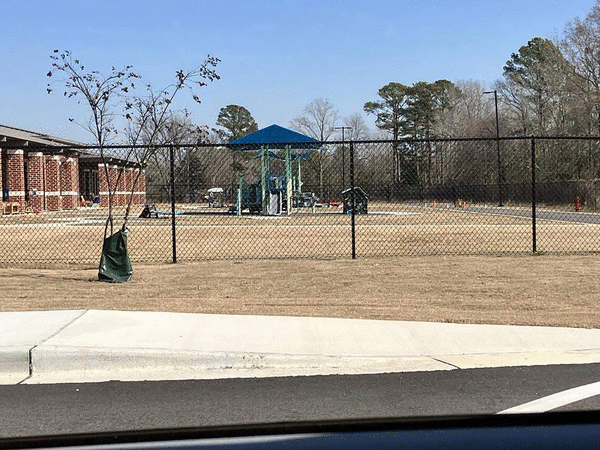
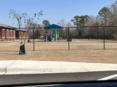
Outside the one-story brick building is a playground. The school is served drinking water by a local utility.
Major concerns about PFAS contamination from sewer sludge center on the toxins tainting soil where crops are grown or where people come in contact with the dirt. PFAS in sludge also can seep through the dirt and into the groundwater many people rely on to supply backyard wells.
Preliminary investigations by state and federal regulators have found dozens of wells near sludge fields are polluted in Darlington County. Researchers from Yale University are now studying whether some of the crops grown in PFAS-polluted soil near Society Hill are pulling in toxins.
County property records show that the Darlington County School District bought more than 110 acres from a local businessman in May 2022 for $1.6 million. But the school district says it knows nothing about sludge at the school site.
“We have no knowledge of any sludge having been applied to the Black Creek Elementary School property,’’ school district spokeswoman Audrey Childers said in an email.
“We have not been contacted by the Department of Environmental Services or the EPA regarding this, and we have not had any reason to reach out to them.’’
An open records request to the district from The State newspaper turned up an environmental study that looked for evidence of contamination on the property. But the more than 300-page consulting report, completed in early 2022, did not mention sludge disposal on the land the district would eventually buy.
Dave Hargett, a consultant who has extensively researched sludge issues in eastern South Carolina, said Darlington County’s school district was right to have commissioned the environmental study. But he’d like to know more about why the report didn’t mention sludge disposal on the land, he said.
The study, known as a Phase I environmental assessment, is a standard part of many real estate transactions, Hargett said. Those buying land can be exposed to liability for pollution if they don’t conduct such studies to make sure prospective acquisitions are free of major environmental problems, he said.
Galey and Lord opened in 1966 in Society Hill, a small town just up the road from Darlington. For decades, it manufactured textiles, while employing hundreds of people in an area where jobs were needed. But the plant experienced a series of environmental problems, and after promising to fix them, shut down in 2016.
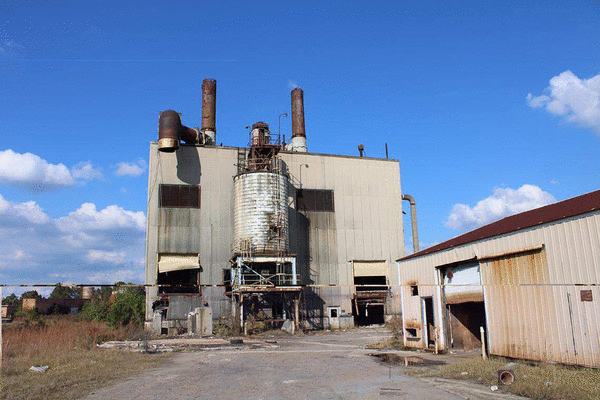
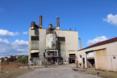
Today, the industrial site is a rusting complex of old buildings and waste basins. The EPA has declared the Galey and Lord property a Superfund site and is considering expanding the Superfund status to up to 10,000 acres of agricultural fields where the plant’s sludge was spread from the early 1990s to 2013. A 2021 EPA study found high levels of PFAS in basins where the sludge was stored before shipping it to farms.
Public meeting planned
The issue of sludge spreading has become a hot one in Darlington County in recent years, not only because of Galey and Lord’s sludge being applied to farmland in the past, but also because the slurry from other sources is still being applied.
A public meeting is scheduled for the Darlington County library at 5 p.m. Thursday to discuss a proposal to spread sludge from chicken plants and other sources on more than 450 acres. A key question people have asked is whether sludge from chicken plants is being put on sites where Galey and Lord’s sludge was once applied. Much of the chicken sludge is coming from out of state.
Marshall Flowers, who sold the land to the school district for construction of Black Creek Elementary, said he’s concerned about the flow of sludge from chicken plants to Darlington County.
But he said he doesn’t remember Galey and Lord sludge ever being spread on what became the school property. The land at one point in the past included a dairy and would not have been a place suitable for sludge, said Flowers, whose family has farmed the area for generations.
Even if sludge did go on the school site, the soil is likely clean because so much earth-moving work was done during construction of Black Creek Elementary, Flowers said. The school sought the property because it was in a good location, he said.
Information about whether soil was removed from the property and replaced with fresh dirt was not available.
Despite assertions by the district and Flowers, data reviewed by consultants for a nature preserve indicate at least part of the site had sludge applied to it more than 25 years ago, as the Department of Environmental Services said in its recent email.
Department records analyzed by consultants for the Chesterfield County preserve show that low to moderate amounts of sludge were applied to the property. In an email earlier this year to Chesterfield County preserve founder Brad Turley, the Department of Environmental Services said a field owned by Flowers “was land applied in 2006.’’ The agency separately told The State that sludge was spread in 1998 and 2001.
Kershaw County lawyer Vincent Sheheen, who is representing Darlington County property owners in a lawsuit against PFAS manufacturers, said concerns about sewer sludge on a school site are disturbing.
But he also said the potential impact of sludge at the Black Creek Elementary site reflects wider problems. Not only are there questions about how PFAS might affect people’s health, but property values could drop on the 10,000 acres that were approved for sludge, he said.
Sheheen is the mayor of Camden and a former state senator whose law firm has done extensive work on PFAS pollution on Darlington County farmland.
“Our position is that PFAS has devalued property – that’s pretty simple,’’ he said. “If the sludge was spread in any amount of volume, there are forever chemicals on the property.’’
©2026 The State. Visit at thestate.com. Distributed by Tribune Content Agency, LLC.






Comments