Florida was on the verge of restoring this beloved river. What happened?
Published in Science & Technology News
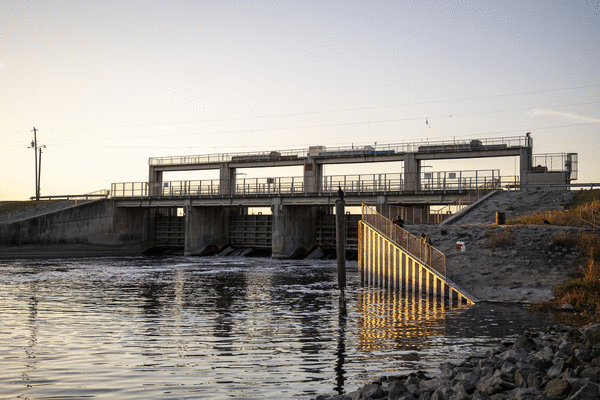
TAMPA, Fla. — A legislative proposal that charted the clearest course in years for reviving Florida’s storied Ocklawaha River, dubbed by supporters as the state’s “next great restoration project,” appeared destined for success last month.
Over several weeks, the bill that required a state plan to restore the winding north-central Florida river cruised through political committees in the annual legislative session with broad and bipartisan support.
The measure called for restoring the Ocklawaha’s natural flow, long stifled by the Rodman Dam, which was built in the late 1960s for the now-abandoned Cross Florida Barge Canal project. Human engineering, then spurred by the promise of economic growth, submerged more than 20 freshwater springs and cut off miles of natural river channel.
All told, this year’s road map for restoring the Ocklawaha River had only three “no” votes in the 120-member House, and just one “no” vote across three Senate panels. But despite the widespread support, the proposal was never called for a final Senate vote before the regularly scheduled session reached its end Friday.
“The question is, why?” said Margaret Spontak, executive director of the Great Florida Riverway Trust.
“You never know in politics what’s happening behind the scenes, but clearly something big went on,” Spontak said.
“Then it all fell apart.”
Was the bill ‘suffocated in the dark’?
At every step of the political process this year, lawmakers lauded the bill’s sponsors for trying to right the environmental wrongs of the past. They said the proposal took a measured approach that brought businesses, wildlife experts, anglers and rural riverside communities to the table.
The bill has “many benefits to our economy, to the environment,” Rep. Lindsay Cross, a St. Petersburg Democrat, said before she joined a unanimous House committee vote Jan. 20.
“It’s exactly what we need to do,” Sen. Ralph Massullo Jr., an Inverness Republican, said before voting to move the proposal forward Feb. 12.
Amid the bill’s unified momentum, longtime river restoration advocates drove to Tallahassee from Gainesville, St. Augustine, Ocala and Jacksonville on Feb. 19. They wanted to “witness firsthand the historic moment” when the Senate would vote on Ocklawaha restoration — what they hoped would be a new chapter in the movement to reverse the course of humans’ intervention upon nature.
That vote never happened.
River advocates learned en route to the Capitol that the bill was pulled from the Senate’s agenda and temporarily postponed. In the final minutes of a four-hour session meeting Feb. 19, Senate President Ben Albritton said the bill wouldn’t be heard.
The proposal officially died when lawmakers adjourned last week.
In a statement Friday, Spontak blamed Albritton for pulling the plug on the proposal before state senators could render their verdict.
“Special interests got in the Senate president’s way,” Spontak said. She was referring to Save Rodman Reservoir Inc., a nonprofit advocating to keep the 9,500-acre reservoir intact to preserve a local outdoor recreation economy, including for anglers who hail the water body as a premier bass fishery.
The group’s executive director, Larry Harvey, is also a Putnam County commissioner. Spontak said the commission “has the ear” of Albritton and Sen. Tom Leek, R-Ormond Beach.
“No matter where you stand on Ocklawaha River restoration, this much is true: A bill this consequential should not have been suffocated in the dark by Senate President Albritton,” Spontak said.
A spokesperson for Albritton declined to comment, instead pointing to statements he made Friday, when a Politico reporter asked him about Spontak’s claims.
“In the dark of night? I disagree with that,” Albritton told environment reporter Bruce Ritchie. “The Senate as a whole had concerns about it, and that’s the way it works.”
Asked whether he believed the measure would have passed if given a floor vote, Albritton didn’t say. More than 20 senators had already voted in favor of the proposal as it moved through the legislative process.
Steve Miller, president of Save Rodman Reservoir, said in a statement that the group’s outreach to Albritton and Gov. Ron DeSantis, and support from local representatives like Leek, is why “the voice of the people prevailed.”
“We launched a true grassroots effort to usurp the (lobbyists) who show up in force to give the appearance of widespread support,” he said.
In an interview with the Tampa Bay Times, Harvey said he was “thrilled that the legislators paid attention to the narratives we were telling them.”
Last year, after the Putnam County Commission said it opposed removing the Rodman Dam and Leek asked DeSantis for a veto, the governor removed $6.25 million proposed in the state budget for river restoration, according to Politico.
At a March news conference in Yulee, a reporter asked DeSantis how he felt about removing the dam.
“A lot of people like the Rodman Dam,” said the governor, who once represented Putnam County, where the dam is located, as a member of Congress.
He suggested that removing the dam would be “rash” and would “pull the rug out” from a community that relies on the reservoir for fishing.
Would DeSantis have vetoed the Ocklawaha bill, had it made it to his desk this year?
“Without seeing what the bill would have looked like in its final form had it passed and reached his desk, we are unable to comment or assume what the governor’s actions would have been,” DeSantis spokesperson Molly Best said in a statement.
A window into a healed river
The lack of action from the Senate deepens a decadeslong debate about how to revitalize a waterway recently deemed one of America’s most endangered rivers.
The Ocklawaha River, lined with wading birds like great blue herons and aquatic plants like spatterdock and pickerel weed, is one of Florida’s most ecologically important waterways, according to the Florida Museum of Natural History. But it’s also one of the most influenced by humans.
What to do with the 7,200-foot Rodman Dam, and its upstream reservoir, has long been a central question.
In 2021, the U.S. Fish and Wildlife Service advocated for removing a portion of the dam to create a free-flowing river, allowing for wildlife like manatees and fish to traverse unimpeded between the Ocklawaha and the St. Johns River.
Giving manatees access to warm-water springs in the Silver and Ocklawaha rivers “would be a major positive contribution” to the future health of Florida’s manatee population, the federal government wrote to regional water managers. If the dam is removed, “fish species diversity and abundance throughout the Ocklawaha River and Silver River will increase.”
Floridians recently got a rare glimpse of what a healthy, free-flowing Ocklawaha River might one day look like.
Every few years, the Florida Department of Environmental Protection, which manages the reservoir, lowers water levels to clear out an overgrowth of aquatic plants.
Last fall, as the state began to draw down the Rodman Reservoir, a “ghost forest” began to resurface: Remnants of once-bustling bald cypress trees emerged from the lowering water, followed by shrouded freshwater oases like Cannon and Tobacco Patch springs. A window of what once was, and what could one day be again.
What comes next for the Ocklawaha? The sponsor of the Senate legislation, Lake Mary Republican Sen. Jason Brodeur, told Florida Politics he is committed to restoring the Ocklawaha.
Spontak said her team at the Riverway Trust will formulate a plan for how to reintroduce a restoration proposal for next year.
“The good thing is, we have never gotten this close,” Spontak said. “The worst thing we could do now is not move forward when we’ve gotten this far.”
©2026 Tampa Bay Times. Visit at tampabay.com. Distributed by Tribune Content Agency, LLC.






Comments