These Illinois dairy and beef farms make raising methane-belching cows part of the climate solution
Published in Science & Technology News
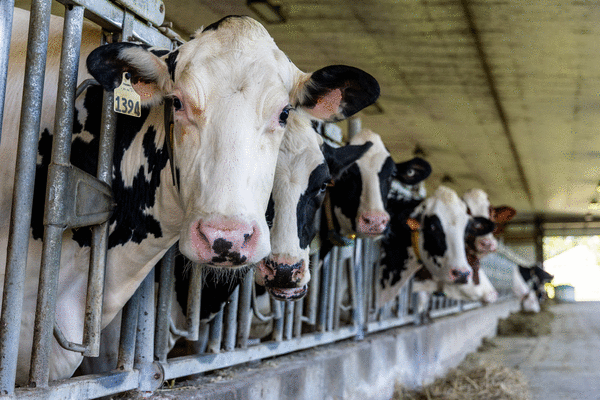
CHICAGO — Illinois is a top agricultural state, generating billions of dollars annually, but even where stalks of corn and acres of soybean vastly outnumber its 400,000 head of cattle, cows raised for beef and dairy account for an outsize portion of the industry’s methane emissions.
A single cow raised for meat produces between 154 and 264 pounds of methane per year, according to the U.S. Environmental Protection Agency, meaning 333,000 beef cattle in Illinois last year could have released between 51 million and 88 million pounds of methane into the atmosphere. This is equivalent to emissions from 151,000 to 260,700 gasoline-powered cars driven in one year.
Cattle produce this powerful, heat-trapping gas through a digestive process called enteric fermentation, which represents over 25% of greenhouse gas emissions from the agricultural sector. As climate change from human activities intensifies, experts say addressing this source of emissions by implementing sustainable and innovative practices — from diet additives to regenerative grazing — can offer quick wins in the fight against global rising temperatures, which is already presenting new challenges to raising cattle.
Cows can spend over eight hours a day regurgitating their partially digested meals to chew again. As bacteria break down food in a specialized stomach, the process releases methane, which cows then belch into the air. It’s part of a natural cycle as the gas is returned to the ground by plants when it converts back into carbon dioxide after 12 years in the atmosphere.
This means the greenhouse gas is “created, and destroyed or absorbed, at kind of a relatively similar rate,” said Josh McCann, associate professor of animal sciences at the University of Illinois Urbana-Champaign, who leads research into nutrition for beef cattle. “And yet, our environmental, atmospheric methane is not going down. It’s increasing pretty rapidly.”
“That cycle doesn’t exist in a bubble. And what we know is that other sources of methane have significantly increased,” said John Tauzel, associate vice president of global agriculture methane at the nonprofit Environmental Defense Fund. These other sources include fossil fuels such as natural gas, oil wells and coal mines, as well as waste from landfills and water treatment.
An often-used analogy equates methane being released into the atmosphere to water running from a faucet into a bathtub, Tauzel said, which people use to argue: “As long as the methane coming into the atmosphere is equal to the methane going out of the atmosphere — into the bathtub, out of the bathtub — we’re all set, the world is fine.”
“The problem is, we don’t have one faucet from cow (methane) coming into the world, into the bathtub. We have multiple faucets now, and we’re turning those up, actually,” he said. “So that the global budget, the global outcome of methane, is now overflowing. We have way too much.”
Atmospheric methane concentrations have more than doubled over the last two centuries, contributing to up to a third of global temperature increases since the Industrial Revolution. Most methane comes from human activities, of which 40% is from agriculture, 35% from oil and gas production and 20% from landfill waste.
President Donald Trump’s U.S. Environmental Protection Agency announced in late November it would delay Biden-era deadlines for the oil and gas industry to limit methane emissions. Earlier in September, the agency proposed a new rule to end the greenhouse gas reporting program for large emitters, including landfills, even as population growth has led to more waste.
At a time when the federal government is loosening regulations across methane-emitting industries, addressing agricultural methane can present quick wins in climate mitigation.
It’s not that cows are the issue, McCann said. But they offer an opportunity to address a greenhouse gas that is 80 times more potent than carbon dioxide over 20 years and reduce its immediate impact, thus slowing the rate of climate change.
Overall, livestock production has only become more efficient in the United States in recent decades, which keeps methane emissions in check. Improved genetics and nutrition mean fewer cows are needed to meet demand: for instance, from 130 million head of cattle in the 1970s to 94 million nowadays.
“We have about 28 million beef cows in the U.S., which is the least amount of cows we’ve had in a very long time since 1951,” McCann said. “So our beef cow herd is relatively small in terms of numbers of cows — and yet we’re producing almost as much beef as we’ve ever produced.”
This means fewer animals are emitting methane for the same production value.
According to the Illinois Farm Bureau, cattle farmers are producing 60% more beef with 40% fewer carbon emissions than 50 years ago, and each gallon of milk produced by dairy farmers creates 63% fewer carbon emissions than in 1944. The United States produces the most sustainable beef globally, according to several industry groups, with the lowest greenhouse gas emissions per pound of beef in the world over the last few decades.
“From a methane standpoint, we don’t have more cows, we have less cows, and those cows are more efficient. We’re doing more with less, and yet, in the same time period, atmospheric methane is a very different kind of story,” McCann said. “Now, at the same time, it doesn’t mean we shouldn’t do anything. There are ways that we can reduce methane in the agriculture and livestock sectors. And so I’m all game to help make cows part of the solution.”
To significantly reduce the impacts of methane, the industry doesn’t even need to become zero-emissions like climate goals that are specific to carbon dioxide, Tauzel said.
A global pledge to reduce methane emissions from livestock by at least 30% from 2020 levels over the next five years, experts say, can limit global warming to 2.7 degrees Fahrenheit — which is the aim of carbon neutrality — and even reduce warming by over 0.36 degrees by 2050.
“We can’t reach our goals of reducing methane if we don’t also include agriculture in the solution set,” Tauzel said.
Some dairy and beef producers are finding that committing to more sustainable practices that reduce methane or capture carbon offer additional benefits: Managing their manure differently to use as fertilizer on their land, rotating cattle on pastures and offering diverse diets are tried-and-true ways to enhance their land’s productivity and make their animals happier.
For instance, a rotational grazing method offers Doug Hanson’s cows a variety of feed throughout the year. A fourth-generation beef producer located in Danforth, 85 miles south of downtown Chicago, Hanson has been employing this method for 20 years. It earned him the Illinois Beef Association’s 2025 Environmental Steward of the Year award.
On a recent weekday, his herd quietly grazed on a paddock of permanent pasture, covered in a variety of grasses such as fescue, orchard grass and perennial rye, as well as white and red clover. Across the 70-acre property, pastures like it are interspersed with seasonal ones that have cover crops. The cattle get moved between pastures to let the plants and soil breathe and regenerate.
“As we move through them, you’ll see that they are all different,” he said, driving a utility vehicle past a pasture planted mostly with alfalfa. Two calves looked longingly into the locked paddock.
Instead of feeding the animals grains to bulk the cows up to market weight faster, the rotational grazing allows the family to take its time and produce high-quality meat, which Hanson’s daughter Maddie later sells out of Hanson Family Meats in Gilman, 6 miles south.
“I’ve had a lot of customers like, ‘This is the best meat we’ve ever had. We like that you slow-grow them on pasture,'” she said.
Hanson also spreads his cattle’s manure as fertilizer. Alongside the cover crops and the rotation in grazing, it has improved the soil’s health and nutrient availability across all his pastures compared with that of tilled, single-crop farmland or overgrazed, eroded grassland.
“You can get more of what Mother Nature already put in that ground,” he said.
By nature, cows are going to do what they’re going to do: ruminate, burp and release methane. But approaches like Hanson’s can lock carbon in the ground, offsetting that environmental impact — and benefiting pastures by letting soil health and biology regenerate in between feedings, which improves fertility and water retention.
To make agriculture part of the solution to greenhouse gases, experts say, industry and government need to invest in this kind of win-win strategy for dairy and beef producers.
Fighting methane with food and poop
At a state-of-the-art dairy farm in St. Charles, 40 miles west of Chicago, Sarah Lenkaitis jokes that her cows eat “way better” than she does.
As is industry standard by now, the Lenkaitis family works closely with a nutritionist who visits the farm every month to ensure the best, most efficient diet for the animals. It mainly includes dry hay, a protein mix, haylage and ground corn, and is complemented by palm fat and byproducts from other industries like corn gluten, roasted soybean meal, wheat middlings and cereal grain. In contrast, beef cows tend to graze on pastures for most of their lives. In Illinois, that is complemented by hay during winter when the ground is frozen.
“It’s a very delicate dance; everything’s gotta work just right,” Lenkaitis said. “And it’s a very methodically formulated ration.”
The farm is currently milking 75 registered Holstein cows, making it average-sized for Illinois and putting their operations on the smaller side for the country, where the average dairy herd size is about 350 cows. Each of their cows produces about 8 to 9 gallons of milk a day.
Even as dairy cow diets have been fine-tuned significantly to improve productivity, thus limiting the industry’s overall emissions, nutrition still offers promising innovations that can even reduce the activity of methane-producing bacteria in cow guts.
For instance, Bovaer is a U.S.-approved feed additive that significantly reduces cattle’s enteric methane emissions by suppressing an enzyme involved in methane production inside the cow’s specialized stomach or rumen. It can most easily be added to the food of dairy cows, which have very controlled diets. Delivering the additive to grazing beef cows can be more challenging, Tauzel said.
“Can we get that Bovaer but in a salt block, for example?” he said, referring to a dietary supplement that cows get for deficiencies of sodium chloride. “Or another way that we can deliver that product without the cow having to take a bite, getting a bite at every meal, because they’re (eating at) pasture, not that casserole.”
However, it’s been challenging to persuade cattle growers to incorporate the food additives, since there is no additional benefit to the cows or the milk or beef they produce.
“It has a cost, but if it doesn’t elicit a production benefit,” McCann said, “how can you ask the producer to pay for something like that?”
Another diet supplement solution is seaweed. Specifically, red marine algae that, added even in small proportions to a cow’s daily feed, can reduce their methane emissions by as much as 80% to 90%, according to some studies. Some companies are beginning to explore ways that producers can obtain carbon offset benefits to reward the adoption of these practices.
Other related emissions from cattle come from the management of their manure.
At dairy farms like the Lenkaitis’ Holsteins, most methane likely comes from cow burps, and the rest from liquid manure systems, Tauzel said. In fact, the industry has continued to increase its methane as it has moved to store more liquid manure in pits or lagoons, he said, instead of depositing it in pastures where it would decompose with oxygen.
It’s another consideration for dairy producers who want to limit the environmental impact of their operations, like the Lenkaitis operation, where each cow produces some 15 to 20 gallons of manure a day.
Liquid manure leads to conditions without oxygen, where bacteria increase methane production, according to the EPA. Beef cows don’t have as much protein in their diets as dairy cows, so their manure is often more solid and dries quickly after falling to the ground — limiting methane emissions.
A few times a day at the Lenkaitis farm, an automated alley scraper slowly moves down the middle of the barn, pulled by a cable, collecting manure and pushing it into a pit. The manure is then pumped through a $100,000 setup that separates the liquids and solids from the manure by processing it through a series of roll presses to squeeze out the fiber that the cows were unable to digest.
“They’ve invested probably more than most farms have done so far in manure systems,” said Tauzel, who visited the operation in St. Charles over the summer. “That’s more capital-intensive for the farmer to implement, and so creating more incentives or better financing, better manure management programs and grants to help farmers — those are key ways to help us solve that methane that we can do, today, in dairy systems.”
After the liquid is separated from the solid fibers, the fibers are dried out, losing any bad odor and can be used as bedding for the cows, so the couple doesn’t need to purchase shavings or sand.
The liquid portion can also be used as nutrient-rich fertilizer that Andrew Lenkaitis said is easier to apply in the fields for the farm’s corn, wheat, hay, soybean and rye crops.
“I make about 75% of the fertilizer that I need,” he said. That, in turn, reduces their reliance on nitrogen fertilizers, which release another potent greenhouse gas, nitrous oxide.
Land use: A problem turned solution
Beef cows are often pastured before being moved to feedlots, but leaving them in a single spot for a long time can lead to overgrazing the land, which degrades the soil.
But grazing cattle doesn’t have to present a problem for soil health and biodiversity; if it’s well-managed, it can be a long-term solution to restore the land and even increase its productivity.
It’s a successful approach that Doug Hanson says he can attest to.
“This could be corn, soybean,” he said, gesturing to the grazing pastures at Hanson Land and Cattle in Danforth. “Most people don’t do this; they don’t take highly productive ground out of production.”
The land is productive in other ways, however. Hanson raises 50 mature cows and their calves on the farm’s 70 acres, which are divided into 16 paddocks of 4 to 5 acres each. Some of them are permanent pastures, over 20 years old. In others, summer feed is planted in the spring and winter feed is planted in the fall.
The cows get rotated between the permanent and seasonal pastures, allowing the grass and plants to rest and rebuild roots. Hanson further divides up each paddock with nylon wire on a portable reel for temporary fencing.
“They get this half for two days, they get that half for two days,” Hanson said, mimicking a diagonal split. Sometimes, they can go as small as separating it into quarters of 1 acre or so each. “Once we’ve moved through all four (sections), then you start right back at the beginning.”
While the strategy doesn’t necessarily reduce methane emissions, it stimulates plant growth and deeper roots, which capture more carbon, essentially offering a way to offset the cows’ environmental impact.
The changes also break up the animals’ routine, which Hanson says they love.
“My wife taught third grade. It’s no different than taking care of kids when they’re hungry,” he said. “As soon as I open the next gate, then they’ll go nuts, just nuts over that. Because they know if we open that next gate, that they’re going to a new pasture.”
In the winter pastures, a 10-way mix of grazeable cover crops can include turnips, radishes and grains like oats, winter rye and barley; in the summer pastures, it can include rape, buckwheat, and sorghum-sudangrass.
“We feel that by giving these cows diversity, … that their rumen is happier,” he said.
And so is the fertile Midwestern soil.
Cover crops pull nutrients from below the surface of the ground back up top, increasing organic matter that has been historically depleted through tillage in the state, and ultimately improving fertility. Hanson also collects the manure, which he later spreads on the cover crops to help increase the soil’s fertility even more.
The manure and cover crops allow for water to more easily infiltrate the ground, preventing erosion and runoff of nutrients such as nitrogen, unlike in overgrazed, compacted land.
South of Hanson’s farm, across a ditch and a dirt road, he stands in front of a massive pile of manure — a year and some 80,000 tons’ worth — sitting on the property where his father-in-law was raised, and where the family will plant 80 acres of corn next year.
“That’s a lot of s—,” he said.
Feeling the heat
When it comes to climate change and agriculture, McCann said he thinks cows end up being the scapegoat “too many times.”
“Culturally, we’re not very good at choosing nuance and third views, right? We’d rather just point fingers,” he said.
Cows are often blamed for their contributions to climate change, but they are also being affected by it.
Illinois ranks 16th among states in the country vulnerable to extreme temperatures, specifically increases in the number of severely cold and severely hot days, according to the Climate Vulnerability Index, a tool developed by the Environmental Defense Fund and Texas A&M University. This means crops will struggle to maintain regular growing cycles, but it also poses dangers to the health and well-being of livestock during hotter, longer summers.
“Climate change is happening, and cows live in that natural system, and as climate changes, that impacts how we raise cows, too,” Tauzel said.
Health impacts from heat stress affect cattle productivity, as metabolic stress, reduced nutrient absorption and increased mortality in embryos and poor sperm quality lead to lower weight gain, milk yield, beef quality and fertility.
A 2022 study found that, under a scenario of high greenhouse gas emissions, global production losses of meat and milk from heat stress were estimated to be $39.9 billion per year by the end of the century. Under a scenario of low emissions, production losses would be $14.9 billion per year. This means a 3.7% to 9.8% reduction in beef production worldwide.
In beef cattle, heat stress impairs the reproductive performance of nursing cows, decreases growth rate and worsens meat quality.
At Hanson Land and Cattle, the beauty of the winter feeding station — which was built with the help of a government grant — is that it works for different kinds of weather, said Maddie Hanson.
“When it’s really hot out, it gives (cows) still an open-faced barn,” she said, as the station is built like a pavilion. “They can still have shade, but then they can still be outside.”
Doug Hanson said some folks erroneously believe cows don’t need shade. “They do,” he said.
“They need shade,” his daughter interjected. “They have to have shade. It’s just like a person.”
Dairy cows, in particular, are sensitive to heat stress. The dairy sector has been estimated to bear over half of the costs of current heat stress to the livestock industry, according to the U.S. Department of Agriculture.
Impacts from climate change, such as drought, have also changed operations on Hanson’s farm — this year, dozens of acres of potential winter pastures won’t be grazed because a lack of rainfall has stunted plant growth.
Unusually dry weather like this forces beef farmers to begin feeding hay earlier than the usual start in January, increasing costs and reducing reserves for later months. It also delays plant regrowth in rotational grazing scenarios.
“The climate has changed, and it’s going to continue to change,” Hanson said. “So if we don’t change with it, then we’ll be like everyone else, we won’t have cattle here.”
____
©2025 Chicago Tribune. Visit at chicagotribune.com. Distributed by Tribune Content Agency, LLC.





Comments