Rick Steves’ Europe: Bone voyage: Exploring Europe's cemeteries and crypts


Every time spooky season approaches, I think back on some of my favorite European cemeteries and crypts. Over the years, I've popped into a lot of burial grounds – some peaceful and scenic, some eerie and evocative – with all revealing compelling stories of the past. While some high-profile places – such as the catacombs in Rome or Père Lachaise Cemetery in Paris – get a lot of press, many lesser-known sights are worth visiting, too. These are some of my favorites.
Naples, Italy: The quirky caves known as the Cemetery of the Fountains (Cimitero delle Fontanelle) are stacked with human bones and dotted with chapels. A thousand years ago, this was just a quarry cut into the hills north of Naples. But in the 16th century, churches with crowded burial grounds began moving the bones of their long dead here to make room for the newly dead. Later, these caves housed the bones of plague victims and paupers. In the 19th century, many churches again emptied their cemeteries and added even more skulls to this vast ossuary. Then a cult of devout locals started to "adopt" the remains. They named the skulls, put them in little houses, brought them flowers, and asked them to intervene with God for favors. If you visit this sight in Naples' gritty Sanità District, consider bringing some flowers. (And let your hotel know where you’re going… in case you never return.)
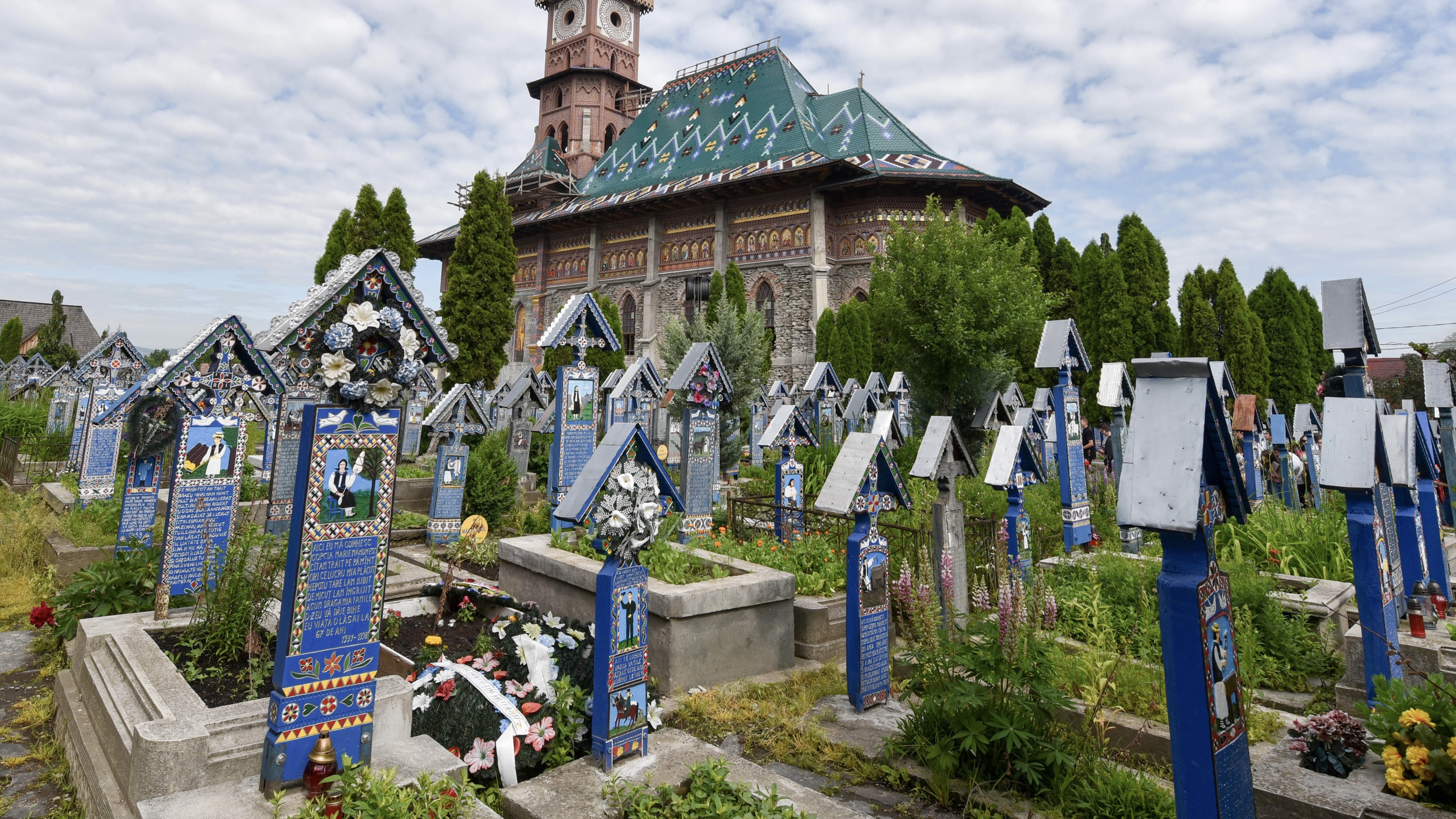
Maramureș, Romania: In 1935, a local woodcarver in northern Romania – inspired by a long-forgotten tradition – began filling a local cemetery with a forest of vivid memorials. Now known as the "Merry Cemetery," each grave comes with a whimsical poem and a painting of the departed doing something they loved. Although the cemetery is dubbed “merry,” many of the poems are downright morose. Tales of young lives cut short by tragic accidents, warriors mowed down in their prime, or people who simply never found happiness are a reminder that life can be anything but cheerful. Even if you can’t read the poems, the images speak volumes: weaver … loved bikes … television repairman … soldier … hit by a car … struck by lightning … nagging mother-in-law. Everything is painted a cheery blue to match the heavens where the souls are headed. It’s a poignant celebration of each individual’s life, a chronicle of village history, and an irreverent raspberry in the face of death.
Boyne Valley, Ireland: Just 30 miles north of Dublin are two enigmatic burial mounds at Brú na Bóinne. These 5,000-year-old passage tombs – Newgrange and Knowth – are massive grass-covered burial mounds built atop separate hills, each with a chamber inside that's reached by a narrow stone passage. Both are precisely aligned to the sun's movements so that a beam of light creeps down the passageway and lights up the chambers – Newgrange at the winter solstice, and Knowth at the equinox. Perhaps the ancients believed that this was the moment when the souls of the dead were transported to the afterlife, via that ray of light. At both sites, huge curbstones – carved with spirals, crosshatches, bull’s-eyes, and chevrons – add to the mystery. Thought-provoking and mind-bogglingly old, these tombs can give you chills.
Rouen, France: When the Black Death swept through northern France in 1348, it took the lives of two-thirds of this community. Dealing with the corpses was overwhelming. The half-timbered courtyard of Aître Saint-Maclou was an ossuary where the bodies were “processed” – dumped into the grave and drenched in liquid lime to help speed decomposition. Later, the bones were stacked in alcoves above the arcades that line this courtyard. The exposed wood timbers were later carved with ghoulish images of gravediggers’ tools, skulls, crossbones, and characters doing the “dance of death.” In this danse macabre, Death, the great equalizer, grabs people of all social classes. A cat skeleton displayed here in a glass case was found in the wall; local historians believe it was a black cat buried alive to ward off evil.
Palermo, Sicily: Recently I found myself surrounded by thousands of mummified bodies at Palermo’s Capuchin Crypt. Generally, when their brothers passed away, the Capuchin monks put the bones on show to remind people about their mortality. But the monks of Palermo didn't just display bones, they preserved entire bodies. Later, they realized they could charge wealthy parishioners for the privilege of being mummified, which became a fashionable way to be memorialized among some Sicilians. By the 1880s, the practice had become forbidden except in special cases, and about 4,000 bodies had been collected in their crypt. Today, the public is welcome to wander this collection of fully clothed and remarkably preserved bodies.
All over Europe, you'll find fascinating cemeteries and crypts to visit. When you do, you'll see that, even long after death, these bones and memorials still have something to say.
(Rick Steves (www.ricksteves.com) writes European guidebooks, hosts travel shows on public TV and radio, and organizes European tours. This column highlights some of Rick's favorite places and travel insights over a lifetime of exploring Europe and sharing his discoveries. You can email Rick at rick@ricksteves.com and follow his blog on Facebook.)
©2026 Rick Steves. Distributed by Tribune Content Agency, LLC.
(c)2026 RICK STEVES DISTRIBUTED BY TRIBUNE MEDIA SERVICES, INC.








Comments