Nvidia's $750 billion deals revive fear of AI circular financing
Published in Home and Consumer News
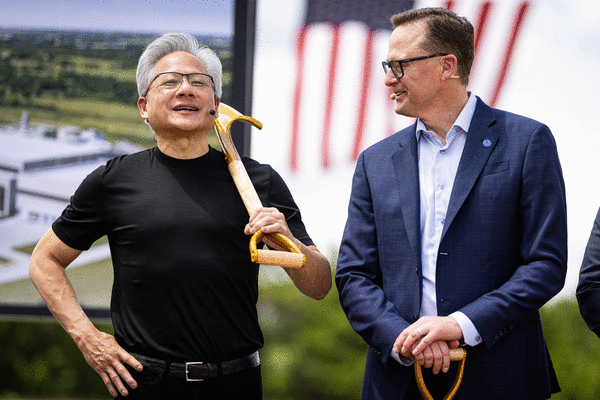
Nvidia Corp. is working on a fresh round of AI infrastructure deals potentially worth more than $750 billion, accelerating a streak of investments that skeptics warn is artificially inflating demand and valuations across the industry.
An artificial intelligence initiative with the parent of South Korean chipmaker SK Hynix Inc. unveiled late Friday is worth more than $500 billion, Nvidia said. The world’s most valuable company is also in discussions to provide a guarantee of as much as $250 billion to help OpenAI lease computing from a U.S. data center project, in what would be among the chipmaker’s biggest financing deals with a customer.
While critics have for months warned of the circular nature of such agreements — the companies Nvidia finances and takes stakes in typically buy or use its chips — the pace of the deals is only quickening. The risk with these transactions is they may create skewed incentives for business across a plethora of industries, spur bad decision-making and magnify losses if demand for AI fails to match lofty expectations. Nvidia is also in discussions to finance $350 billion of OpenAI’s purchases of its chips for the U.S. project, according to a person familiar with the matter.
“While Nvidia’s investments and partnerships reinforce confidence in long-term AI buildouts, investors remain concerned about circular financing,” said Gary Tan, a portfolio manager at Allspring Global Investments. “Capital is increasingly being used to fund future AI customers and infrastructure deployments.”
The latest moves by the dominant maker of AI processors add to a frenzy of deals across the ecosystem by the company in the past couple of years. It’s taken stakes in developers such as OpenAI and fellow chipmakers like Marvell Technology Inc., aiming to fuel industrywide growth.
Industry peers are opting for similar arrangements. Google, whose AI entries include Gemini, agreed to backstop lease payments at five data center locations for Anthropic PBC, helping the OpenAI rival obtain what amounts to a $35 billion loan.
Such transactions have left many AI companies increasingly intertwined, leaving the industry exposed to systemic shocks. Among the central concerns is also the industry’s rising debt levels, with many AI companies boosting borrowing to fund their data center and chip projects.
As part of Nvidia’s pact with Hynix parent SK Group, the companies will team up to build more than 2 gigawatts of AI data centers on the Korean Peninsula. That’s roughly the amount of energy needed to power 1.5 million homes. The first of these so-called AI factories, built by SK Telecom Co., will open next year.
“This is the golden ages for Korea,” Nvidia Chief Executive Officer Jensen Huang said in an interview with Bloomberg Television. “Their semiconductor business is booming. Their industrial business is booming. You know, this is a country that has the ability to help the world build out the AI infrastructure.”
A prospective deal under discussion with OpenAI would help the ChatGPT creator lease a $500 billion, 10-gigawatt hub that a SoftBank Group Corp. subsidiary is developing in Ohio, people familiar with the matter said. Nvidia may provide a guarantee of as much as $250 billion to the AI lab and is discussing financing OpenAI purchases worth $350 billion, one of the people said. Negotiations are in their early stages and could collapse or financing terms may change, the people said. The Wall Street Journal reported the talks earlier.
“Nvidia guaranteeing more of OpenAI’s data center debt deepens vendor financing that’s already under scrutiny,” said Billy Leung, an investment strategist at Global X Management. “It’s as much a reminder of funding strain in the AI buildout as it is a demand signal.”
If realized, any backing from Nvidia to OpenAI may help address concerns from creditors about extending financing to an unlisted and unprofitable business for the ChatGPT developer’s ever-growing computational needs.
It also helps SoftBank founder Masayoshi Son’s ambition to play a central role in AI’s development. As with highly leveraged data center operations, SoftBank’s business is increasingly predicated on the AI spending rush continuing. Much of the Japanese company’s earnings now hinge on valuation gains stemming from the ChatGPT developer and prospects for an eventual blockbuster IPO.
SoftBank has committed nearly $65 billion in investments to OpenAI alone by October and has signed a $40 billion bridge loan — one of the largest-ever bridge financings in the Asia-Pacific region — to finance that investment. But the company’s growing bet and reliance on a company in which it has limited control is causing unease among investors.
For Nvidia, closer ties with SK Group will help improve its access to computer memory chips. That company’s Hynix unit and South Korean rival Samsung Electronics Co. are the two biggest providers of the crucial components — chips that are in short supply because of the global build-out of AI data centers. Nvidia will help Hynix design future high-bandwidth memory chips, an effort that will help guarantee access to supply.
The $500 billion-plus value of the deal includes money that Nvidia will spend buying memory chips, as well as purchases by SK Group of Nvidia’s supercomputers, Huang said in the interview. “So between us, we’re going to do half a trillion dollars’ worth of business,” he said.
Late Friday, Nvidia also said it will invest $1 billion in Naver Corp. to help finance an AI data center under construction in South Korea. The funding will allow Naver, an internet and cloud service provider, to more than triple the size of the facility. The site — developed jointly with U.S. private equity firm Brookfield Corp. — will use Nvidia’s AI computing hardware. Naver’s stock soared more than 8% in Seoul.
Huang has argued that Nvidia’s investments in companies such as OpenAI and Anthropic will help not only his business but provide an investment return. Nvidia also has invested in data center companies including IREN Ltd., CoreWeave Inc. and Nebius Group NV. Collectively, Nvidia has announced more than $540 billion of similar deals this year alone, excluding the potential new agreement with OpenAI.
Huang has pushed back on the idea that its deals are circular in nature, even as it’s backing the very companies that are the main buyers of its chips.
“It’s a small percentage of the amount of money that they ultimately have to go raise,” he said of the CoreWeave investment in January. “The idea that it is circular is — it’s ridiculous.”
—With assistance from Ian King.
©2026 Bloomberg L.P. Visit bloomberg.com. Distributed by Tribune Content Agency, LLC.







Comments