Billionaire investor warns sports prediction markets harm men
Published in Home and Consumer News
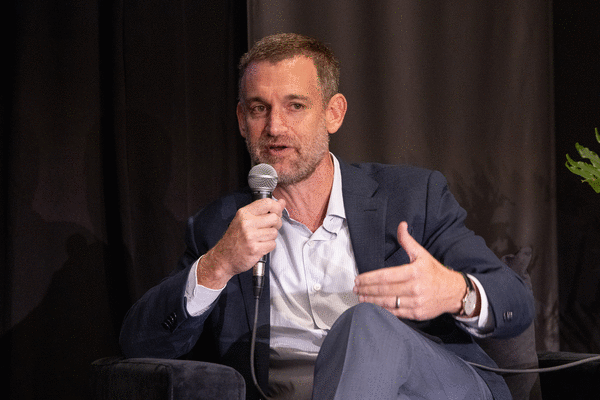
John Arnold, the billionaire energy trader-turned-philanthropist, made his fortune by predicting the direction of markets. Now, he’s sounding the alarm on fast-growing prediction markets, saying they’re harmful to young men and boys.
His concern lies in how platforms for sports-event contracts and online betting more broadly are designed to keep users constantly engaged. Unlike traditional forms of gambling, wagers can be placed seamlessly — quickly and easily through mobile apps with direct links to bank accounts, he said. That raises the risk of addiction, particularly among young males, who are increasingly targeted by sports-betting platforms, he added.
“The sites have, deliberately or not, created a pathway for teenagers to get accounts and start gambling heavily,” Arnold, based in Houston, said in a telephone interview. “It’s leading to a lot more irresponsible play.”
Rather than an outright ban, Arnold is calling for guardrails and referred to early research showing that sports betting can lead users to sink into debt and face mental health challenges. His foundation is giving at least $4 million this year to address the impacts of sports gambling.
Prediction markets tied to real-world events such as wars and elections are booming. Kalshi Inc. dominates U.S. exchanges, with sports bets making up about 80% of trading volume last month, according to Bank of America Corp. The lender estimates the market for U.S. sports-related contracts may reach roughly $1.1 trillion annually.
The rapid growth is intensifying debate within the finance industry over the line between investing and gambling. Charles Schwab Corp. Chief Executive Officer Rick Wurster this week said the brokerage is considering prediction markets tied to financial events, but would steer clear of sports gambling, which he has described as being at odds with the company’s mission and can harm users over time. Cboe Global Markets Inc. has said it plans to start its own prediction markets offering, but will avoid products related to sports for now because there is little legal or regulatory clarity.
Prediction markets are federally regulated and open nationally, and to people under the age of 21. Gambling sites, however, are governed by state laws.
Arnold, 52, said he isn’t opposed to prediction markets more broadly, including those tied to geopolitical events such as wars. They can have legitimate uses such as providing price signals that allow businesses to hedge political risks, he said. Moreover wagers, such as how long the Iranian ceasefire may last, can unfold over days or weeks rather than instantly and as such they don’t drive addictive behavior like sports betting, he added.
A former energy trader at Enron Corp., Arnold ran a hedge fund that two decades ago profited by betting against another fund, Amaranth Advisors, which imploded after losing billions of dollars in the energy markets. He became the youngest billionaire in the U.S. at the time. Arnold shuttered his fund in 2012 at age 38 to pursue philanthropy with his wife.
Since sports-based prediction markets are akin to gambling, they should be governed by state gambling laws, Arnold said. Currently, prediction markets are regulated by the Commodity Futures Trading Commission, which classifies sports wagers as “event contracts.” Arnold lauded bipartisan legislation proposed last month by Sens. John Curtis and Adam Schiff who are seeking to bar entities registered with the CFTC from listing contracts that are akin to sports bets or a “casino-style game.”
The former trader said states had legalized sports gambling in the wake of a 2018 Supreme Court ruling because of the potential tax revenue. Lawmakers then started to see the fallout from their decision, he said.
Arnold said his concern about sports betting grew after his teenage son asked him about opening an investing account and said his classmates had accessed them despite being underage. Arnold said he didn’t allow his son to follow through.
Arnold criticized Robinhood Markets Inc., saying the trading platform blurred the line between investing and gambling.
Robinhood said in a statement that when new customers sign up, they're asked if they're interested in products beyond stocks and exchange-traded funds, including prediction markets and crypto. If they are, they have to open separate accounts for those asset classes, it said. Robinhood rolled out a feature this year that allows customers to opt out of sports-event contracts altogether.
“When legacy institutions or individuals feel threatened by innovation, they often respond by questioning whether everyday investors should be allowed to participate,'' said JB Mackenzie, vice president of futures and prediction markets at Robinhood. He added that all eligible customers should be able to access federally regulated markets and make investment decisions on their own terms.
Arnold also said sports betting platforms allow users to place continuous wagers in seconds and boost engagement through features such as “parlay” bets, which are made up of multiple wagers on individual statistics.
“It’s not like you’re doing one bet, you’re doing 20 bets at a time,” he said.
Research into the impacts of sports betting is still in its infancy, Arnold said, adding that he’s waiting for more evidence before pushing for policy changes. In the meantime, he suggests stronger age verification, limits on bets and marketing restrictions. Self-exclusion lists, which are voluntary programs that allow gamblers to exclude themselves from gambling, could also help, Arnold added.
Besides debt, he said harms can include lower credit scores and mental health challenges — and in extreme cases, suicide. Arnold said one of his friends took his life because of gambling debts.While men are more likely than women to be at risk to gambling problems more broadly, for online betting, women are more than twice as likely to develop problems, the Massachusetts Council on Gaming and Health said in a 2026 report.
Arnold’s foundation gave $2 million this year to the American Institute for Boys and Men in Washington to start a policy group focused on sports betting. His foundation also plans to announce in the coming months more than $2 million for studies into the financial, behavioral and social impacts of sports gambling.
That’s part of a broader effort focused on boys and young men. Last year, his foundation and Maryland Gov. Wes Moore announced $20 million in grants for programs that included support for young males. It’s also donated money to causes including criminal justice and higher education.
(With assistance from Emily Nicolle and Isabelle Lee.)
©2026 Bloomberg L.P. Visit bloomberg.com. Distributed by Tribune Content Agency, LLC.






Comments