Countertop maker Cambria wants big tariffs on cheap quartz imports. Homebuilders are fighting the effort
Published in Home and Consumer News
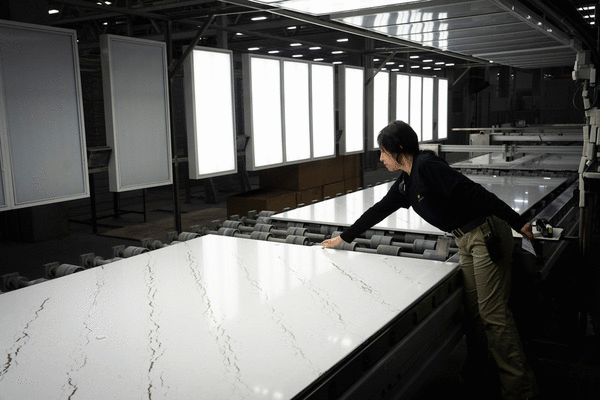
Countertop maker Cambria and seven other U.S. manufacturers won a resounding victory from the International Trade Commission, which ruled that a significant increase of cheaper quartz imports from Pacific Rim countries seriously undercut their ability to be profitable.
This is the second big trade win for Cambria, the giant in the U.S. quartz countertop market. Company CEO Marty Davis won a trade fight in 2018 against China. Its current victory comes after he and other U.S. quartz makers filed complaints against importers from the Pacific Rim.
Trade Commissioners this week heard testimony from companies across the quartz industry regarding potential penalties.
American slab makers like Cambria, Guidoni USA and Daltile want a 50% tariff on imports, plus new quotas that could greatly restrict future quartz imports into the United States.
Groups of homebuilders, quartz fabricators and installers argued that penalties would hurt their businesses and, ultimately, consumers.
The Trump administration will decide what the punitive levy might be, or whether there are restrictions on how much quartz can be imported.
Davis told the commission on Tuesday, April 14, that illegal imports had “robbed” the domestic industry of $6 billion worth of business because of “wave after wave of unfairly traded imports.”
Davis said the foreign slab makers benefited from manipulated currencies and foreign government subsidies.
Cambria, based in Le Sueur, Minnesota, employs 1,800 workers at three slab factories in the state and three Canadian quartz mines. Sales are more than $500 million annually.
While the requested tariff could help Cambria and the other U.S. quartz manufacturers, it also could hurt the industry they serve, several quartz finishers, retailers and service firms have argued.
The commission received more than 700 statements against the tariffs, saying the duties would raise quartz prices for those who operate showrooms and who cut, buy and install imported countertops in new homes and renovation projects.
Ken Gear — executive director of Leading Builders of America, whose members include nine of Minnesota’s largest homebuilders — said if the proposed penalties were adopted, they would add about $1,000 to the average U.S. home price.
They also would affect the construction industry and associated businesses, he said, resulting in a loss of $634 million in revenue and about 100,000 jobs.
But Davis and other quartz manufacturing executives who testified at Tuesday’s closely watched hearing said low-priced quartz has amounted to “illegal dumping,” when importers flood a market with goods below market value or the cost of production.
In this case, Davis said, the practice resulted in 260 million square feet of underpriced quartz slabs in the U.S. last year, up from 120 million six years ago. The complaint claims the culprits are from India, Turkey, Thailand, Vietnam and Malaysia.
Commissioners have until May 18 to submit their penalty recommendations to President Donald Trump.
The eight-member Quartz Manufacturing Alliance of America, which also includes Guidoni USA, Daltile and LX Hausys America, claims that if quotas and tariffs were used to even the playing field, imports of illegal quartz countertops would be cut by about 80 million square feet annually.
“Your decision sets the stage for a strong and appropriate remedy that will give the domestic quartz surfaces industry a chance to recover, invest, further expand, grow and thrive in America,” Davis told the commission Tuesday.
While Davis is well-known as a Trump supporter and donor, support for the measure crosses party lines.
U.S. Sen. Amy Klobuchar, a Democrat from Minnesota, told the trade judges during a February hearing that she has visited Cambria, seen its workers and strongly supports penalizing trade violators.
“Cambria is not alone,” she said. “It represents a broader domestic industry that depends on fair competition to survive and grow. And when others don’t play by the rules — and when enforcement does not keep pace — it is American companies, workers, and families in my state that pay the price."
Along with the Leading Builders of America trade group, a group of quartz showroom owners and installers formed the Save Quartz Jobs coalition to lobby against the severe penalties that Cambria’s group asked for.
The coalition, along with CaesarStone Ltd. and Granite South Inc., which both operate in Minnesota, testified Tuesday. The commission also heard from representatives from the countries that would be affected, and from attorneys representing the large quartz importers Arizona Tile and M.S. International.
Nearly a dozen quartz finishers from around the country sent video testimony saying they may have to lay off workers or close if imported quartz countertops suddenly faced steep tariffs.
Jennifer Lorensen, the operations director for Stone Source in Plymouth, said in a letter to the Minnesota Star Tribune that companies like hers would face much higher costs that would have to be passed on to customers.
“We should be focused on making homeownership more attainable for families,” she said. “This trade petition would do the opposite."
Cambria’s Davis said the opposition campaign was orchestrated by overseas importers who stand to make billions by keeping the status quo.
Davis disputed that import penalties would cost jobs or raise housing prices. Countertops are less than 1% of the cost of a home, he said.
“It’s inconsequential as relates to the total cost of a new home” he said.
The groups opposing the higher tariffs have claimed that Davis will benefit from his relationship with Trump, something Davis called “nonsense.” He said Trump is too busy to weigh in on a topic like countertops.
©2026 The Minnesota Star Tribune. Visit at startribune.com. Distributed by Tribune Content Agency, LLC.







Comments