Many Twin Cities offices are sitting empty. Rents are rising anyway
Published in Home and Consumer News
MINNEAPOLIS — The Twin Cities office market is a paradox: There’s a glut of empty space but rents keep rising.
“It’s opposite of what you’d think,” said Tom DeSautel, a commercial broker with Cushman & Wakefield. “No one is in the office. … How could my rent possibly be going up?”
New data shows that during February, the average office rent in the metro was up 2.9% compared to a year ago, according to the research firm CommercialCafe. That was the seventh-biggest gain in the nation, which saw an overall 1.9% decline.
Many tenants have embraced some level of remote work, so they need less space. But they want the space they occupy to be more luxurious. Their thinking? Entice reluctant workers back to the office while saving money on square footage.
That means the most desirable buildings are leasing while older, less amenity-rich ones continue to empty out.
Suburban office buildings, particularly those along the I-394 and I-494 corridors, have seen some of the highest rent increases.
In downtown Minneapolis — where office vacancies remain about 30%, well above a metro average ranging from 17% to 22% — landlords have less leverage. Those property owners aren’t slashing rents, but more of them are maintaining pre-pandemic rates.
This divide may only deepen as property owners sitting on vacant buildings run out of cash or fail to refinance mortgages to pay for the kinds of improvements tenants now demand.
Concessions continue
Rising rents don’t necessarily mean higher profits for landlords.
Owners might waive rent for a few months or offer other concessions to land leases. Should a new tenant need to update or reconfigure a space to meet their needs, it’s common for landlords to cover some of the costs.
“You really have to look at: What’s the net effective rent to the landlord?” said Jim Damiani, a commercial broker for Newmark. “What do they put in their pocket at the end of the day after deducting all these costs?”
Brokers said landlords are unlikely to lower rents to woo tenants, even if their buildings have large vacancies. Such a move could signal a long-term loss of property value.
“They have to refinance someday,” Damiani said. “They may want to sell someday. So they want to keep rents at a certain level.”
Some landlords cannot afford to reduce rents — and may even need to raise them — due to the rising costs of debt, operating expenses and property taxes.
“It’s not like Kohl’s, where you can take in a 30 percent off coupon and get a discount,” DeSautel said. “The building has value, and there’s debt, and at the end of the day, the owner needs to service the debt. Can’t lease space for less than cost of that debt. You can’t take a loss on space.”
Flight to quality
The nicest offices with the most luxe amenities — think golf simulators and concierge services — are expensive. Building owners are investing millions in improvements ranging from state-of-the-art meeting spaces to resort-style perks.
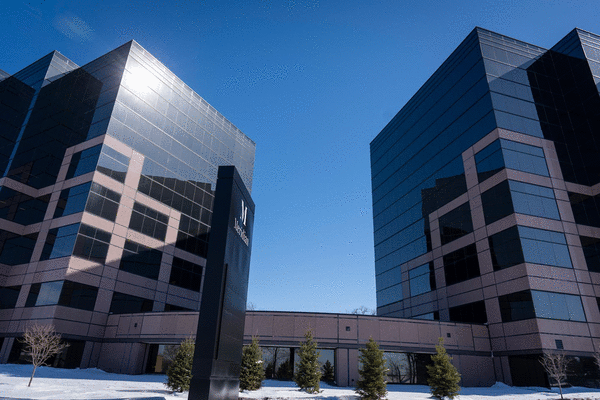
Case in point: U.S. Bank’s 2024 move out of Richfield’s Meridian Crossings could have been a death knell for the two-building office campus. Without its corporate anchor, the property was nearly empty — a fate that doomed other metro office properties that lost tenants in a wave of post-pandemic downsizings.
But owner Piedmont Realty Trust, an Atlanta-based real estate investment company, went all in with a $12 million renovation.
“It’s a completely different experience in those buildings now,” DeSautel said. “When you walk in, it feels like you’re at a Four Seasons.”
Piedmont’s bet paid off less than two years later, before construction even finished. The landlord signed leases for about 90% of the complex, with rents jumping to more than $30 per square foot — far surpassing pre-pandemic rates of $17 or $18.
Employers may agree to those higher rates because they need less space, Damiani said.
The Colonnade, a 355,000 square-foot office building in St. Louis Park, is another success story. The property was headed toward foreclosure until the new owner bought it at a steep discount and completely renovated it. That led to a nearly full building and significantly increased rents.
Stable ownership preferred
Yoga rooms and on-site dry cleaning or car washes aren’t the only must-haves for tenants these days. Many also prioritize building owners who are on sound financial footing.
In the increasingly competitive office world, brokers said, successful property owners will be those with the financial wherewithal for improvements.
Piedmont, for example, has no debt on its buildings. That’s enabled it to invest heavily in updates to Meridian as well as its other holdings, including downtown Minneapolis’ U.S. Bancorp Center and 9320 Excelsior Crossings in Hopkins.
“It’s a competitive advantage — just the ability to transact quickly and give your word to somebody and be able to deliver on that without having to turn around and negotiate with a lender on the lease terms or the capital commitment," said Patrick McGregor, vice president of asset management for Piedmont. “I think that’s been a significant advantage for Piedmont, especially in the Minneapolis market.”
Owners that acquired buildings at low prices following the pandemic also have an edge. Minneapolis-based Hempel Real Estate, for instance, bought downtown’s LaSalle Plaza in 2023 for less than a third of its previous sale price and has since invested nearly $14 million in upgrades.
But Hempel hasn’t raised rents in the building, said Josh Krsnak, the company’s CEO. Instead, it has focused on increasing revenue with new deals. LaSalle Plaza was 68% occupied when Hempel purchased it. Now occupancy stands at about 82%, thanks to nearly 100,000 square feet of leases signed last year.
“Occupancy cures most sins,” Krsnak said. “So if I could just keep my occupancy up, which is kind of my short-term plan, I can worry about pushing rents a couple of years from now if it makes sense.”
Piedmont started raising rents at the U.S. Bancorp Center on Nicollet Mall after launching a $15 million renovation in 2024, said Damian Miller, executive vice president for the firm’s central region. But not at a rate that’s matched Meridian.
“I do think you see those same themes play out in downtown,” Miller said. “Just the level of leasing activity hasn’t been as strong as it has been out in the suburbs.”
©2026 The Minnesota Star Tribune. Visit at startribune.com. Distributed by Tribune Content Agency, LLC.







Comments