Zillow changes course by allowing posting of homes not yet on MLS
Published in Home and Consumer News
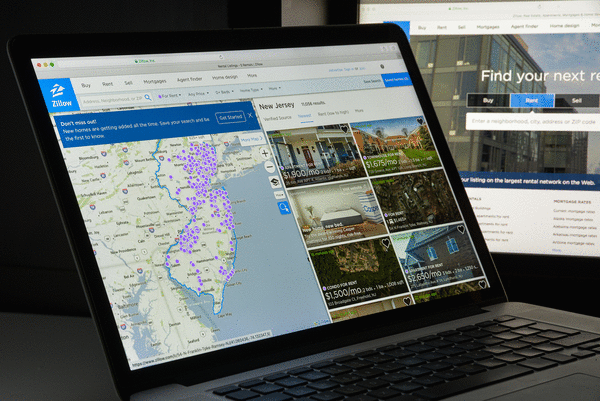
Two online real estate rivals seem to be inching closer to finding common ground.
After a yearlong lawsuit over Zillow’s ban on private and early marketing of homes championed by the real estate brokerage Compass, the standoff came to an end Wednesday.
Compass dropped its lawsuit, just a day after Seattle-based Zillow announced it will allow homes that haven’t officially hit the wider market to be advertised on its website starting next month.
Similar to Compass’ “coming soon” listings, Zillow’s premarket homes, called “Zillow Preview,” allow sellers to experiment with pricing and gauge buyer interest before their homes officially go up for sale and are added to a wider database of listings called the Multiple Listing Service.
Zillow Preview listings don’t need to display how long a listing has been up or any price changes — factors that could influence how buyers perceive home values.
The move, introduced as beneficial for buyers, marks a change in the Seattle-based real estate company’s stand on such listings. Over the last year, Zillow has rigorously defended its ban on homes not listed on MLS — a rule the company has now adjusted to fit its own venture.
As of Tuesday, Zillow only bans listings that were exclusively advertised in a private listing network.
On Wednesday, the real estate brokerage Compass said it would drop a lawsuit it filed last year against Zillow over the original rule. Compass has long provided similar early looks at listings in addition to private listings that only a select group of buyers and agents can access.
Compass CEO Robert Reffkin described the updated standards as a “reversal” of Zillow’s policy in an Instagram post on Wednesday.
“We are pleased to see that both other brokerages and portals are now recognizing the strong consumer demand for more options in how they sell their homes,” he said.
In a statement, a Zillow spokesperson said the company welcomes Compass’ decision to voluntarily withdraw its lawsuit but that its standards will still block Compass’ private listings.
“Our standards remain in effect, and Zillow will continue to choose not to display listings that were previously hidden from the public for the benefit of any one company. Any suggestion that these standards are no longer being enforced is incorrect,” the Zillow spokesperson said.
Zillow Preview
Zillow’s announcement came just weeks after another rival, Seattle-based Redfin, trumpeted that it would syndicate Compass’ premarket homes labeled “coming soon” listings.
Marketing homes before they are formally listed might bring some relief for sellers who have been struggling as the market shifted in favor of buyers.
The sluggish housing market has been especially apparent in the Seattle area over the past few years — but these sneak peeks are unlikely to be an option for properties in Washington, where strict industry rules limit how homes can be advertised.
Elsewhere, agents from select brokerages can use Zillow’s new service to advertise for-sale homes that haven’t yet been added to regional MLS databases. Across the U.S., home shopping websites and agents rely on feeds from MLS databases.
Those agents must be from Zillow’s participating partners: Keller Williams, RE/MAX, HomeServices of America, Berkshire Hathaway HomeServices and Side, according to a Zillow news release.
The premarket listings will only appear on Zillow and its subsidiary Trulia, as well as the websites of participating brokerages and agents. Home shoppers will be able to save and share these listings, connect with the listing agent or schedule tours with a Zillow partner agent in advance, according to the news release.
Zillow does not limit how long listings can be premarketed and does not require them to eventually be brought to the MLS, according to Zillow’s website.
While other real estate giants, including Redfin and Compass, have framed their equivalent offerings as beneficial for sellers, Zillow described its new feature as a win for home shoppers.
“In a growing number of markets, the public cannot see pre-market homes, including listings often referred to as 'coming soon.’ Zillow Preview brings these homes out of the shadows and into the daylight, making them publicly visible instead of confined to closed systems,” Zillow said.
The announcement is an obvious dig at Compass, which offers private listings unavailable to the wider public in addition to its “coming soon” premarket listings.
Redfin, owned by Rocket Companies, began showing Compass’ “coming soon” listings on Monday as part of a three-year syndication agreement. Those premarket listings are available to anyone surfing Redfin, but Rocket said Compass’ private listings will soon follow.
Rocket and Compass said both kinds of listings allow sellers to gauge early interest in their homes, which can prevent homes from selling below listing prices and reduce the chances of homes lingering on the market. The “coming soon” listings don’t show days on market, price drop history and home valuation estimates — all features that Zillow shows on its regular listings.
Zillow’s stock continued rising gradually on Wednesday after shooting up almost 7% by the time the market closed Tuesday.
Despite Wall Street’s bullish attitude toward Zillow, the announcement drew mixed reactions across the real estate industry.
Zillow’s news release quoted executives from the partnering brokerages praising the new features for increasing transparency and accessibility for buyers.
But others, including the Northwest Multiple Listing Service, the MLS representing most of Washington, say Zillow’s announcement runs contrary to its initial push for transparency.
“Anything less than total transparency and readily available, comprehensive information is unacceptable,” NWMLS CEO Justin Haag said in a statement.
Washington left out
Despite Zillow and Redfin showing interest in premarket advertising, early looks at Washington homes for sale will be rare.
The NWMLS, which agents rely on to circulate their listings, requires homes for sale to be added to its database before any advertising. The organization considers “coming soon” listings similar to private listings because they are technically active listings, but they are not submitted to the service.
“Consumers don't want a fragmented marketplace where they have to question if they really have all the information they need when selling or buying a home,” Haag said in a statement. “‘Coming soon’, ‘Preview’, or ‘Private’ listings are marketing ploys that do not benefit sellers or buyers; they only serve to benefit the listing firm.”
John Manning, a Seattle-based agent at RE/MAX Gateway, said he’s not disappointed that the NWMLS won’t allow him to advertise premarket homes on Zillow.
It’s not in a seller’s best interest to advertise their home before it’s prepared for the market, he said.
“If you have people driving by your house when it’s in the middle of preparation, they’re going to form a very different value opinion than they would when they see the finished product,” he said.
Manning said prelistings could lead to early market deals that skip over the competition of the full market.
“Essentially, what you’re doing is creating a little backroom on Zillow,” he said.
Although NWMLS considers private listings and premarketed listings to be the same, Washington law does not.
On Tuesday, Washington Gov. Bob Ferguson signed Senate Bill 6091, which bans private listings. The law does not, however, ban premarket listings. The law only requires that listings be “concurrently marketed to the general public and all other brokers.”
“At the end of the day, I don’t have a personal preference for how listings are marketed,” the bill’s primary sponsor, Sen. Marko Liias, D-Edmonds, wrote in an email following Zillow’s announcement. “I just want to make sure every buyer has equal access to the same information.”
©2026 The Seattle Times. Visit seattletimes.com. Distributed by Tribune Content Agency, LLC.







Comments