Seattle Airbnb prices are spiking for World Cup. Should you rent your home?
Published in Home and Consumer News
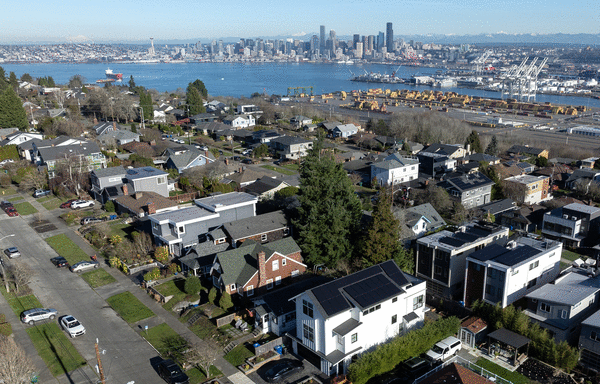



Seattle residents will have a choice this summer: Get paid to ditch town for a few weeks, or learn to call soccer “football” in their own homes in exchange for hundreds of dollars. Many are considering renting out their homes to World Cup tourists.
Nearly 150,000 fans from around the world will need lodging throughout Seattle’s six 2026 FIFA Men’s World Cup matches between June 15 and July 6, according to Airbnb. With hotels booking up, hosting tournament-goers might be a goal-den opportunity for Seattle-area homeowners to make some quick cash.
Seattle’s hotels will occasionally reach 100% during the World Cup, according to the tourism nonprofit Visit Seattle, leaving the city’s 4,325 short-term rentals to fill in the gaps.
Demand for short-term rentals in Seattle is up 55% on nongame days and as high as 185% on game days, according to AirDNA, a short-term rental data analytics platform.
Airbnb, the short-term rental listing company, is offering $750 to people who rent out their entire homes in World Cup host cities and host guests between now and July 31.
On top of that $750, hosts can take advantage of skyrocketing short-term rental rates. Some Seattle Airbnbs are double their usual rates during big matches, such as when USA faces Australia on June 19.
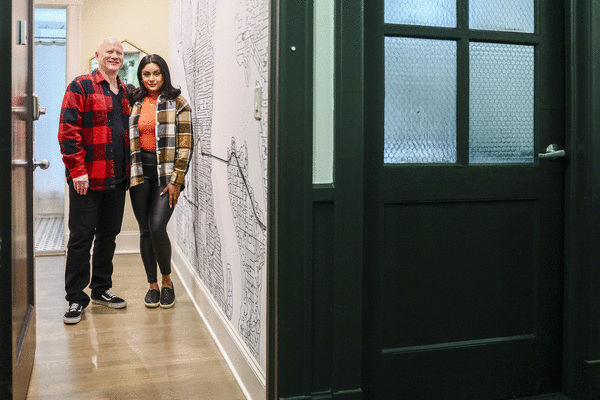
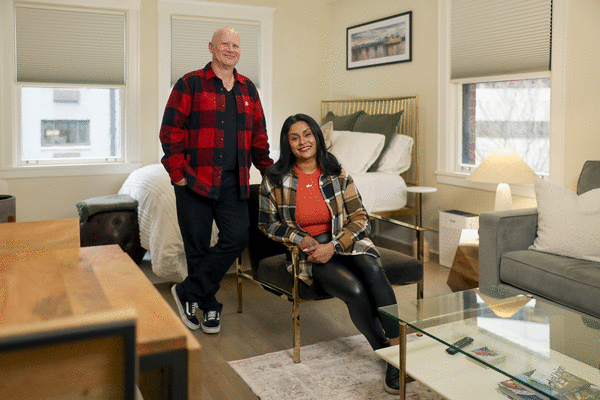
Christopher John, the owner of a short-term rental condo in downtown Seattle, said he was fully booked within a week of FIFA announcing the full schedule, despite raising prices 30% to around $500 a night during match weeks. He could have charged more, he said.
“Even (30%) was too low,” he said. “We’ve got people coming from Belgium, Australia. It’s a once-in-a-lifetime event. So if people want to see it, then they’ll definitely take the opportunity.”
According to AirDNA, people are booking short-term rentals in Seattle for 22% more on nongame days, or $257 a night, and around 30% higher on game days, or $256 to $304.
But some short-term rentals are going for much more.
One rental owner posted on Facebook her shock at Airbnb’s recommended rate of nearly $1,000 a night for her three-bedroom house in Lynnwood, Washington, during match weeks.
“I may poop my pants if someone actually books at this rate,” she wrote on Facebook.
That suggested price isn’t an outlier. Airbnb shows some houses are going for over $1,000 a night around match days. Sure, some of those are waterfront homes or nine-bedroom estates. But others are modest townhomes and suburban houses.
Vaughn, with Rumbl Rentals, said homes that are close to Lumen Field, near public transportation, have lots of bedrooms or offer unusual amenities are likely to attract more demand for World Cup travelers.
News of high demand and prices has made its way around to homeowners who have never listed their homes for rent. Seattle-area homeowners on Facebook are offering to rent out their homes to World Cup travelers.
“They’re able to go on vacation and come back with a little bit of money in their pocket,” Vaughn said.
Others, like Shoreline-resident Rachel Belfield, are considering sharing parts of their homes with travelers during match weeks for some extra cash. Belfield hopes to charge $250 a night for a studio space in her house.
“I bought tickets for myself for the World Cup, so this will help us recoup some of those costs,” she said. “We may even make a new friend from across the country or perhaps across the world.”
What could go wrong?
Thinking a lot could go awry with renting out your home on a whim? You’re not wrong.
That’s the premise of an episode of the comedic sitcom "Broad City," where two broke millennial women rent out their New York apartments for outrageous prices while staying out all night. One woman returns home to find she’s been robbed, while the other finds her elderly guests catatonic after smoking marijuana.
There’s a lot to be learned from this fictional — but very possible — worst-case scenario.
Theft, damage and lingering guests are more likely to occur if hosts don’t take certain precautions, Vaughn said.
Vaughn, whose company specializes in helping people new to hosting travelers, recommends that hosts store valuables in a safe place and have an “owner's closet” where they store items they don’t want guests touching.
Working with professionals, he said, can also ease new hosts’ minds.
Most short-term rental listing companies provide coverage for property damage and host liability. Larger companies, such as Airbnb, offer background checks and help support hosts’ house rules (such as no smoking or drug use) by giving guests who break them low ratings.
Hosts can also reach out to real estate agents to help them list their homes as short-term rentals, Vaughn said.
Fouls and penalties
The other mistake the sitcom’s characters made? The way they went about renting out their apartments would be considered entirely illegal in real life — both in New York and Seattle.
For the most part, only homeowners can list their homes as short-term rentals in Seattle. (Sorry, Seattle’s 450,000 renters.)
Renting out a living space for 30 days or less always requires obtaining a business license and a short-term rental license, said Beth Gappert, the head of Seattle’s City Consumer Protection division, which regulates short-term rentals. That goes for folks only renting out a room in their house too.
Despite swirling interest in renting out homes for the World Cup, new short-term rental applications have barely ticked up from recent years, according to the city of Seattle. If someone is caught operating an unlicensed short-term rental, they can expect to pay more than $1,000 in fines, Gappert said.
Homeowners shouldn’t be intimidated by Seattle’s regulations, she said.
“It's not a complicated process to get a license from the city of Seattle,” she said, “It's not super burdensome, and it's not cost-prohibitive either.”
Step one, obtaining a business license, takes about 30 minutes. It can be done online at www.Filelocal-wa.gov and costs $50.
Then, hosts need to determine if their property is subject to a required city inspection. To put it simply — those renting out their primary home don’t need an inspection, but those looking to rent out second homes or detached accessory dwelling units do.
At least 48 hours after applying for a business license, hosts may apply for a short-term rental license, which is $75 and should only take a matter of minutes if everything is in order. Go to services.seattle.gov and click on “Licenses - Short Term Rental or Network Company.”
Overall, the entire process should take as little as three business days. But Gappert said her team is there to help if anyone gets confused.
“I don't want people to be languishing and frustrated if they're trying to do it, and they want to do it right,” she said.
After the city issues the licenses, homeowners can then head to websites such as Airbnb, Vrbo and Rumbl Rentals to advertise their homes.
©2026 The Seattle Times. Visit seattletimes.com. Distributed by Tribune Content Agency, LLC.







Comments