Sacramento is doubling down on tiny homes. Is it a bold move or a misguided one?
Published in Home and Consumer News
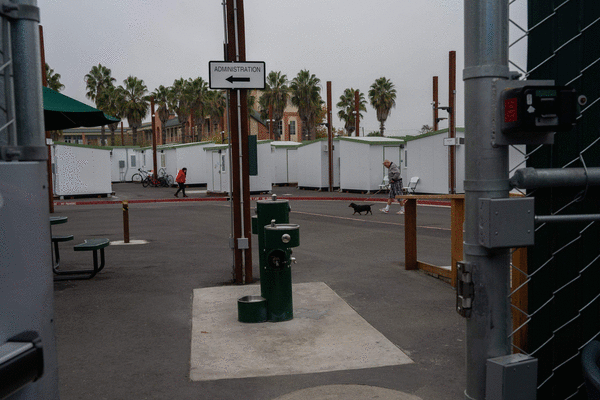
Sheleko Maynard was riding on a bus, worried about the possibility of spending another year living alone outside in a tent when she got a call: She had been accepted into a tiny home community in Sacramento and could move in the next day.
That was about a year ago. The 75-square-foot dwelling gave her a heater, a bed to herself and a desk she filled with her Bible and devotionals.
“I could come in here and close the door and cry and read and pray,” Maynard, 55, said inside the small house. “I went through a lot.”
That included struggling with a drug addiction. She relapsed a couple times after moving in, she said, before begging God for help to break the cravings. Maynard said she has since stopped using drugs and was recently approved for a housing voucher, which would allow her to move into an apartment or other home of her own.
“This place saved me.”
Sacramento is one of many cities across California that have embraced so-called “tiny homes” as an answer to stubbornly large homeless populations. They see the mini houses as an effective way to get people like Maynard off the streets and into a temporary shelter.
Currently, Sacramento manages 246 of the small units. It also refers people to a site with 175 tiny home beds in south Sacramento that it runs in partnership with the county.
City officials have grand plans to expand that number.
They want to build roughly 160 new tiny dwellings for people who are 55 years and older and place them in several sites across the city. Officials hope people will be able to move into at least a quarter of them before the end of the year. The estimated cost to set up all of the new tiny homes is $13.5 million.
But Sacramento also wants to take an approach with the 120-square-foot homes that will set it apart from other major California communities.
The city plans to charge people 30% of their income to stay in the new dwellings and it will treat them not just as temporary shelter, but also as potential long-term housing options for those who keep paying the monthly rent. What’s more, Sacramento wants to serve as a landlord for the new tiny houses, making it the largest city in the state to try that strategy as part of its response to homelessness.
“It’s more cost effective for the taxpayers,” said Sacramento Mayor Kevin McCarty. “And, bottom line, it’s more unsheltered homeless off the streets.”
The city’s new blueprint has attracted criticism from advocates and other close observers who argue the strategy won’t have the desired result of reducing homelessness.
“They don’t reduce homelessness because everyone living in tiny homes is still homeless,” said Margot Kushel, director of the Benioff Homelessness and Housing Initiative at the University of California, San Francisco. “The only way to end homelessness is housing.”
Brian Pedro, the director of Sacramento’s homeless response department, said the city doesn’t have time to wait for enough traditional housing to be built.
“If somebody solved homelessness and they have the best practices, then give me the manual and we’ll use that, but nobody has solved this, nobody has gotten everybody off of their streets and so there is no best practice,” he said. “We know some things work better than others, but if we keep using the same model, we’re going to keep having the same result. And we have to try something different.”
A long road
In California, the trend of using tiny homes as a way to reduce homelessness increased in the 2010s, as officials searched for ways to tackle a growing problem, and find alternatives to large encampments that popped up across the state in the wake of the Great Recession.
What counts as a tiny home can mean different things based on where you are in California. Some have amenities like bathrooms and kitchenettes, others have neither. Costs for the houses vary, so do their sizes.
City officials in San Jose and Oakland were some of the first to explore their use, over nine years ago. Then-Sacramento Mayor Darrell Steinberg also latched onto the idea.
In 2018, he called on the city to spend $21 million over three years to subsidize construction of up to 1,000 small dwellings. He saw them as a cheaper and quicker alternative to getting people off the street.
“If you start from the place that living outside is unacceptable from a moral, safety and health perspective then micro homes have to be part of the strategy,” he said in a recent interview.
The city put out a request for ideas from local developers. But a year after the announcement, there was little progress on the goal.
Steinberg became frustrated with the Sacramento Housing and Redevelopment Agency’s work on the plan. A year after the mayor’s announcement, the agency had received several proposals for the small dwellings, but it had not come up with a recommendation on which to pursue.
At a council meeting, he pressed agency officials to start building tiny homes.
“Providing homeless housing is complex and requires many different solutions,” La Shelle Dozier, the agency’s then-executive director, said in a statement at the time in response to the mayor’s request. Dozier said the agency “continues to work on tiny homes as one possible solution, searching locally, regionally and nationally for best practices.”
Steinberg kept pushing, but the city ran into other delays with connecting the homes to water, sewer and electricity, finding places to put them and the need to meet permitting and other requirements.
“We kept moving forward. It was messy, in part, because there was such resistance to both siting and what was seen at the time as unconventional strategies,” the former mayor said. “It was undeniable progress in hard times.”
Delays and unfulfilled goals were not unique to Sacramento.
In 2023, Gov. Gavin Newsom vowed to deliver 1,200 small homes combined to Sacramento, Los Angeles, San Diego County and San Jose, at a cost of about $30 million.
Sacramento was the only one in the group to receive homes. The state eventually provided money directly to the other three local governments so they could purchase the dwellings themselves, after months of delays in selecting a builder and awarding contracts.
The state built out a site of 175 tiny home beds on Stockton Boulevard in south Sacramento – half the original number the governor promised for the city.
Doubling down
Sacramento’s new tiny home strategy hinges on changing the way city officials view the small dwellings. All three of the sites it currently uses are treated as temporary shelters. But the planned communities are seen as more than that, with the goal of filling a gap between Sacramento’s short and long-term housing options.
“We have people sitting in all of our shelters for years and one of the reasons that they’re not leaving is not because they didn’t stabilize, but because they literally have nowhere to go,” said Pedro, the city’s homeless response director.
Sacramento officials say they are tailoring the new communities to homeless people who are 55 years and older because they make up about one-fifth of the city’s total unsheltered population and that percentage is growing.
Residents must have a fixed income. Pedro told the City Council in September that his team had identified more than 600 people who could be eligible to live in them. Requiring residents to pay the 30% income fee, he told council members, will help offset the expense of running the sites.
Still, the money those fees bring in is unlikely to put a large dent in the initial $13.5 million price tag to open them.
The city plans to have no more than 40 homes each in four separate locations across Sacramento. Once they are open, Pedro said the city expects to pay about $2 million combined annually for cleaning, landscaping and security for the four sites.
Each home will have electricity, air conditioning, heating and come with a bed. Bathrooms, laundry services and a kitchen will be communal.
Homeless advocates have denounced the decision to charge a fee, arguing that it will only burden financially vulnerable people.
“If you’re charging people part of their income to live in a shack that is really not much better than a tent, then you can understand why people might say no to that,” said Kushel, the homeless initiative director at UCSF.
Even so, current and former tiny home residents said they were open to paying the fee to stay in one of the new communities.
Terry Swilley said his health was dramatically improving in the 11 months he had spent at the Stockton Boulevard tiny home site. Being allowed to live with his loyal Shih Tzu terrier Lala was helping. So too were regular check-ins with a psychiatrist and doctor.
“I’m way too old. It’s time for me to get back on the right track,” said Swilley, 60, “and this is pointing me in the right direction.”
He did not have an income but said he was working to earn supplemental payments from the federal government for people with little income and resources. Swilley said he would prefer to have his own bathroom, sink and stove in a small home, but would still pay to live in the city’s new communities.
“I love the tiny homes, to tell you the truth,” Swilley said. “It really did save me.”
Trying to keep costs down is also one of the reasons the city is planning another uncommon approach: To serve as a landlord for the small homes instead of paying a contractor to do so.
People living in the units will gain tenancy rights once they start paying the program fee. That means the city can only evict people after a court order, must repair health and safety issues and must also provide accommodations for people with disabilities. That could also open it up to tenant lawsuits.
“The city is taking on a lot by acting as a landlord for a shelter and I think the outcome is going to be different from what they’re hoping to achieve,” said Sharon Rapport, a lobbyist for the Corporation for Supportive Housing, an organization that advocates for affordable housing with support services as a way to reduce homelessness.
“It’s a very weird thing: the concept of city as landlord,” she added.
Sacramento State social work professor Arturo Baiocchi, who has toured the city’s tiny home sites with graduate students, supports the idea of Sacramento taking on landlord duties, saying that it will give people a direct place to go with their concerns about the communities.
“Then we can go to the source and say ‘this is what is wrong about the program and this is why we’re not happy about it,’” Baiocchi said.
Pedro said the city would serve as landlord for the time being but could eventually hand the duties off in the future.
“It’s an interesting road that we’re going down,” he said. “There is no best practice on this and we’ll see where this road leads us.”
‘Multiple goals’
Pedro said the city’s focus on trying to decrease the number of unsheltered people living in Sacramento is about setting realistic expectations.
“Because if you set the goal of trying to solve homelessness,” he said, “good luck.”
He and McCarty cite the price of the tiny homes when arguing their case for the new strategy. The estimated cost of the new communities works out to about $85,000 per home, Pedro told the City Council. The city’s more traditional supportive housing options average roughly $420,000 per unit, he said.
But is using the mini dwellings even an effective way to reduce homelessness? Many are skeptical.
“Tiny homes can be a space that gives people an opportunity for respite and getting off the street temporarily,” said Alex Visotzky, a California Policy Fellow with the National Alliance to End Homelessness. “But if they’re not coupled with a strategy to get people back into housing, it’s not a solution.”
City data has been mixed. One of Sacramento’s current tiny home sites, known as the Grove, near American River Parkway, has 50 small cabins and is reserved for young adults. More than 40% of people who lived there in the first five years of operation moved out to more permanent housing, according to figures the city provided to The Sacramento Bee last year.
Residents at another site, called Roseville Road, moved into more permanent housing almost 17% of the time in the first year and a half of the community. That was before the city recently increased the number of homes there to close to 200, and replaced some travel trailers that used to be there.
Pedro said it would be fantastic if people in Sacramento’s new tiny home communities move on to more traditional housing options. But the city won’t judge its success only on that figure. Helping people bring more stability to their life, and getting them back to a place where they are paying monthly rent, doing their laundry, buying groceries and performing other daily tasks, he said, is also a win.
“There’s multiple goals in this,” Pedro said, “and it’s not just: ‘You will come here and you will go to permanent housing.’”
People living at the new sites will have access to support for behavioral health, substance use and housing needs, through caseworkers, along with other services.
That support is important in determining how well a tiny home site works, said Ryan Finnigan, a researcher for UC Berkeley’s Terner Center for Housing Innovation.
“I do think it provides an important tool in the toolbox,” Finnigan said of tiny homes, “but it’s certainly not a one-size-fits-all solution.”
(The Sacramento Bee’s Theresa Clift contributed to this story.)
©2026 The Sacramento Bee. Visit at sacbee.com. Distributed by Tribune Content Agency, LLC.







Comments