Tesla Cybercabs join Waymo in Detroit robotaxi testing
Published in Automotive News
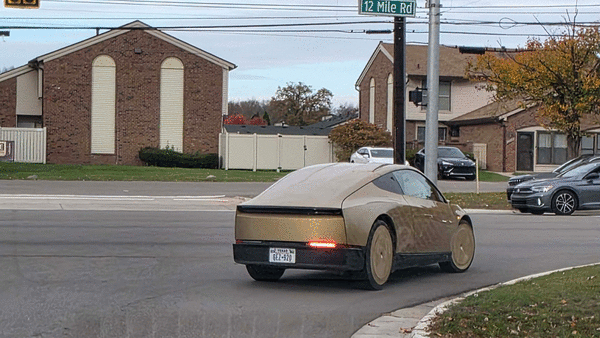
SOUTHFIELD, Michigan — The autonomous rideshare wars are heating up just in time for the cold Michigan winter.
A fleet of gold, butterfly-door Tesla Cybercabs has joined Waymo driverless vehicles in Detroit, expanding the competitive playing field from Austin, Texas, to Michigan's more complicated, multi-season environment. Two dozen Cybercabs are operating out of Tesla Inc.’s Southfield collision repair facility on 12 Mile and have been seen on major roads, including I-696, M-10, Telegraph and Eight Mile.
The distinctive, electric Cybercabs have test drivers using temporary steering wheels. The two-seat Cybercab is designed to have no steering wheel once the service becomes fully operational.
Cybercab is part of Tesla’s larger Robotaxi ridesharing service that also uses Model Y electric vehicles. Cybercab is currently only accessible to the public in Austin; the Robotaxi service operates with Model Ys in Tampa and Miami in Florida and Austin, Dallas and Houston in Texas, with plans to expand. Cybercabs have been spotted at Miami International Airport and outside Philadelphia, according to teslarati.com.
The Cybercab’s appearance in Metro Detroit this fall comes a year after Waymo LLC’s rideshare service began testing in the region. Alphabet Inc.-owned Waymo began fully autonomous testing this October without human specialists driving its powder blue, Chinese-made Zeekr Ojai EVs as the rideshare company inches closer to public service.
Waymo Product Communications Manager Chris Bonelli said there is still no timeline for the so-called Waymo Driver service deployment in Detroit. Tesla, which has no public relations staff, could not be reached for comment on its timeline for public deployment.
“The expansion of autonomous rideshare testing in different weather situations in different cities is important for developing the technology,” said Stephanie Brinley, associate director for automotive intelligence for Mobility Global. “Tesla has not officially said that they're testing here, so hard to say what they're specifically doing.”
Waymo is the leader in the autonomous rideshare space, with 270 million miles logged in cities from San Francisco to Phoenix to Atlanta. In addition to Detroit, it is preparing to expand to snowbelt cities Denver, Minneapolis, Chicago and Montreal. Tesla’s website says its Robotaxi service has logged over 4 million miles.
Significantly, the Cybercabs operate with cameras only while the Waymo vehicles operate with a combination of Lidar, radar and cameras. Tesla’s solution is expected to be cheaper to operate as the competing services scale across North America. Tesla advertises on its website that “if you are interested in purchasing a fleet or an individual Cybercab vehicle for commercial purposes, fill out the form and a representative will contact you.”
The Cybercab is built at Gigafactory Texas in Austin, Texas. Waymo buys Zeekr Ojai electric minivans from Zeekr in China, then outfits them with Waymo hardware and software in its Mesa, Arizona, facility.
Waymo does not disclose its Detroit operations. Tesla test drivers are under a non-disclosure agreement.
The Cybercab looks like a Model Y married a Model 3 with its Y-like, horizontal LED light arching across the fascia and its low, 3-like sedan body style. But with room inside for just two passengers and their luggage, it is noticeably smaller than either of Tesla’s best-selling retail models. Its length is 11 inches shorter than a Model 3, and about 4 inches narrower.
“Detroit is important symbolically to these companies; it is a big area, and there's opportunity here, but it is not as important as in terms of potential use as at New York or Chicago or some of the other cities,” Brinley said. “The weather plays an important role.”
Specs are different, too, with a 48 kWh battery that is nearly half the size of the one in the Model Y, which contributes to the Cybercab’s lighter 3,000-pound weight. Range is just shy of 300 miles on a charge. New York yellow cabs inspired the Cybercab's appearance, with gold seen as a premium upgrade.
Come up on the Cybercab in traffic and its narrow stance reminds one of a hybrid 2000 Honda Insight. The gold coupe's roof tapers to the rear tail, with no rear window. The side view is equally dramatic — even before the butterfly doors open on exit — with staggered gold aero wheels measuring 18 inches up front and 21 inches in the rear.
In cities where Robotaxi and Waymo rideshare services operate, they work similarly through an Uber app for ride-hailing.
©2026 www.detroitnews.com. Visit at detroitnews.com. Distributed by Tribune Content Agency, LLC.







Comments